


About Domestic Assault
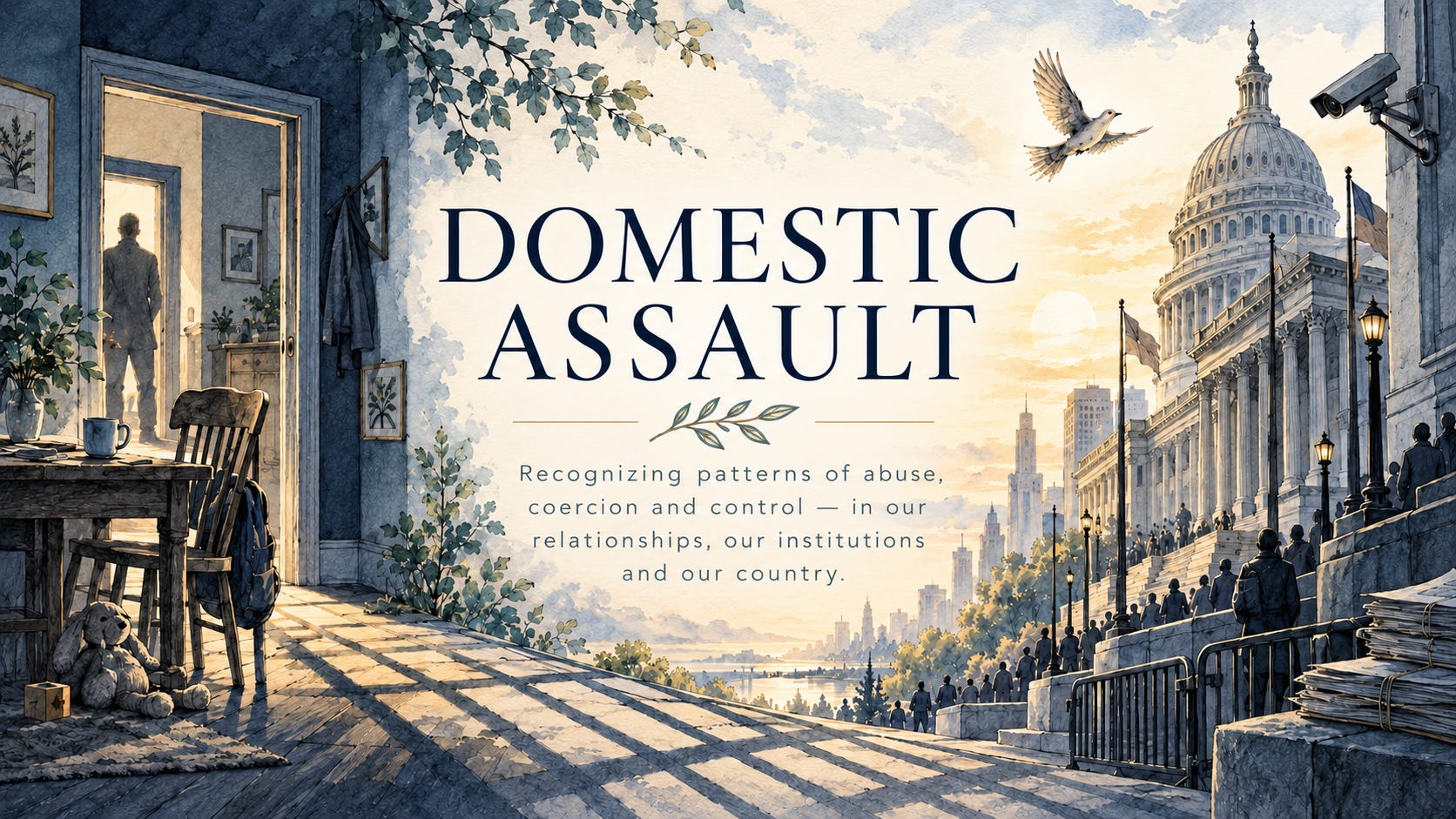
DomesticAssault.com is a publication and community devoted to recognizing patterns of abuse, coercion and control—in our relationships, our institutions and our country.
Abuse is too often understood as a collection of separate incidents.
A cruel remark.
A threat.
A lie.
A boundary crossed.
A frightening outburst.
An apology.
Another promise that it will never happen again.
Viewed one at a time, each incident can be explained away.
But abuse rarely exists one incident at a time.
The pattern is the story.
That is why I created DomesticAssault.com.
I write about coercive control, gaslighting, manipulation, intimidation, isolation, sexual exploitation, institutional failure, life after abuse, and the ways power can be used to make people doubt themselves, submit, stay silent or look away.
Some of this writing comes from lived experience. Some comes from decades of thinking about behavior, health, resilience and power. Sometimes the starting point is a film, documentary, court case, law, book, news story or cultural moment that exposes a pattern worth examining more closely.
But the central question is almost always the same:
What happens when one person—or one institution—gains power by making someone else smaller, quieter, more frightened, more confused or less free?
Abuse Does Not Stop at the Front Door
Domestic Assault begins with relationships, but it does not end there.
The mechanisms of coercion can appear anywhere power exists: inside families, workplaces, churches, schools, organizations, institutions and governments.
The circumstances are not identical.
But the patterns can still teach us something.
Gaslighting works by attacking confidence in what we know to be true.
Coercive control works by gradually narrowing someone’s freedom.
Intimidation teaches people that resistance carries a price.
Isolation separates people from information, support and competing perspectives.
Repeated boundary violations make yesterday’s unacceptable behavior seem almost ordinary tomorrow.
And institutions can become complicit when protecting themselves becomes more important than protecting the people they were supposed to serve.
Understanding those patterns can help us recognize abuse earlier—whether it is happening inside a home, an organization or public life.
This Is a Community
I want DomesticAssault.com to become a place where people read, recognize, think, talk and feel less alone.
It is for people who are living through abuse now.
It is for people who have left.
It is for people who are only beginning to understand what happened to them years ago.
It is for people worried about someone they love.
It is for people trying to understand why intelligent, capable human beings can become trapped in coercive relationships.
And it is for anyone trying to understand how abusive power works—and how people, communities and institutions can resist it.
You do not have to tell your story to belong here.
You do not have to disclose anything.
You do not have to have the perfect words for what happened.
You can simply read.
Sometimes recognition comes first.
About Me
I’m Joyce Strong, RN, BSN—a writer, nurse, coach and survivor of domestic abuse.
I write from lived experience, research, curiosity and a lifelong interest in human behavior: why people do what they do, why we sometimes fail to recognize danger while we are living inside it, what allows coercive systems to persist, and what helps human beings survive, rebuild and reclaim themselves.
I do not write because I have every answer.
I write because language matters.
Being able to name what is happening can change what we understand.
Recognizing a pattern can help us stop blaming ourselves for isolated moments that never made sense on their own.
It can help us trust our perceptions again.
It can help us make safer decisions.
It can help us understand what happened to someone we love.
And sometimes it can be the beginning of freedom.
Power, Institutions and the Larger Pattern
We are living through a period in American life when understanding abuse of power has become especially important.
Most of us have either experienced abuse ourselves or watched someone close to us experience it. We know, at least instinctively, how coercion can work inside a relationship: the gaslighting, intimidation, escalating boundary violations, punishment for resistance, demands for loyalty, control of information and gradual normalization of conduct that once would have been unthinkable.
Those patterns do not magically disappear when power moves outside the home.
They can appear wherever people are pressured to surrender judgment, ignore what they can plainly see, accept escalating violations or remain silent because challenging authority feels dangerous.
This is one reason I write about institutional scandals and failures as well as interpersonal abuse.
The Epstein story, for example, is not only a story about one predatory man. It raises enduring questions about the victims who fought to be heard, the people and systems surrounding him, institutional accountability, concealed or disputed information, and what happens when powerful networks are better protected than vulnerable people.
Those questions belong here.
So do questions about institutions that fail abuse victims.
Organizations that protect reputations instead of people.
Systems that reward silence.
Cultures that punish whistleblowers.
And governments in which fear, intimidation, disinformation or demands for obedience begin replacing accountability.
The scale changes.
The fundamental question does not:
Who has the power, how are they using it, and what happens to the people who say no?
What Comes After Recognition
This publication is not only about what abuse does to us.
It is also about what comes afterward.
Recovery.
Rebuilding trust in ourselves.
Learning to recognize healthy relationships.
Setting boundaries without apologizing for having them.
Understanding trauma without allowing trauma to become our entire identity.
Finding community.
Finding our voice.
Finding humor again.
Finding curiosity again.
Finding purpose again.
And eventually rediscovering something abuse tries very hard to steal:
our ability to fully engage in the joy of life.
Supporting the Work
DomesticAssault.com is an independent, reader-supported publication and community.
My goal is to keep the core writing available to everyone, regardless of ability to pay.
Paid subscriptions help make that possible.
If this work helps you understand something you have lived through, recognize something happening around you, support someone you care about, or simply see a pattern more clearly, I hope you will consider becoming a paid subscriber.
Your support helps sustain the research, writing and community behind DomesticAssault.com—and helps keep the door open for the person who may desperately need to find this work but cannot afford to pay for it.
Recognize the pattern. Find your voice. Build your freedom.
