

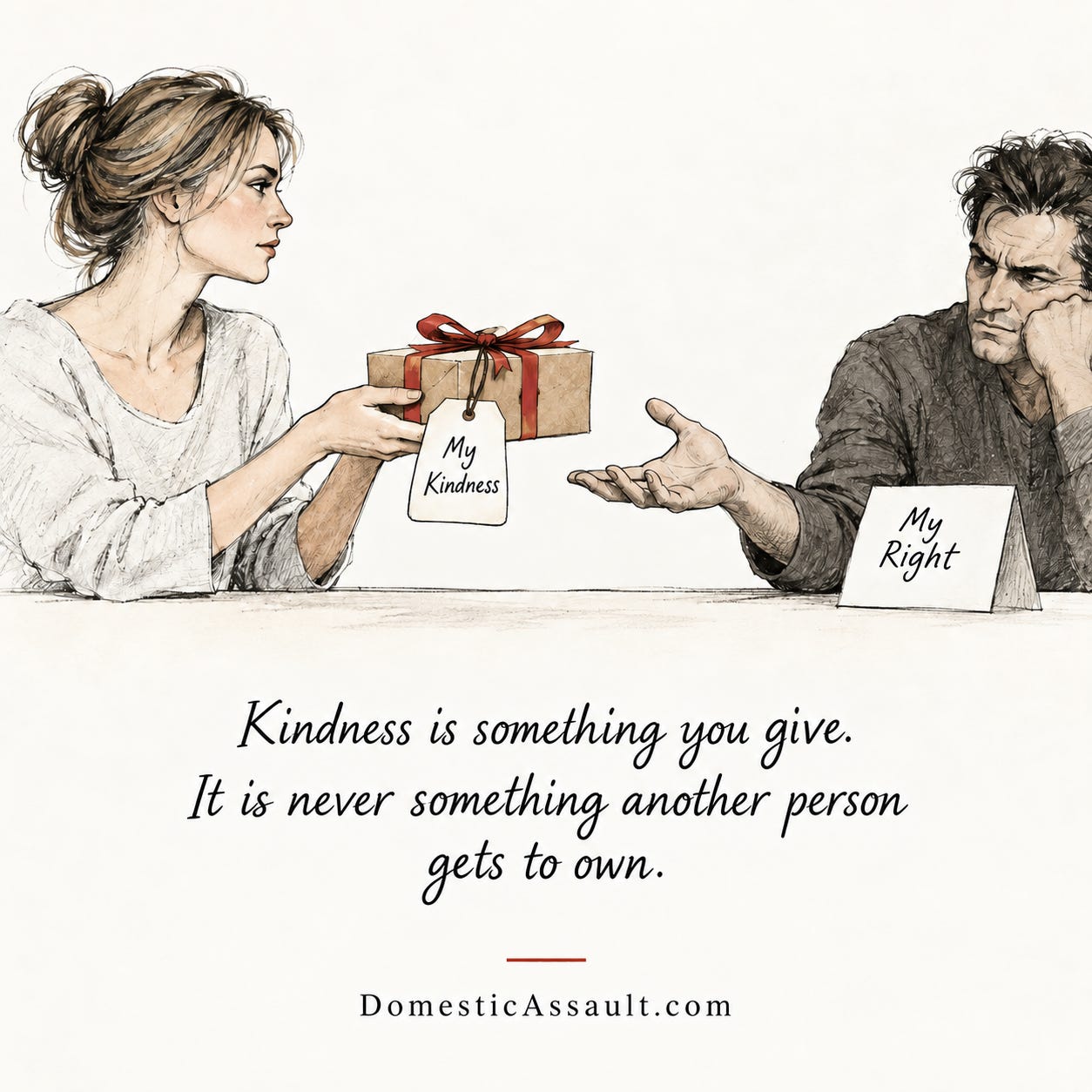
One of the quieter ways entitlement develops in a relationship is when something you once did freely becomes something the other person begins to expect.
Maybe you drove them somewhere because they needed help. Maybe you loaned them money because things were tight. Maybe you watched the children, changed your plans, answered the phone every time they called, covered a bill, cooked dinner, forgave something painful or stepped in during a crisis.
You did it because you cared.
Then, somewhere along the way, the favor stopped being a favor.
It became expected.
And when you finally said no, you were treated as though you had broken an agreement you never made.
That shift matters, because one of the clearest signs of entitlement is when another person stops recognizing your generosity as something you choose to give and starts treating it as something they have a right to receive.
Kindness has consent built into it
A gift is a gift because I choose to give it. Help is help because I decide to offer it. My time belongs to me before I give some of it to you. So do my money, my home, my emotional energy, my labor, my attention and my forgiveness.
None of those things become someone else’s property because I shared them yesterday.
Yesterday’s yes does not create today’s obligation.
That sounds obvious when you write it down. It becomes much less obvious when you are living inside a relationship where someone has spent years teaching you otherwise.
Entitlement is more than ordinary selfishness. It is the belief that your needs, your limits and sometimes even the ordinary rules of the relationship should bend around the other person.
That is where kindness can become dangerous in an unhealthy relationship.
The question stops being, Will you do this for me?
It becomes, How dare you not do this for me?
You often see the entitlement when you stop giving
Sometimes entitlement is difficult to recognize while you are still providing what the other person wants.
You see it when you stop.
You stop answering immediately. You stop lending money. You stop changing your schedule. You stop rescuing them from consequences. You stop tolerating the insult. You stop being available on demand.
Then watch what happens.
A healthy person may be disappointed when you say no. They may even be frustrated. But they can still recognize that you have the right to decide what you will and will not do.
An entitled person often experiences your boundary as a personal offense.
That is when the punishment begins.
It may look like anger, sulking, guilt, silent treatment, accusations or threats. It may mean dragging other people into the conflict and telling them how selfish you have become. Suddenly the issue is no longer whether you are able or willing to help. The issue becomes your character.
You have changed. You don’t care anymore. You’re selfish. After everything I’ve done for you. I guess I know where I stand.
The boundary has been turned into betrayal.
Gratitude disappears when entitlement takes over
Another sign is that appreciation begins to disappear.
At first, the person may have thanked you. Eventually there is nothing to thank you for because, in their mind, this is simply what you are supposed to do.
Of course you picked them up. Of course you paid. Of course you changed your plans. Of course you tolerated the behavior. Of course you said yes again.
What was generous last month becomes expected this month. What was exceptional becomes ordinary, and what was ordinary becomes insufficient.
This is why people sometimes discover that the more they give, the less appreciated they become.
The problem is not generosity.
The problem is that generosity has been absorbed into an entitlement system.
This is where entitlement begins to overlap with coercive control
A person who believes they are entitled to your resources will eventually experience your boundaries as interference.
If they believe they are entitled to your attention, privacy may look suspicious. If they believe they are entitled to know where you are, independence becomes disloyalty. If they believe they are entitled to your money, financial limits become selfishness. If they believe they are entitled to your body, sexual boundaries become rejection. If they believe they are entitled to your emotional labor, your exhaustion becomes irrelevant.
That is why entitlement belongs in conversations about coercive control.
Sometimes the question is not simply, Why does this person keep violating my boundaries?
A better question may be:
Do they believe I am entitled to have boundaries at all?
That is a very different problem.
Kind people often turn the blame back on themselves
This is where people who have spent years giving can begin to question themselves.
Maybe I did too much. Maybe I made it too easy. Maybe I spoiled them. Maybe I should have said no sooner. Maybe I am too forgiving.
But your kindness did not create another person’s entitlement.
Kindness, conscientiousness, loyalty and generosity are not defects. The problem arises when someone recognizes those qualities and decides they are available for exploitation.
That distinction matters because survivors are too often given the wrong lesson.
They are told to become harder. Trust less. Give less. Stop caring so much.
That is not the lesson.
The lesson is to learn the difference between someone who appreciates your kindness and someone who quietly incorporates it into their expectations.
One receives your generosity.
The other begins to believe they own it.
Entitlement destroys equality
Healthy relationships are not based on keeping score. Sometimes one person gives more. Sometimes the other does. Families go through illnesses, unemployment, financial trouble, grief and crisis. Love absolutely includes periods when one person carries more of the load.
But something essential should remain underneath all of it.
Equality.
Your needs still count. Your exhaustion still counts. Your money is still yours. Your time still belongs to you. Your body still belongs to you. Your no remains available to you.
Once another person begins to believe that their needs automatically outrank yours, the relationship has changed.
Your generosity no longer looks like generosity to them.
It looks like something they are due.
One of the clearest tests is what happens when you say no
You do not have to make it dramatic.
You do not need seventeen paragraphs of explanation.
You can simply say, I can’t do that today.
Or, I’m not paying for that.
Or, That doesn’t work for me.
Then pay attention to what happens next.
Someone who cares about you may not like your boundary, but they can recognize your right to have one.
Someone who feels entitled to you may regard the boundary itself as unacceptable.
That is information.
Your kindness is still yours
You do not have to stop being generous because somebody exploited your generosity.
You do not have to become cold because somebody weaponized your warmth.
You do not have to stop helping people because someone once confused your willingness to help with a lifetime contract.
Kindness is powerful precisely because it is voluntary.
The moment another person demands it, extracts it, punishes you for withholding it or insists that yesterday’s generosity created today’s debt, something fundamental has changed.
Your kindness has been converted into their entitlement.
Recognize the pattern.
Kindness is something you give. It is never something another person gets to own.
Join my community
If this work helps you recognize patterns more clearly, understand coercive control or put language around something you have lived through, please consider becoming a subscriber.
I keep my work accessible because I want people to be able to read it, share it and use it.
Paid subscribers make that possible.
Your support helps me keep researching, writing and publishing about coercion, control, manipulation, entitlement, abuse and the patterns that are too often minimized or misunderstood.
If you can support this work with a paid subscription, thank you.
If you cannot, you can still help by subscribing free, sharing these articles and sending them to someone who may need the words.
Join my community. Help me keep this work going — and help someone else recognize the pattern sooner.