


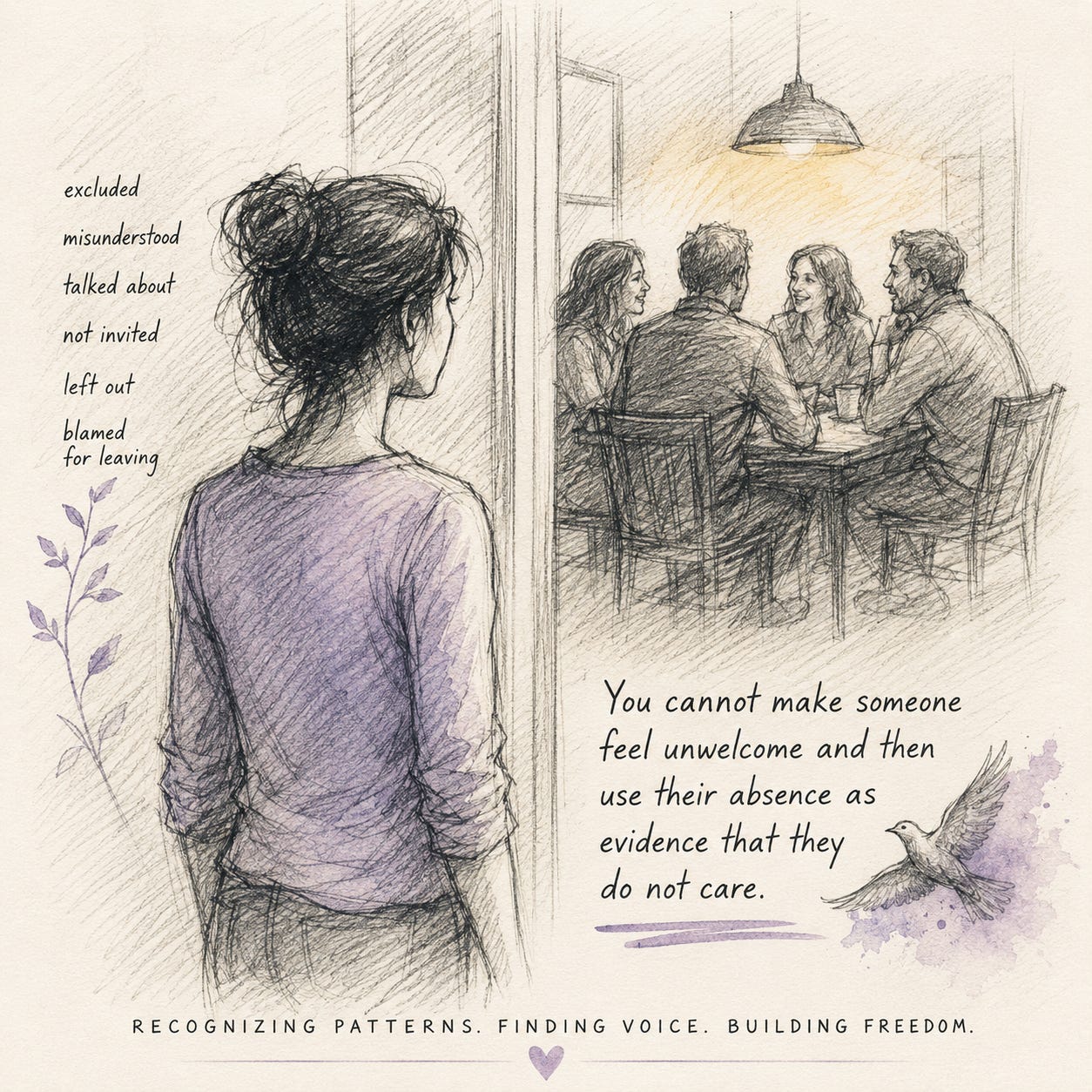
There is a way of pushing someone out of a family, friendship or community that doesn’t require anyone to tell them to go.
Nobody has to ban you from the house. Nobody has to announce that you’ve been excluded. Nobody even has to admit that anything has changed. Other people simply begin knowing things you don’t know.
Relationships form around conversations you weren’t part of. Someone you thought was neutral suddenly seems angry with you. Another person becomes strangely distant. Someone makes a comment that doesn’t quite make sense unless there was a conversation before it. You walk into a room and sense something has already happened, except apparently you are the only person who doesn’t know what it was.
Eventually you start staying away.
And that’s the part I don’t think we talk about enough.
Isolation doesn’t always look like someone preventing you from leaving. Sometimes it looks like making the places where you once belonged increasingly uncomfortable to enter.
Nobody Had to Tell You to Go
We tend to imagine isolation in domestic abuse as something obvious. You can’t see your friends. You can’t talk to your family. You can’t go there. You can’t call her.
Sometimes it is that blatant. Sometimes it is much more sophisticated.
The relationships around you begin changing. One person becomes especially close to another. Complaints are shared. Grievances are repeated. Events are interpreted for people who weren’t there. Details that support one version of the story travel easily; everything that might complicate that version somehow doesn’t.
Nobody needs to tell the target, You’re not welcome here.
The atmosphere can do it.
After enough uncomfortable encounters, subtle digs, unexplained hostility or the unmistakable feeling that other people know something about you that you don’t, you begin making your own adjustments. You visit less. You wait to be invited. You avoid certain people. You watch what you say. You decide you’d rather stay home than walk into another situation you don’t understand.
From the outside, that can look entirely voluntary.
She doesn’t come around anymore.
Maybe the more important question is: What happened that made her stop coming?
Recruiting Other People Changes the Balance
There is a name for part of this: triangulation. Instead of dealing directly with another person, someone brings a third person into the relationship or conflict.
But that word alone doesn’t capture everything that can happen.
Other people can become validators, messengers, critics, witnesses and eventually enforcers. They may not know that’s the role they’re playing. They may sincerely believe they’re helping someone they care about.
A complaint can sound perfectly reasonable. In fact, it may be true.
Someone doesn’t pick up after himself. Someone is difficult. Someone forgot something important. Someone said something insensitive. Someone has habits that drive everybody crazy.
None of us is particularly difficult to criticize if somebody is building a case.
The question is what happens with those criticisms.
Are they part of an ordinary conversation between friends? Or are they being accumulated, repeated and delivered to other people until those people begin viewing someone through a carefully constructed lens?
That’s when something seemingly ordinary can become much more consequential.
You Can Be Recruited Without Knowing It
This is the part that deserves much more attention.
Sometimes you’re not the person being isolated. You’re the person being recruited.
Someone complains about a partner, sibling, parent, child or friend. You know the complaint has some truth in it, so you agree. Then another complaint comes. You agree with that one too.
Before long, you may find yourself criticizing someone you love based on a stream of information being supplied by somebody else.
You may think you’re being fair. You may think you’re helping. You may even think you’re protecting the person doing the complaining.
You may have no idea that you’ve been given a role in a much larger pattern.
That’s why I have become much more interested in what happens around coercive control. The person exerting control doesn’t necessarily have to personally deliver every criticism, consequence or punishment. Other people can begin doing some of that work.
And they may never realize they’ve been enlisted.
The Target Has an Impossible Problem
Imagine trying to defend yourself against a conversation you never heard.
You don’t know exactly what was said. You don’t know who heard it. You don’t know how long it has been going on. You don’t know which version of events people have been given.
You only see the result.
Someone’s behavior toward you changes. A remark comes out of nowhere. Someone confronts you about something you didn’t know was an issue. A person who once seemed warm becomes guarded.
If you ask what’s wrong, you may get nothing.
Nothing’s wrong.
Now you’re left trying to respond to something nobody will acknowledge is happening.
That’s an incredibly effective position from which to destabilize someone because there is almost nothing concrete to grab onto. If you react strongly, your reaction itself can become evidence that the negative story about you was right.
So you learn to be careful.
And eventually, you may learn to stay away.
Pay Attention to Information That Only Travels One Way
None of this means every friendship outside a relationship is suspicious. People are allowed private conversations. They’re allowed to vent. They’re allowed to dislike each other. Families form alliances. Friends sometimes take sides. Human relationships are messy.
What matters is the pattern.
Who consistently controls the information? Who gets to tell the story first? Does one person’s interpretation repeatedly arrive before the other person does? Are people being encouraged to confront someone rather than talk with them? Does hostility seem to appear in people who weren’t originally part of the conflict? Is one person becoming increasingly uncomfortable in places where they once belonged?
And perhaps the most important question for those of us on the outside: Am I being asked to form a judgment about someone who isn’t in the room?
Sometimes the best thing you can do is refuse the assignment.
When They Push You Out, Then Blame You for Leaving
Eventually the person on the outside really does make a choice. They stop visiting. They wait to be invited. They avoid certain gatherings. They become cautious around particular people. They decide the emotional cost of showing up is too high.
Then the story gets flipped.
She doesn’t come around anymore.
Or worse:
See? She doesn’t care about us.
Now the withdrawal that was created by exclusion, hostility or repeated discomfort becomes proof against the person who withdrew. The environment pushes someone out, then uses that person’s absence to justify the way they are being treated.
That is how responsibility gets reversed.
If someone has clearly said they do not feel comfortable coming unless they are invited, or has explained why certain situations or people feel hostile or unsafe, continuing to exclude them while later blaming them for not showing up is not neutral.
You cannot make someone feel unwelcome and then use their absence as evidence that they do not care.
That is a way of rewriting cause and effect so the person on the receiving end becomes responsible for the very isolation they were reacting to.
That is a form of isolation we need to get much better at seeing.
Join This Community
Domestic Assault is about recognizing patterns that are easy to miss when we look at one incident at a time. This is one of them.
I want us to get better at recognizing when someone is being pushed to the edges of their own relationships. I also want us to recognize something harder: when we may be getting pulled into somebody else’s pattern and helping to isolate another person without understanding what we’re doing.
You don’t have to tell your story to belong here. You can read, learn, recognize something you have lived through, or realize for the first time that you may have been standing somewhere inside somebody else’s pattern.
Everything I publish here will remain free to everyone. Paid memberships support the research, writing and time it takes to build this community while keeping the work open to all.
If this work helps you see something you couldn’t see before, subscribe and stay with me.