


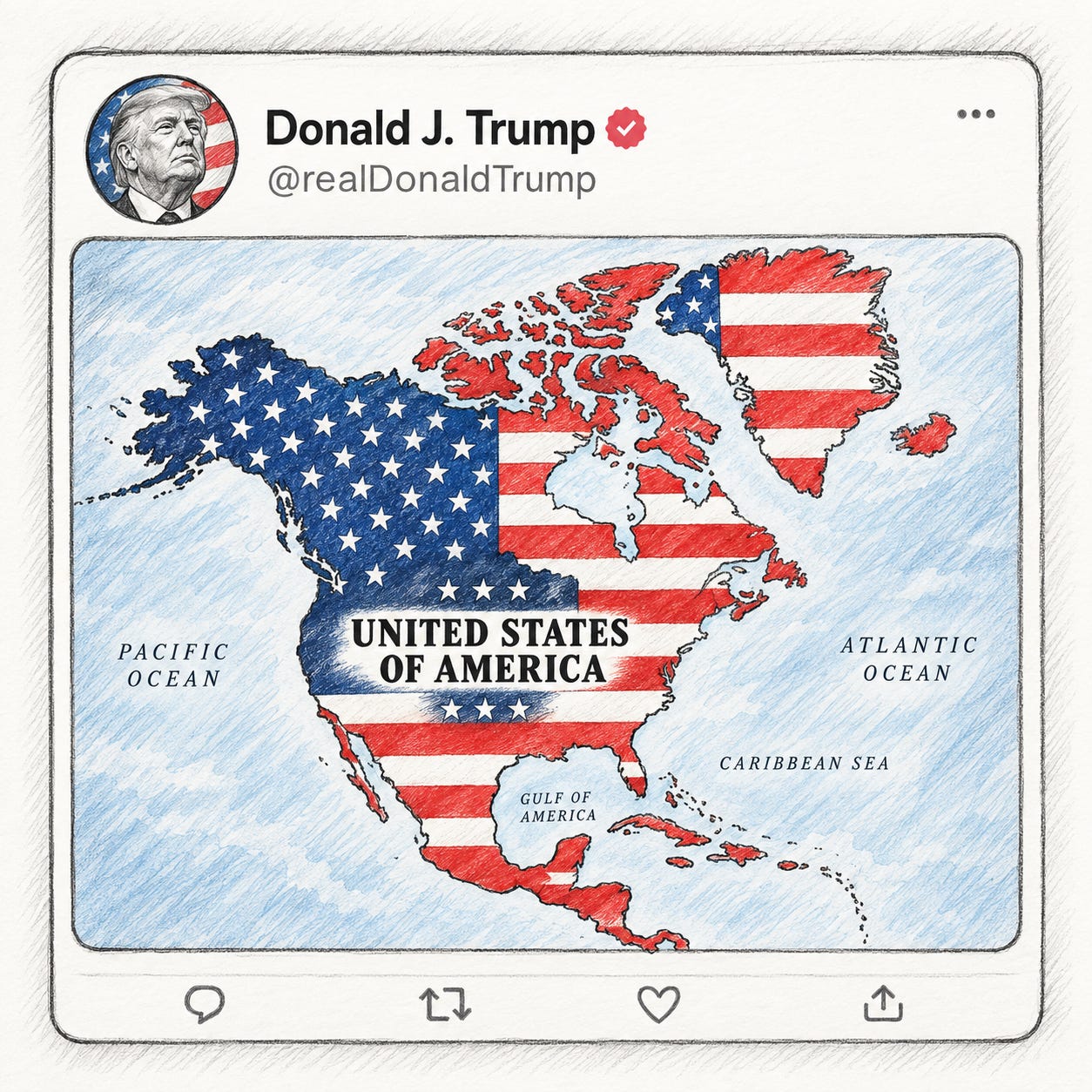
Trump posted a map on Truth Social this week that looked, at first glance, like one more piece of the strange political theater we have become accustomed to. The American flag was stretched across not only the United States but Canada, Greenland, Iceland, Mexico, Central America and the Caribbean, the whole expanse labeled “United States of America.”
There was no explanation attached to it.
Iceland did not find it amusing. Its government summoned the U.S. ambassador. Denmark’s foreign minister called the imagery disturbing, and Greenland’s leaders have already made their position on Trump’s long-running interest in acquiring their territory abundantly clear.
I looked at the map and thought about something I have been writing about here on mu Substack and my publication Domestic Assault.
Boundaries.
Not borders in the geopolitical sense, although obviously those matter too. I mean the deeper idea of a boundary: the place where one person’s authority ends and somebody else’s begins.
People who have experienced coercive control understand how important that distinction can become.
No Should Not Begin a Negotiation
One of the most exhausting things about living with someone who does not respect boundaries is that nothing ever seems settled.
You say you don’t want to do something, and instead of accepting the answer, the other person asks why. You explain why, and your explanation becomes something to argue with. You explain again, and another objection arrives. Before long you are not discussing whether you want to do something at all. You are defending your right to have wanted something different in the first place.
That is how a boundary can gradually become a negotiation.
It may not begin with a threat. Often it begins with persistence. The person pushing simply refuses to recognize that your answer has ended the discussion.
And because most people do not want to live in a state of permanent conflict, they engage. They explain. They defend themselves. They compromise on things they never wanted to compromise on. Sometimes they eventually give in, not because they have changed their minds, but because maintaining the boundary has become more exhausting than surrendering it.
Then, from the outside, somebody says: Well, she agreed.
Maybe she did.
The more useful question is what it took to get her there.
Entitlement Changes the Question
I write about patterns because patterns of power can appear in very different places.
The pattern that interests me here is entitlement: the belief that another person’s boundary does not deserve the same respect as your desire to cross it.
Trump has spent years talking about Greenland as though the wishes of the people who live there were an obstacle to an American acquisition rather than the central fact of the matter. He has repeatedly played with the idea of Canada becoming the 51st state. Now comes a map that simply eliminates boundaries altogether and replaces them with an American flag.
What interests me is not whether Trump actually expects Iceland to become part of the United States. I have no idea what he expects.
It is that a powerful person can place an outrageous proposition into circulation and force everybody else to respond to it.
Now Iceland must summon an ambassador. Denmark must answer. Greenland must answer. Canada must answer. Journalists must ask what it means. Diplomats must calculate how seriously to take it.
The burden quietly moves from the person crossing the boundary to the people who must defend it.
That dynamic is painfully familiar.
You Find Yourself Defending What Should Have Been Obvious
People who have lived with coercive control sometimes describe conversations that sound absurd when repeated later.
Why should you have to explain that you are allowed to speak privately with your own friends?
Why should you have to argue that the money you earned does not automatically belong under somebody else’s control?
Why should a parent have to defend maintaining a relationship with her own children?
Why should someone have to provide an acceptable reason for wanting an evening alone, keeping a password private, declining sex, going to work, seeing family or simply saying no?
Yet inside a controlling relationship, those arguments can become normal.
That may be one of coercive control’s most damaging accomplishments. It changes what the less powerful person believes must be justified.
Instead of asking, Why do you believe you have the right to control this?, everyone begins asking the targeted person to explain why she is resisting.
That is an enormous shift.
And once I learned to see it, I began seeing it everywhere.
Jokes Can Carry Power Too
The defense for behavior like Trump’s map often arrives quickly: he’s trolling. He’s joking. He likes provoking people. Everyone is taking him too seriously.
Perhaps.
But jokes do not occur in a vacuum, and they do not exist outside power.
A joke from somebody who has no authority over you is one thing. The same joke from the person who controls your livelihood, your immigration status, your access to money or your physical safety can feel very different.
Anybody who has lived around an intimidating person knows this instinctively. Sometimes the cruelest comments arrive with a laugh attached to them. If you object, the joke itself becomes the defense.
Can’t you take a joke?
Now the problem is no longer what was said. The problem is supposedly your reaction to it.
That is another wonderfully efficient way to erase a boundary. Not only are you expected to tolerate the intrusion, you may be blamed for objecting to it.
Power determines whether everybody in the room has the same freedom to laugh.
Watch What Happens After the Boundary
I have become less interested in declarations than in what happens after them.
Anybody can say they respect another person’s independence. The test comes when that person uses it.
Anybody can say they respect boundaries. The test comes when somebody establishes one they do not like.
Anybody can say they believe in consent. The test comes after the answer is no.
What happens next?
Does the person accept the answer and adjust?
Or does the campaign begin?
Do they bargain, punish, ridicule, threaten, recruit allies, withdraw affection, create consequences, keep asking, pretend not to understand, or simply behave as though the boundary never existed?
That is where a great deal of coercive behavior reveals itself.
And sometimes the most important thing we can teach ourselves is that we are allowed to stop participating in the negotiation.
You do not always owe another explanation.
The Map Is the Message
That is why this odd map caught my attention.
A border is one of the clearest boundaries human beings create. Whatever disputes countries may have, a sovereign nation does not ordinarily wake up one morning and discover that another country’s leader has colored over it with his flag.
The image is absurd precisely because the boundary is so obvious.
But perhaps that is why it is useful.
It makes visible something that is often much harder to see inside ordinary relationships: the assumption that another person’s line matters only until someone more powerful decides to move it.
The danger is not simply crossing boundaries. Human beings make mistakes. We misunderstand each other. We occasionally push too far and apologize.
The danger is the belief that the boundary was never really yours to establish.
That is something else entirely.
At Domestic Assault, I keep returning to these patterns because recognizing them can change the way we understand what is happening around us. Coercive control is rarely one dramatic incident. More often it is a system built slowly out of entitlement, pressure, intimidation, punishment, isolation and the steady erosion of another person’s authority over her own life.
Sometimes learning to recognize it begins with one very simple idea:
A boundary does not require the approval of the person who wants to cross it.
If this kind of writing helps you recognize those patterns more clearly, I hope you’ll join my community here at Domestic Assault. My writing will remain freely available because I believe this information needs to be accessible. Free subscribers help build the community, and paid subscribers make it possible for me to keep doing the work.
Sources
Reuters, September 8, 2026 — reporting on Trump’s map and Iceland’s decision to summon the U.S. ambassador.
Associated Press, September 8, 2026 — reporting on the international response to Trump’s map and his previous territorial rhetoric involving Greenland and Canada.