


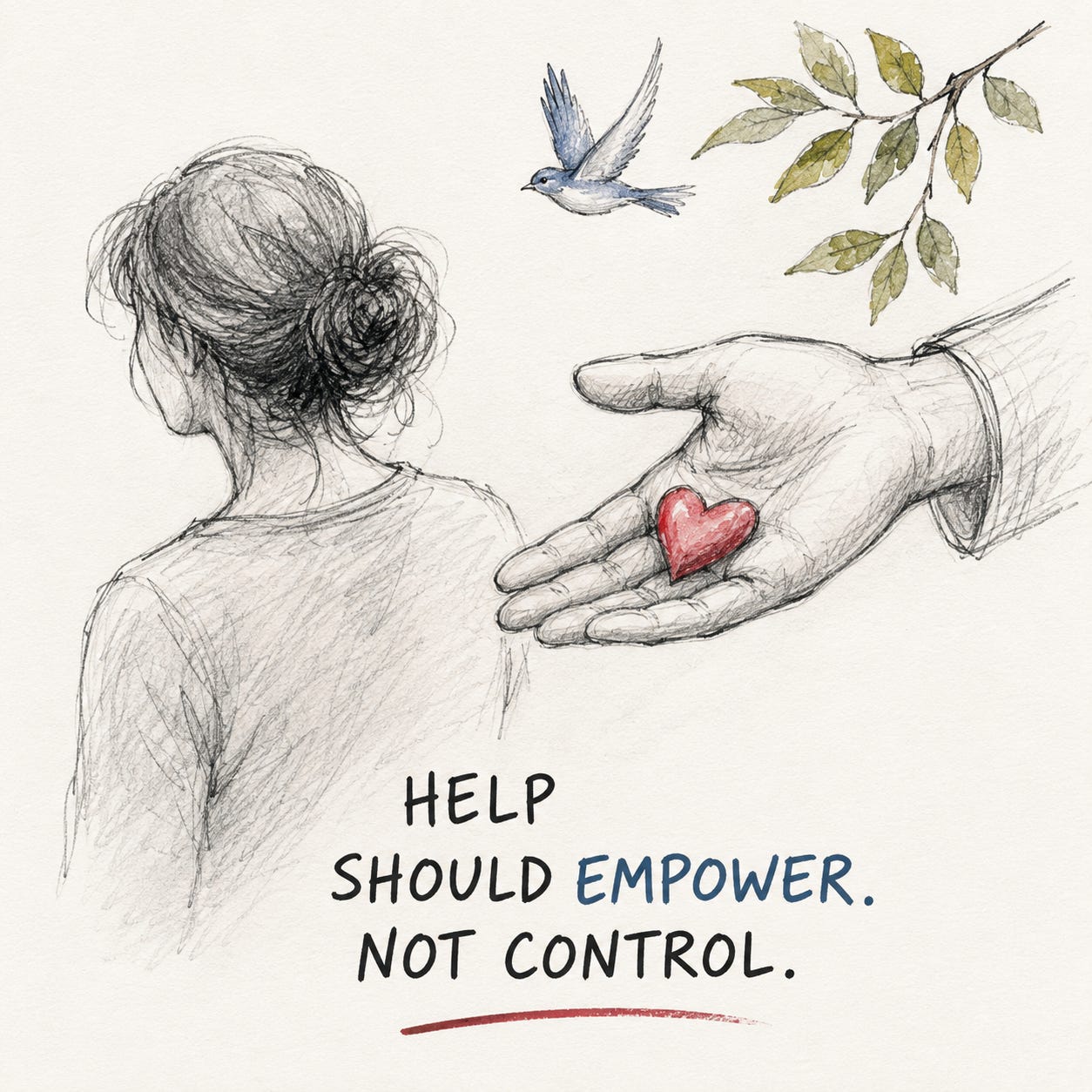
Most of us want help sometimes. We need it when we’re sick, overwhelmed, grieving, aging, raising children, struggling financially or simply carrying more than one person can reasonably manage alone.
And most people who help us really are helping.
But there is a line that can be crossed so gradually that neither person recognizes exactly when it happened. Help can become control when the person receiving it begins losing the right to decide how that help is given.
Someone offers to handle the finances because you’re overwhelmed. Soon you’re being questioned about what you spend.
Someone takes over a household responsibility because it’s difficult for you. Eventually you’re no longer allowed to have an opinion about how it’s done.
Someone offers transportation, makes appointments, speaks to professionals for you or manages something complicated on your behalf. It begins as assistance. But somewhere along the way, I can do this for you becomes I know what’s best for you.
The distinction isn’t whether the helper has good intentions. People can love us deeply and still become controlling.
Help should increase your ability to live your life
Healthy help asks, What do you need?
Control says, Here’s what I’ve decided you need.
Healthy help allows you to disagree, change your mind, make choices the other person wouldn’t make and sometimes even make mistakes.
Control becomes irritated by those things.
That’s one reason controlling behavior can be so difficult to recognize when it comes from someone we love. There may be no threats. No screaming. No obvious cruelty. There may instead be enormous effort, sacrifice and genuine affection.
And that makes it emotionally complicated to say, I appreciate everything you’re doing for me, but this is still my decision.
Gratitude does not require surrendering autonomy.
Dependence can change a relationship
The risk becomes greater when one person genuinely needs another person’s assistance.
Age, disability, illness, financial problems, childcare, housing or transportation can create practical dependence. The person providing help may gradually accumulate power simply because they control something the other person needs.
That doesn’t automatically make the relationship abusive. But it does create an imbalance worth noticing.
Ask a simple question: Can the person receiving the help still say no?
Can they disagree without being punished? Can they ask for the help to be provided differently? Can they make decisions the helper doesn’t approve of? Can they stop accepting the help without retaliation, humiliation or guilt?
If the answer repeatedly becomes no, something important has changed.
Sometimes we have to recognize it in ourselves, too
Control isn’t only something other people do.
Those of us who love fiercely can cross this line ourselves. We can become so convinced that we’re protecting someone, fixing something or preventing a bad outcome that we stop noticing that another adult has the right to make a different choice.
Recognizing that doesn’t make someone terrible. It gives us an opportunity to correct course.
Maybe the question isn’t simply, Am I helping?
Maybe it’s: Am I helping this person live their own life—or am I slowly making their life mine to manage?
That distinction matters because the best help doesn’t make another person smaller. It helps them remain themselves.
Join my community
Domestic Assault is about recognizing patterns of abuse, coercion and control—not only after they become unmistakable, but while they’re still difficult to name.
All of the core writing here will remain freely available because I believe this information needs to be accessible to anyone who needs it.
If you find value in this work, join my community by subscribing. Paid subscriptions help support the research and writing and allow me to continue building a place where we can talk openly about these patterns, understand them better and, hopefully, help one another see them sooner.
Thank you for being here and for supporting my work.