


Donald Trump did not become an abuser when he became president. He arrived in American politics with a long public history of allegations of abusive and sexually aggressive behavior toward women, and Americans heard his own recorded words about what he believed celebrity allowed him to do to them. Years later, a civil jury found Trump liable for sexually abusing and defaming E. Jean Carroll, and that judgment survived his appeals.
That history matters because I don’t believe what Trump subsequently did to MAGA was some sophisticated political technique he happened to discover on the campaign trail. He already understood how domination worked.
He understood overwhelming attention. He understood seduction and salesmanship. He understood how to make himself enormous in somebody else’s world. He understood denial and counterattack, how to discredit people who challenged him and how to make virtually every conflict revolve around Donald Trump. And after a lifetime of selling the Trump brand, he understood perhaps the most important principle of the con: find the hunger first, then sell yourself as the thing that will satisfy it.
When Trump entered politics, there were millions of Americans hungry for exactly what he knew how to sell.
They felt forgotten. They felt unseen. They felt disrespected. Some had watched factories disappear and communities deteriorate. Some had watched economic security become increasingly difficult to attain. Some believed the culture no longer respected them or the lives they had built. Some had lost faith in government, journalism and other institutions. Some came from cultures in which hierarchy, toughness, obedience and loyalty were highly valued and vulnerability was not.
They were not all the same people, and they did not all arrive there by the same road. But enough Americans had been primed by their lives, their communities, their media and their experiences to respond to someone who would tell them that their pain was real, their anger was justified, somebody else was responsible—and he was the one man strong enough to save them.
Trump recognized them.
That may have been his greatest political skill.
He didn’t begin by controlling them.
He began by loving them.
Or, more precisely, by making them feel loved.
He Love-Bombed the Unseen
Trump told them they were patriots. They were hardworking Americans. They were the forgotten men and women who had built this country while corrupt politicians, corporations and elites abandoned them. He didn’t shame their anger. He validated it. He didn’t tell them they had misunderstood America. He told them they understood America better than the people running it.
After years of feeling unseen, suddenly one of the most famous men in America was looking directly at them and saying, in essence, I see you.
That was the love-bombing.
And it worked spectacularly.
Trump didn’t merely give these Americans a candidate. He gave them an identity.
MAGA.
There was a name for them now. A slogan. A hat. A flag. A community. There were enormous rallies where thousands of people who had felt ignored could look around and discover they weren’t alone. They were surrounded by people who shared their anger, their fears, their frustrations and their hopes.
They belonged.
And standing at the center of all that belonging was Donald Trump.
Listen to the architecture of his own language when he accepted the Republican nomination in 2016. He spoke about people who had been “neglected, ignored, and abandoned.” He called them the “forgotten men and women” and said they no longer had a voice.
Then:
“I am your voice!”
And shortly afterward:
“I alone can fix it.”
Put those statements together.
You’ve been forgotten. You’ve been abandoned. You’ve lost your voice. I see you. I am your voice. I alone can fix it.
That is the architecture of the relationship.
Trump identified the wound, validated it, positioned himself as the person who understood it and then made himself the solution.
The people who felt powerless were promised power.
But there was a catch they couldn’t yet see.
Their power would increasingly have to flow through him.
Then He Gaslit Them
Once someone becomes the person you trust because everyone else supposedly failed you, that person acquires extraordinary power over what you believe.
Trump spent years attacking not simply individual journalists but the credibility of the press itself. Prosecutors investigating him could be corrupt. Judges ruling against him could be politically motivated. Republicans who challenged him could become RINOs. Officials who contradicted him could become part of the establishment or “deep state.”
The universe of trustworthy people became smaller.
And this is where the manipulation becomes extraordinarily difficult to escape, because contradictory information can actually strengthen the relationship.
If journalists say Trump is lying, that’s because the media lies. If prosecutors investigate Trump, that’s because justice has been weaponized. If former Trump officials criticize him, they betrayed him. If Republicans oppose him, they aren’t real Republicans. If experts contradict him, perhaps the experts are compromised too.
Eventually, evidence that might ordinarily cause someone to reconsider the leader can be transformed into evidence that the leader was right all along.
See? They’re all against him. He told us they would be.
The belief begins defending itself.
And the person who warned you not to trust anyone else becomes the person you trust more than anyone else.
Then He Made His Problems Their Problems
The next transformation was even more consequential. Trump increasingly fused his personal fate with the fate of his followers.
At CPAC in 2023, Trump reminded supporters that he had declared himself their voice in 2016. Then he went further. He called himself their “warrior,” “justice” and “retribution.”
That wasn’t ordinary political language.
Trump was no longer merely saying, I represent your political interests.
The message had become: Your struggle and my struggle are the same struggle.
If they came for Trump, they were coming for you. If they prosecuted Trump, they were persecuting you. If they humiliated Trump, they were humiliating you. If Trump defeated his enemies, you defeated yours.
His grievances became their grievances, and their grievances became his justification.
That changes political allegiance into something much harder to break. If I support a politician because I prefer his policies, I can abandon him when he stops representing those policies. But if that politician becomes intertwined with my identity, rejecting him means confronting something much larger than immigration, taxes or trade.
It can feel like rejecting part of myself.
Then Loyalty Changed Direction
Politicians are supposed to be loyal to the people who elect them.
Somewhere along the way, the relationship reversed.
The question should always have been: Is Donald Trump still loyal to the things I elected him to do?
Instead, loyalty to Trump himself became increasingly important within his movement and government. When Trump prepared his second administration after the 2024 election, Reuters reported that prospective officials were being scrutinized for previous criticism of him as his team sought loyalists for key positions.
That reversal is crucial.
Is Trump loyal to what I believe? is the question of an independent citizen.
Am I loyal to Trump? is the question of a follower.
One keeps the citizen at the center of the relationship.
The other puts Donald Trump there.
And that is precisely what happened to a movement supposedly created to return power to forgotten Americans.
Donald Trump became the center.
And Now Comes the Abuse
This is the part of the relationship America needs to talk about now.
Because Trump’s supporters do not stop experiencing the consequences of his decisions simply because they voted for him.
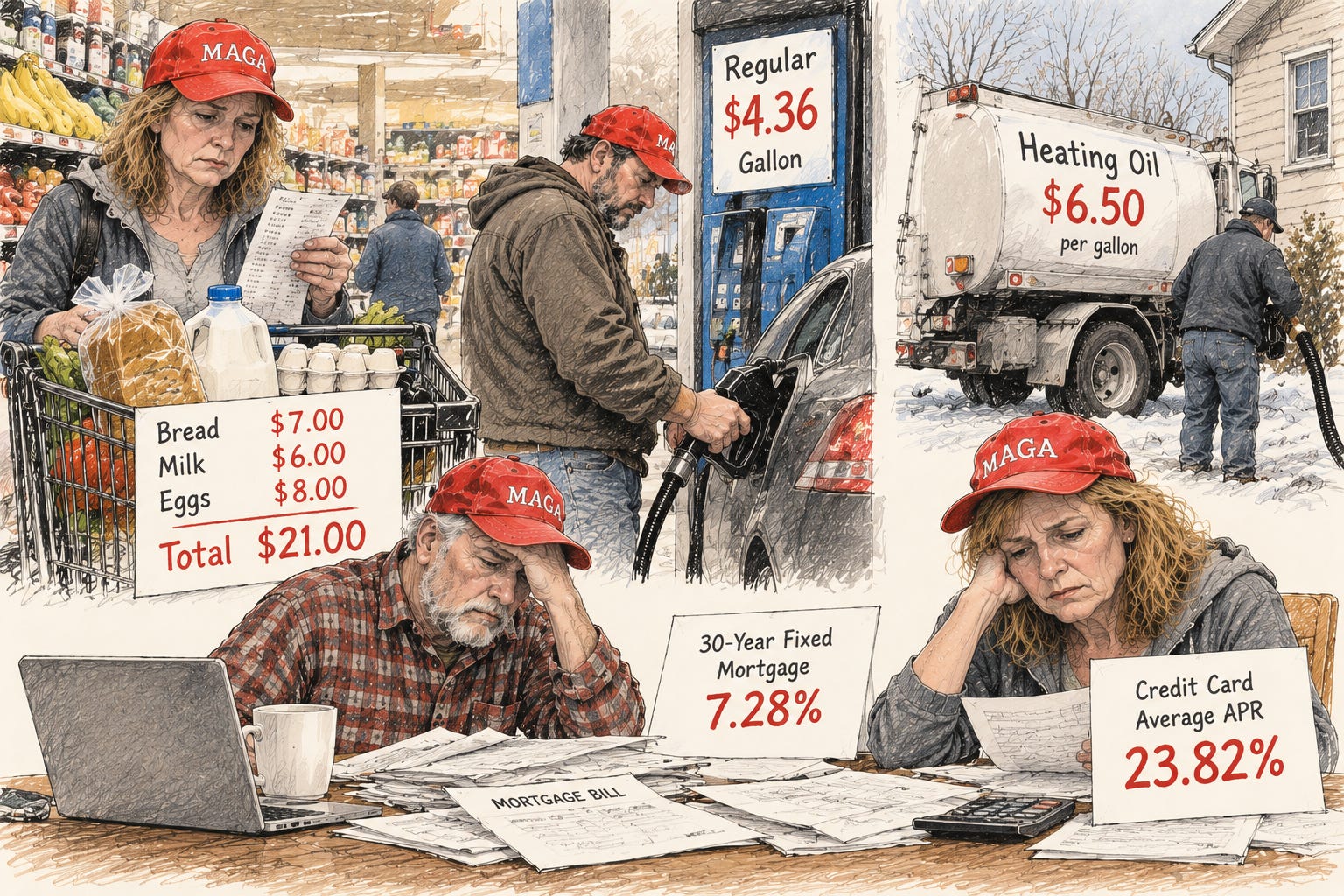
A farmer doesn’t stop being hurt by a policy that damages his farm because there’s a Trump sign beside his barn. A factory worker doesn’t become immune to economic consequences because she voted Republican. A family struggling to pay for groceries, heating oil, gasoline, healthcare, a mortgage or credit-card debt doesn’t get a separate MAGA economy. A young American sent into a war doesn’t become invulnerable because his parents supported the commander in chief.
Trump’s supporters live under Trump’s presidency too.
And this is where the analogy becomes especially uncomfortable.
In an abusive relationship, eventually the person who once promised to protect you can become the person hurting you. The person who promised safety becomes a source of instability. The person who told you everyone else was responsible for your pain can inflict pain himself while continuing to tell you somebody else is responsible for it.
But by then, leaving is far more complicated than simply recognizing the harm.
Because leaving means confronting the entire relationship.
Walking Away Means Confronting Ten Years
People outside MAGA often ask the wrong question.
They ask, How can they possibly still support him?
They assume another fact will do it. Another contradiction. Another broken promise. Another scandal. Another policy consequence. Surely this one will finally make people see.
But imagine what walking away can require after ten years.
You may have defended Trump to your children and argued with your siblings about him. You may have lost friendships. You may have donated money, attended rallies, bought the hat, flown the flag and spent countless hours defending him online. You may have repeated claims that later proved false. You may have excused behavior you once insisted you would never tolerate from a president.
You may have built friendships and community around MAGA.
You may have built part of your identity around MAGA.
Now imagine being asked to consider that the man you defended for a decade didn’t merely disappoint you.
He used your loyalty.
That is a brutal possibility to confront because now you aren’t being asked merely to change your opinion about Donald Trump.
You’re being asked to reconsider ten years of your own decisions.
And perhaps most painfully, you have to consider the possibility that the man who spent a decade warning you that everyone else was manipulating you was manipulating you himself.
That Doesn’t Make MAGA Stupid
This is where Trump’s opponents repeatedly make a terrible mistake.
They mock his supporters. They call them stupid, ignorant, gullible or deplorable and then wonder why those people retreat further into the community that tells them they are valued.
Manipulation does not require stupidity.
Smart people can be manipulated. Educated people can be manipulated. Successful people can be manipulated. Strong people can be manipulated. People who pride themselves on being skeptical can be manipulated.
One of the most effective ways to manipulate someone is to convince them that they are among the few people perceptive enough not to be manipulated.
That’s why humiliation doesn’t necessarily break the bond.
Sometimes it strengthens it.
If everyone outside the relationship tells you you’re an idiot while the person inside it tells you you’re brilliant, patriotic, special and one of the only people who understands what’s really happening, where are you likely to feel safest?
Right where you already are.
And an experienced manipulator understands that.
MAGA Never Belonged to Donald Trump
This is the part I wish more Americans understood.
The people who became MAGA existed before Donald Trump came down that escalator.
They had political beliefs before him. They worried about immigration, jobs, trade, taxes, crime, government spending, religion, globalization and cultural change before Donald Trump put those concerns beneath a red hat.
Donald Trump did not invent those people.
He recognized them.
Then he validated them.
Then he gave them an identity.
Then he made himself indispensable to that identity.
That’s the trick.
A movement ostensibly created to return power to forgotten Americans gradually became organized around the grievances, legal problems, political survival, enemies and ambitions of one man.
The forgotten Americans were supposed to become the center of American politics.
Instead, Donald Trump became the center of theirs.
And so perhaps the most important question for MAGA isn’t whether Democrats were right about Donald Trump.
Forget Democrats.
Forget liberals.
Forget the media.
Forget me.
Ask yourself something much simpler:
When did supporting Donald Trump become more important than Donald Trump supporting you?
You don’t have to become a Democrat to ask that question. You don’t have to become liberal. You don’t have to change your position on immigration or taxes or guns or abortion. You don’t have to apologize to anybody for how you voted. You don’t even have to stop believing in making America great.
You only have to remember who was supposed to be in charge of this relationship.
You were.
Donald Trump found Americans who felt unseen and told them he saw them. He validated their anger, gave them belonging and helped create an identity around their grievances. Then he taught them to distrust the people and institutions that contradicted him. He fused his identity with theirs and made loyalty to himself central to the movement.
The love-bombing worked.
The gaslighting worked.
The control worked.
And now the man who promised to protect MAGA can hurt the very people who trusted him while the relationship itself makes walking away extraordinarily difficult.
As abusive relationships do.
But there is one thing an abuser never wants the person on the other side of that relationship to discover:
You can take yourself back.
Your judgment was yours before Donald Trump.
Your values were yours before Donald Trump.
Your voice was yours before Donald Trump.
Your country was yours before Donald Trump.
None of them ever belonged to him.
Join My Community
If this piece made you think differently about what has happened to America over the past decade, join my community here on Substack.
I write about the patterns beneath the headlines—the connections between power, manipulation, politics and human behavior that can disappear when we treat every day’s outrage as an isolated event.
This community isn’t about being told what to think. It’s about looking harder at what is happening around us, asking the uncomfortable questions and refusing to surrender our own judgment to anyone.
If you are already here, thank you. Please restack and share this piece. Conversations like this only matter if they escape the room where they started.
And if my work is valuable to you and you’re able to do it, please consider becoming a paid subscriber. Reader support gives me the independence and time to keep researching, connecting the dots and writing the things I believe need to be said.
Come join us.
Your voice belongs here.
This was difficult to read, but the idea of looking at political loyalty through the lens of love bombing really made me think. The cycle you describe, intense praise and promises followed by anger, blame, fear, and then another round of reassurance, is a powerful way to examine how people can become emotionally attached to a political movement even when they are disappointed by it.
What struck me most is that your piece isn’t simply asking, “Why don’t people change their minds?” It asks what happens when belonging itself becomes part of the equation. Once politics becomes tied to identity, community, loyalty, and the fear of admitting you may have trusted the wrong person, walking away can become much more complicated than changing an opinion.
Whether every part of the abuse analogy fits can certainly be debated, but you gave me a perspective I hadn’t considered this way before. That is what good writing should do. It should make us stop scrolling for a minute and actually think.
A true narcissist if I ever saw one and I've seen a few!