


Imagine a father responding to his daughter’s legitimate question by insulting her intelligence, calling her pathetic, and humiliating her in front of the family.
Imagine a husband treating his wife that way. Or an employer responding to a worker’s question about safety by attacking the employee’s competence.
We would recognize the behavior. We would call it bullying, intimidation, and emotional abuse.
Now imagine the President of the United States doing it in front of the world’s cameras.
We don’t have to imagine it.
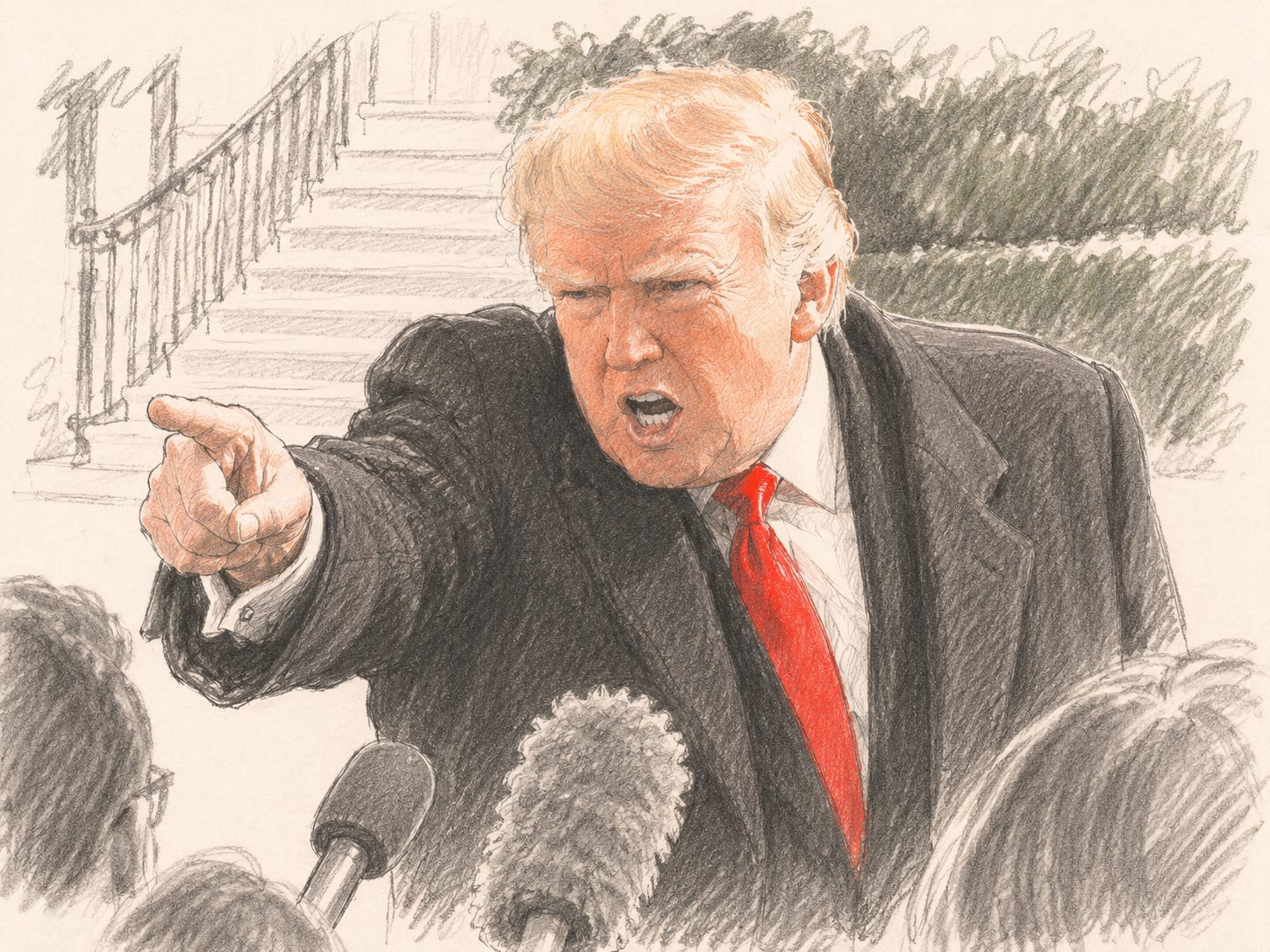
On November 16, 2026, Trump publicly berated NBC correspondent Yamiche Alcindor as she questioned him about the nationwide Federal Aviation Administration ground stop and his administration’s priorities.
Air travel had been disrupted across the country. Passengers had been stranded. Thousands of flights were affected, and Americans wanted explanations about the reliability of the aviation system.
Alcindor asked whether the administration had devoted too much attention to Washington construction projects while the nation’s air traffic infrastructure was deteriorating.
That’s a legitimate question for the president.
Trump responded with an extended defense of White House renovations, describing windows, plaster, columns, a helipad, and his planned ballroom.
When Alcindor pressed him about responsibility for the aviation crisis, he called her “pathetic.” At another point, he told her she lacked talent.
Later, when asked what responsibility he accepted for the grounding, Trump answered, “I don’t take any responsibility.”
There it was.
Personal humiliation for the person demanding accountability. No responsibility for himself.
What are we teaching our children when the President of the United States demonstrates that the way to handle an uncomfortable question is to attack the person asking it?
And what are we teaching them when the people surrounding him excuse it?
This Is What Abuse of Power Looks Like
I’ve spent much of my professional life studying human behavior, working with people, raising children, and helping individuals recognize patterns that influence their relationships and decisions.
One of the most important things I’ve learned is that power changes the consequences of behavior.
When two people disagree as equals, both can challenge the other.
But when one person controls employment, money, status, access, or authority, public humiliation carries an additional threat.
The person on the receiving end may have much more to lose.
A reporter questioning the president is doing her job. She is exercising a responsibility essential to democratic accountability.
The president holds enormous institutional power. His words can influence public opinion, shape how supporters treat journalists, and affect whether reporters feel free to ask difficult questions.
When he responds by insulting the person instead of answering the question, he uses the visibility and authority of his office to turn scrutiny into a public confrontation.
That’s the behavior I want readers to recognize.
The question was about government responsibility. Trump made it about the reporter’s supposed inadequacy.
And the country watched.
The Familiar Tactics of Intimidation
People who have experienced coercive relationships often recognize recurring patterns.
Someone raises a legitimate concern. The more powerful person becomes angry, changes the subject, questions the other person’s intelligence, attacks their credibility, or portrays the question itself as an offense.
The original issue disappears beneath the attack.
The person asking becomes the problem.
We see versions of these tactics in families, workplaces, institutions, and politics.
That doesn’t mean every rude exchange meets the legal or clinical definition of domestic abuse. Context, relationship, frequency, and patterns of control matter.
But the parallels in behavior deserve attention.
In today’s exchange, the question concerned the government’s handling of a serious disruption to public transportation.
Trump responded by defending his construction projects and disparaging the journalist challenging him.
An ordinary disagreement about funding or infrastructure would have involved explaining what happened, what the administration knew, what actions were underway, and who was responsible for preventing a recurrence.
Instead, the reporter became a target.
When a person with extraordinary power treats accountability as a personal attack, the public has reason to question how that power is being exercised.
The Infrastructure Crisis Was Real
Let’s not lose sight of what prompted the questions.
On November 13, a nationwide FAA ground stop disrupted departures across the United States after failures involving the nation’s air traffic control communications infrastructure.
Transportation Secretary Sean Duffy and Homeland Security Secretary Markwayne Mullin described instability involving older systems. The administration said the grounding was undertaken to protect aviation safety.
Years of inadequate modernization have left parts of the system increasingly difficult to maintain. The Government Accountability Office identified serious concerns about the sustainability of the FAA’s aging technology before this incident.
The problem crosses administrations. It deserves investigation, serious investment, and public accountability.
That’s precisely why the press was asking questions.
Americans have a right to know what happened, what the government is doing, how much the solution will cost, and who is responsible for managing the response.
A president can disagree with a journalist’s premise. He can correct inaccurate information, challenge the framing of a question, and defend his administration’s priorities.
Those are ordinary parts of public debate.
He doesn’t have the right to humiliate the journalist to do any of them.
And Where Are the Adults in the Room?
I want to talk about the people who watch this behavior and defend it.
Political allies. Administration officials. Members of Congress. Commentators. Supporters who dismiss the insults as entertainment, toughness, or merely Trump’s personality.
What exactly are they defending?
The president’s right to disagree with a reporter? Nobody is denying that right.
His ability to answer aggressively? That’s not the issue either.
The issue is the use of personal degradation in response to legitimate scrutiny.
And when people with influence justify that behavior, they help establish a standard under which intimidation becomes acceptable if the person using it is sufficiently powerful or politically useful.
An employer behaving this way would face questions about professionalism and leadership. A teacher doing it to a student could face serious consequences. Parents who routinely humiliate their children can inflict lasting emotional harm.
Why should the standards of public leadership be lower?
There’s also a difference between remaining silent and actively defending humiliation as a virtue.
People have different reasons for avoiding confrontation with political leaders. Some fear professional consequences. Some may genuinely agree with the president’s policies and believe his combative style is part of his effectiveness.
But agreement with someone’s policies doesn’t require approval of everything he says or does.
You can support a president’s decisions without defending his mistreatment of other people.
And when people hold positions of institutional responsibility, their willingness to challenge misconduct matters.
The most powerful people in the country should be held to demanding standards of conduct, not granted exemptions from them.
This Isn’t One Bad Morning
Trump’s attacks on reporters have been documented repeatedly.
In August 2026, Axios published an analysis of his disparaging remarks toward female journalists, including attacks on their competence, appearance, and credibility.
The White House has defended his confrontational style as political candor and rejected claims that his treatment of reporters is motivated by gender.
That defense deserves examination against the documented pattern.
In November 2025, Trump told a female Bloomberg reporter, “Quiet, piggy,” during a question about the Epstein files. He also criticized another female journalist for asking Saudi Arabia’s crown prince about the killing of Jamal Khashoggi.
These incidents illustrate why today’s confrontation shouldn’t be considered in isolation.
A political leader who repeatedly directs personal insults at journalists invites scrutiny of the broader consequences for the press and the public.
Press freedom isn’t limited to whether journalists are legally permitted to ask questions.
It also depends on whether those holding power respect the legitimacy of questioning them.
The president doesn’t have to like a reporter. He doesn’t have to like the question.
But the public’s right to ask questions through a free press is bigger than his personal feelings.
What Are We Teaching Our Boys?
This is where today’s confrontation connects to another ongoing exploration at Domestic Assault.
I’ve been writing The Lost Launch, a series about young American men struggling to establish independent lives in a rapidly changing world.
We tell them to grow up. Take responsibility. Work hard. Respect other people. Control their anger. Accept consequences. Stop blaming everyone else for their problems.
These are reasonable expectations.
Then they watch the President of the United States ridicule people who challenge him and reject responsibility when asked about a crisis under his administration.
What lesson are they supposed to take from that?
That respect is something only less powerful people owe to those above them?
That authority means never having to admit a mistake?
That strength is demonstrated by humiliating someone who asks a difficult question?
I don’t believe every young man who witnesses Trump’s behavior will imitate it. People are influenced by families, communities, educators, peers, and many competing examples of leadership.
But public figures provide models of behavior, and the messages adults send about those models matter.
When a family condemns bullying at school but celebrates it in politics, what standard is the child supposed to understand?
When we demand accountability from unemployed young men while defending a powerful leader’s refusal to accept responsibility, how do we explain that contradiction?
When we tell boys that honesty and integrity are essential to success but excuse dishonesty and cruelty from successful adults, what are we teaching them about character?
We cannot demand maturity, integrity, and accountability from our sons while treating those same qualities as optional for the most powerful man in the country.
Our boys deserve better examples.
So do our girls.
Real Strength Does Not Require Humiliation
I want young people to understand the difference between strength and intimidation.
Strength is being able to answer a difficult question without losing control of your behavior.
Strength is admitting when something went wrong and taking responsibility for finding a solution.
Strength is respecting someone whose role is to challenge you, even when you strongly disagree.
And strength is recognizing that holding power increases your responsibility for how you treat other people.
That is the kind of leadership we should expect from parents, employers, teachers, coaches, public officials, and presidents.
There is nothing weak about restraint.
There is nothing courageous about humiliating someone who has less institutional power than you.
And there is nothing admirable about treating accountability as an insult.
The country deserves a president who understands these distinctions.
Domestic Assault at Scale
I created DomesticAssault.com to examine coercive control, gaslighting, abuse, and the misuse of power, including the consequences that reach far beyond individual households.
Today’s confrontation illustrates why that broader conversation matters.
The power of the presidency is institutional. Its influence extends into families, schools, workplaces, and communities. Public conduct helps establish what people consider acceptable from leaders.
Calling this domestic assault at scale is my way of examining the social consequences of abusive behavior exercised through national power.
When humiliation is normalized by people in authority, it can contribute to a culture in which contempt is mistaken for strength and accountability is treated as weakness.
Those attitudes can travel from politics into ordinary relationships.
And people who have experienced emotional abuse know how exhausting it can be when every legitimate concern becomes another occasion for attack.
We should recognize the tactics without needing to wait for physical violence or an official finding of abuse before objecting to cruelty.
An abusive way of exercising power doesn’t become admirable when the person using it is president.
What Accountability Should Look Like
At a minimum, Americans should expect straightforward answers about the aviation disruption.
What caused the failure? Which systems were affected? What warnings had been identified? How much modernization is needed? What funding has been appropriated, and what remains unfunded?
The administration should explain its response, and Congress should examine the infrastructure needs and exercise oversight.
And when journalists ask those questions, they should receive answers rather than personal attacks.
We should also expect public officials to recognize the distinction between political loyalty and the obligation to maintain professional standards.
No one needs to agree with every question a reporter asks. No one needs to agree with every conclusion in the resulting coverage.
But a functioning democracy depends on the ability to question powerful officials without the questions themselves becoming grounds for public humiliation.
The Standard We Choose to Accept
I keep returning to the image of children watching the adults around them.
Children learn from what we do, what we praise, what we excuse, and what we refuse to challenge.
We can tell them that respect matters, that bullying is wrong, that honesty is important, and that responsible adults admit mistakes.
But those lessons lose their credibility when we treat powerful people differently.
I don’t want our boys growing up believing that the way to win an argument is to destroy the person challenging them.
I don’t want our girls learning that speaking up invites humiliation and that the people in authority will look away.
And I don’t want Americans becoming so accustomed to public cruelty that we stop recognizing it.
The president has extraordinary power. He also has an extraordinary responsibility to demonstrate how power can be exercised without contempt for others.
Today, he gave us another reason to examine that responsibility.
The people who defend him should examine their own.
A country cannot teach its children that character matters while teaching its leaders that character is optional.
And every adult who excuses cruelty from the powerful has a choice to make about the standard the next generation will inherit.
Join the Conversation at Domestic Assault
Domestic Assault explores the ways coercive control, intimidation, gaslighting, emotional abuse, and the misuse of power affect individuals, families, institutions, and society.
I’d especially like to hear from parents, teachers, coaches, journalists, healthcare professionals, and people who have experienced workplace or family intimidation.
How do we teach children to recognize the difference between leadership and bullying? What responsibility do people have when they witness someone with authority humiliating another person? How do we challenge harmful behavior without reproducing it ourselves?
And what happens to a society when the most powerful people are permitted to operate under standards we would never accept from our children?
Share your experiences and perspectives in the comments.
Subscribe to DomesticAssault.com to join the conversation and follow the continuing explorations of abuse, power, and accountability, including The Lost Launch.
Please share this article with others who are willing to confront these questions.
The standards we tolerate today help shape the world our children will live in tomorrow.
Help Keep Domestic Assault Independent and Growing
I created DomesticAssault.com to examine abuse, coercive control, gaslighting, and the misuse of power, whether it happens within families, institutions, corporations, or government.
This work takes time, research, and a willingness to ask uncomfortable questions. I’m one independent writer, and I rely on readers like you to help keep these conversations going.
Please subscribe to DomesticAssault.com, whether as a free or paid subscriber. I keep my articles free because I believe access to information and education shouldn’t depend on someone’s ability to pay.
If you can afford a paid subscription, your support helps me continue writing independently. If you can’t, a free subscription, thoughtful comment, restack, or share is enormously valuable.
Every subscription matters. Every share helps. And every new voice makes this community stronger.
Thank you for helping me continue this work. I have a great deal more to say, and I hope you’ll be part of the conversation.
I never thought in my lifetime, that watching the president of the United States on TV or reading his social media posts would be detrimental to impressionable children’s mental development. He’s as bad an influence on the scale of belonging to a gang. It must be confusing for 3rd and 4th graders, who’ve experienced a bully just like him in their own classroom, but this is coming from a child who appears to be trapped in an adult’s body.
I want to know who the reporters are that don’t support what Trump says to fellow reporters yet they fail to stand up and say something. Is it because their job is more important or do they really fear Trump?