


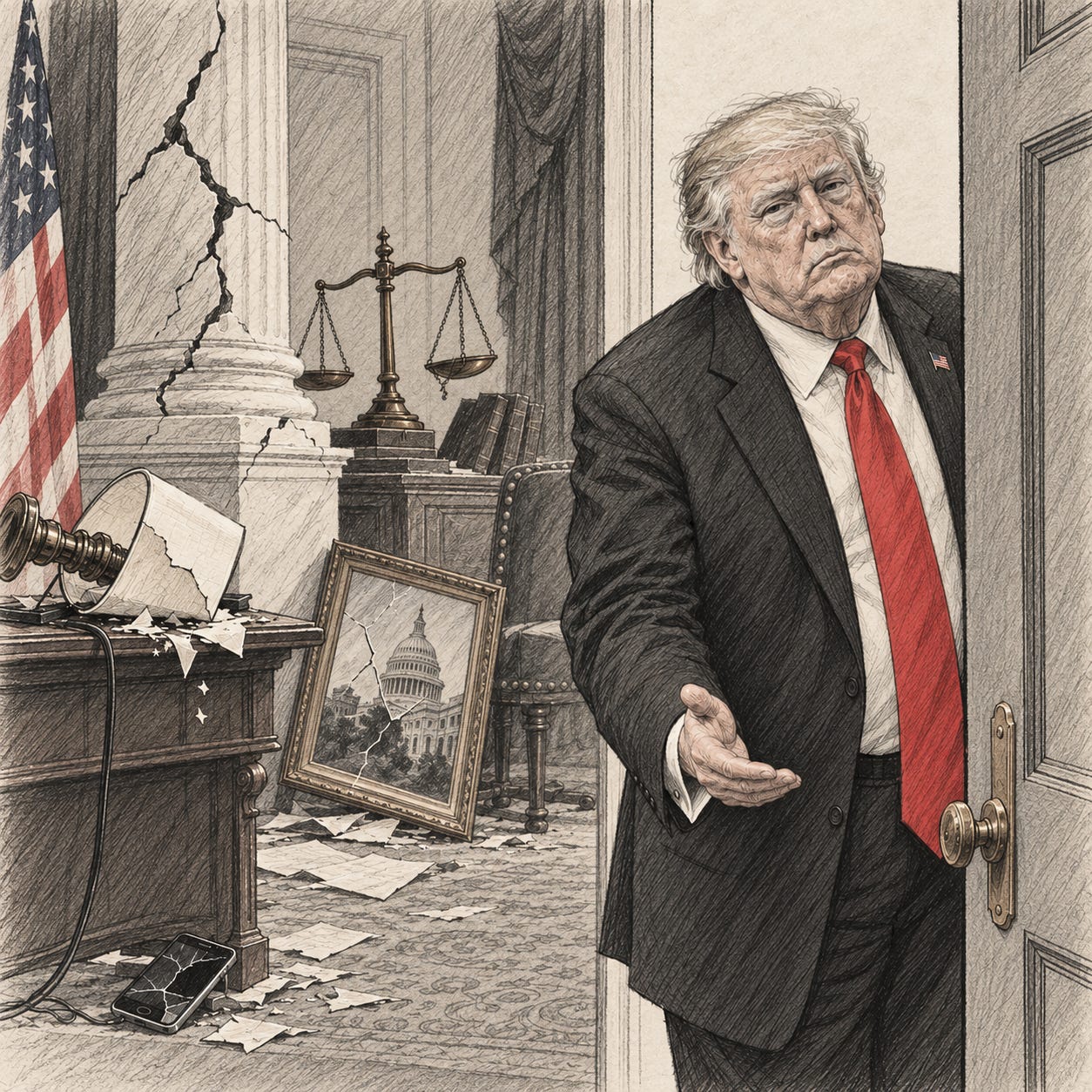
I read something this morning from Shadows of Control that captured a truth many people who have lived with abuse understand instinctively.
An abusive person may appear completely out of control, raging through a house, throwing things, smashing property, punching walls. Yet somehow it is your phone that gets broken, your belongings that are destroyed, the wall beside your head that gets punched. Then someone knocks on the door and, almost instantaneously, the person who supposedly could not control himself can answer it calmly.
That is the part worth remembering.
Not because every outburst is calculated down to the broken coffee cup, but because what looks like uncontrolled rage can function as control. The destruction has an audience. The fear has a target. And the ability to stop when stopping becomes useful tells us something the explosion itself does not.
I have been thinking about that while watching Donald Trump exercise the enormous powers of the presidency.
Stop Looking at Each Broken Thing
One of the mistakes people make in abusive situations is examining every event separately.
Why did he smash the phone? Why did he threaten her job? Why did he humiliate her in front of the children? Why did he empty the bank account? Why did he suddenly become charming when someone else walked into the room?
Separated from one another, every incident invites its own explanation. Maybe he was angry. Maybe there was a misunderstanding. Maybe this time was different.
Put the incidents together and something else begins to emerge.
That is increasingly important when looking at the Trump regime because the sheer volume of individual controversies can obscure what is happening across the whole landscape.
Reuters undertook that exercise last year and documented at least 470 people, organizations and institutions subjected to actions it classified as part of Trump’s campaign of retribution during his second term. The list crossed almost every major center of independent power in American life: federal employees, prosecutors, law firms, universities, media organizations and others who had opposed Trump, investigated him, represented people he opposed, or challenged his policies.
Four hundred seventy targets should change the way we look at the individual stories.
The law firm is not just a law-firm story. The university is not simply an education story. The broadcaster is not merely another Trump-versus-the-media fight.
The question becomes what happens to a society when institutions throughout it learn that challenging the person holding executive power can carry a price.
The Damage Is Broader Than the Headlines
Trump’s regime has used federal authority in disputes with some of the country’s most powerful law firms, including executive orders restricting firms whose lawyers, clients or previous work drew his objections. Four firms obtained court orders blocking those actions. Nine others instead negotiated agreements with the White House that included pledges approaching $1 billion in free legal work.
Universities have faced threatened or frozen federal funding, changes to research support, immigration actions involving students and faculty, and demands affecting institutional policies. The administration is now proposing rules that could jeopardize the tax-exempt status of schools over programs that consider race, while simultaneously seeking greater political control over the distribution of federal research money.
The pressure has reached American history itself. The administration has threatened federal support for the Smithsonian, demanded changes in how museums present the country’s past and objected specifically to what Trump described as excessive attention to slavery.
It has reached journalism and entertainment. ABC and Disney are now suing the Federal Communications Commission, saying an unusually early review of eight broadcast licenses has affected programming decisions because executives fear retaliation from the administration. The FCC denies that it is infringing on ABC’s First Amendment rights. The licenses were not scheduled for normal renewal until between 2028 and 2031.
It reaches deeper still, into the ordinary machinery of government and the information Americans surrender to it.
This week a federal appeals court ruled that the IRS unlawfully gave immigration authorities taxpayer information involving approximately 47,000 addresses, violating federal privacy protections created after Watergate. The administration has also sought to require states receiving certain federal benefits funding to report people believed to be in the country illegally to Homeland Security, expanding immigration enforcement into universities, motor-vehicle departments and other parts of state government.
Any one of those stories can disappear after a day or two.
Together they describe something much larger.
The Point Is What Everyone Else Learns
This is where the domestic-assault lens becomes useful.
Control does not require punishing everyone.
It requires enough people to understand what may happen if they resist.
If one law firm is targeted, another law firm watches. If one university loses billions of dollars, another university notices. If one broadcaster faces government scrutiny after angering the president, every corporate owner with broadcast licenses understands the possible stakes.
That is how power can travel far beyond the people directly touched by it.
ABC’s lawsuit provides an unusually clear example because the company says the pressure has already affected decisions inside the network. It says executives have become more cautious about booking political candidates and have considered the possibility of administration retaliation when making programming decisions. The FCC disputes ABC’s characterization of its actions, but the significance of the case extends beyond who ultimately prevails in court. An institution says it has begun changing its behavior because it fears what government power might do next.
That is the moment worth noticing.
In a controlling relationship, eventually nobody has to throw the lamp.
Everyone already knows what happened to the last one.
Courts Have Been Finding the Boundaries
There is another reason the broader pattern matters.
Federal courts have repeatedly been asked to decide where presidential authority ends and constitutional protections begin. A Reuters review published in August found 75 federal court rulings in which judges concluded that Trump administration actions infringed First Amendment protections involving speech, religion or the press. Some rulings have been appealed, stayed or overturned, and the administration has argued repeatedly that judges are improperly interfering with legitimate executive authority. But the number and range of the cases reveal just how often those boundaries are now being tested.
That matters because institutions themselves are part of the system designed to constrain power.
Courts can say no. Lawyers can challenge the government. Universities can conduct research the government dislikes. Journalists can ask questions a president would rather not answer. Museums can describe history without asking the White House which parts are acceptable. Civil servants can follow statutes rather than personal loyalty. States can challenge federal authority.
None of those institutions is perfect.
That is beside the point.
Their independence is part of what prevents any president from becoming the only meaningful source of authority in the country.
And Then He Opens the Door
That image from Shadows of Control keeps coming back to me: the person who appears consumed by rage until someone knocks.
Then the door opens and everything changes.
The voice softens. The posture changes. The performance is over because the circumstances have changed.
With Trump, the important question is not whether every angry statement is strategic or every presidential action motivated by retaliation. No outsider can know that.
What we can examine is where government power is being applied, who is receiving it, what happens after resistance and whether other people and institutions begin altering their behavior because they have seen what happened to someone else.
That is why counting only the broken things is no longer enough.
There are too many of them.
The deeper story is the atmosphere created around them — the lawyers calculating the risk of taking a case, the university wondering whether a grant will disappear, the broadcaster considering whether a program will provoke the government, the civil servant wondering whether professional independence will cost a career, the immigrant wondering whether information given to one government agency will quietly find its way to another.
That is how control expands.
Not because everyone is attacked.
Because everyone is watching.
And eventually the most consequential damage may not be the institution that was punished.
It may be the institution that saw what happened and decided not to risk being next.
Recognize the pattern.
Sources
Reuters, Trump’s campaign of retribution: At least 470 targets and counting, November 26, 2025.
Reuters, Trump vowed to ‘bring free speech back.’ Judges in 75 cases ruled that he has stifled it, August 4, 2026.
Reuters, Trump invokes presidential privilege in lawsuit over law firm orders, August 18, 2026.
Reuters, ABC says intimidation by Trump’s FCC forced programming changes, August 19, 2026.
Reuters, US to spend $5 billion on health, construction research powered by AI, July 22, 2026.
Reuters, Trump administration threatens to cut federal agencies’ support for Smithsonian, September 3, 2026.
Reuters, IRS under Trump unlawfully shared taxpayer info with immigration authorities, court rules, September 8, 2026.
Reuters, Trump’s DOJ threatens to cut aid to states unless they report migrants without legal status, September 2, 2026.
If courts CAN say no, if lawyers CAN challenge government, if universities CAN conduct research the government dislikes, if museums CAN describe history without asking the WH which parts are acceptable, if Civil servants CAN follow statutes rather than personal loyalty, and IF states can challenge federal authority; how in God's name did we as a country arrive where we're at today? Journalists, you get a pass from me for the most part, as you've been screaming the warning for years. Apparently, as I've come to personally discover; no one is seemingly reading, listening or watching. Or, maybe too many simply don't care. I dunno. It's exhausting.