


November 1, 2026 | Domestic Assault
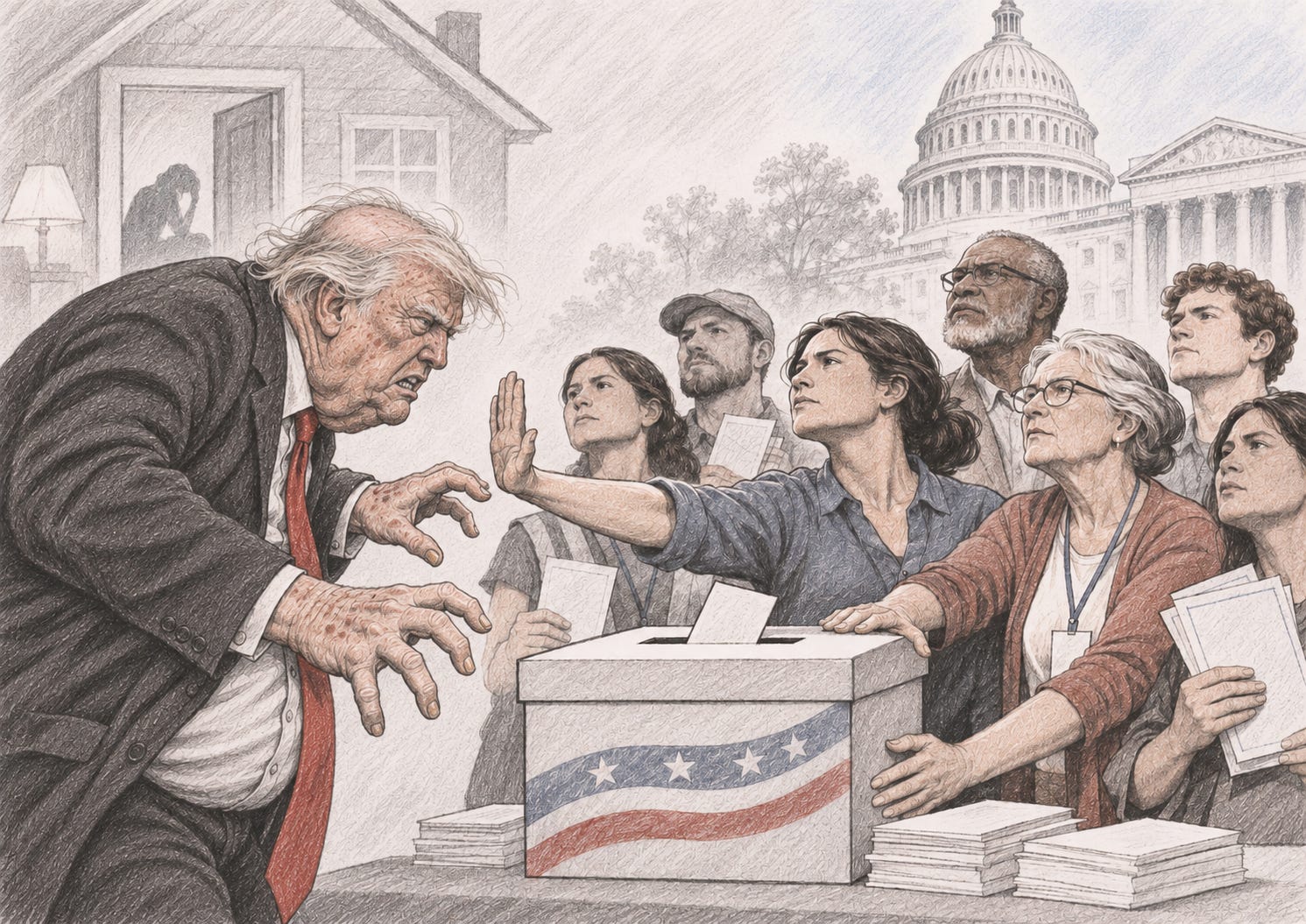
The same patterns that trap people in abusive relationships can operate inside governments: manufactured emergencies, intimidation, surveillance, punishment, isolation, and the refusal to accept no. As federal courts intervene and states resist election-related demands, America faces a familiar question: How do we stop someone who believes the rules should never apply to him?
This Is What Coercive Control Looks Like
I have spent decades studying human behavior, working with people, and understanding the damage that occurs when one individual attempts to control another.
I have also lived with coercive control.
I know how it works.
The threats. The accusations. The manufactured emergencies. The rules that constantly change. The punishment for disagreeing. The rewriting of history. The insistence that everyone else is lying.
And perhaps most destructive of all, the gradual conditioning that makes people afraid to trust their own judgment.
Domestic assault is not always a punch in the face.
Sometimes it is the destruction of another person’s independence, one calculated act at a time.
And sometimes the same methods appear on a much larger scale, inside institutions and governments.
That is why I call Trump the Domestic Assaulter in Chief.
I recognize the tactics. The intimidation, the manipulation, the manufactured crises, the punishment for resisting, and the relentless attempts to control what others think, believe, and do.
I’ve seen what these behaviors do to individuals and families. Now I’m watching the same patterns unfold across our government, with the power of the federal government behind them.
And the current battles over America’s elections provide a disturbing opportunity to examine those patterns.
On November 3, Americans will vote in the midterm elections.
But the fight is not only about Election Day.
It concerns who may vote, which ballots get counted, which officials control the process, whether certified results are accepted, and whether the representatives chosen by voters are permitted to exercise their authority.
We need to connect the dots. And then we need to understand how people fight back.
Step One: Manufacture a Threat
An abuser frequently begins by creating a crisis.
Something terrible is supposedly happening. Someone is lying. Someone cannot be trusted. Something must be done immediately.
The victim is then expected to surrender independence in exchange for protection from the alleged danger.
Trump has used false claims about the 2020 election for years.
Courts rejected his efforts to overturn the results, but the narrative survived.
Now his administration has invoked allegations of illegal noncitizen voting as justification for extraordinary interventions in the 2026 midterm elections.
Voting illegally in federal elections is already a crime. Election officials already have procedures for investigating eligibility.
The question is whether the federal government has reliable, individualized evidence supporting the extraordinary measures it seeks.
So far, states and courts have identified serious problems with Trump’s demands.
The coercive-control parallel is the use of an accusation as justification for taking control of someone else’s decisions.
Step Two: Demand Access to Everything
In an abusive relationship, surveillance can become a powerful instrument of control.
Where were you?
Who did you speak with?
Let me see your phone.
Give me your passwords.
Prove you have nothing to hide.
The demands are often presented as reasonable requests for honesty or protection.
Now consider the Trump administration’s pursuit of voter-registration information.
The Justice Department has demanded extensive state voter records, including sensitive personal details. State officials have challenged the legal authority for some of those demands and raised concerns about the reliability of federal eligibility databases.
The administration says it is investigating unlawful registrations and protecting elections.
States are responsible for administering federal elections under the constitutional framework, subject to federal law. They are not required to abandon lawful procedures merely because federal officials assert that someone is ineligible.
The distinction between legitimate investigation and coercive interference becomes critically important when the demand is accompanied by threats.
Step Three: Threaten the People Who Refuse
On October 30, U.S. District Judge Trina Thompson issued an extraordinary temporary restraining order against the Justice Department and Department of Homeland Security.
The judge found that senior federal officials had likely violated the Voting Rights Act’s prohibition against intimidation and had exceeded their authority in their treatment of election workers.
Her order bars officials from threatening prosecution or demanding that election administrators stop processing, reject, or segregate ballots solely because the federal government alleges that registered voters are ineligible.
The order remains in effect through November 16, with a hearing scheduled for November 13.
Think about the significance of that finding.
A federal judge has intervened days before a national election to protect election workers from coercion by federal officials.
The workers themselves are not supposed to be subordinate to Trump’s personal political preferences.
Their responsibility is to follow election law.
Yet the court found that federal pressure was placing them in the position of risking prosecution for doing their jobs.
This is a familiar coercive tactic.
Do what I demand, or suffer the consequences.
And when the victim resists, the controller portrays that resistance as wrongdoing.
Step Four: Challenge the Ballots
California: More Than 20,000 Voters Targeted
The Justice Department demanded that California set aside ballots associated with more than 20,000 people the administration suspected were noncitizens.
California officials questioned the accuracy of the federal list.
A federal judge rejected the government’s emergency request, warning that it could disrupt an election already underway and disenfranchise lawful voters.
On October 30, the Ninth Circuit also rejected the administration’s requested emergency intervention.
The administration’s allegations were not sufficient to justify the sweeping ballot restrictions it sought.
And this is where the story becomes especially troubling.
A voter may be a United States citizen.
A voter may be properly registered.
A voter may follow every instruction.
Yet a disputed government database can still place that person’s ballot under suspicion.
In a coercive system, innocence does not always protect you from accusation. The accusation itself becomes the weapon.
Washington: The State Said No
Washington Secretary of State Steve Hobbs received a federal demand concerning more than 400 people alleged to be unlawfully registered.
His office examined the list.
And found problems.
It included United States citizens. Some individuals were not active registered voters. Some entries were duplicated. The information provided lacked details needed to verify identities reliably.
The federal letter even misstated Election Day as November 2 rather than November 3.
Hobbs responded publicly and demanded actual evidence before lawful ballots could be rejected.
He wrote:
“Without individualized proof of ineligibility, it would be both irresponsible and illegal for election officials to decline to process a registered voter’s ballot.”
That sentence deserves national attention.
Because it demonstrates what resisting coercion looks like.
Hobbs did not merely insist that the federal government was wrong.
He examined the evidence, identified the defects, refused the unsupported demand, and explained the limits of his authority.
He did not surrender his judgment because someone more powerful demanded obedience.
That is how an individual resists coercive control.
And that is how an institution can resist it.
Step Five: Expand the Pressure Across the Country
On October 29, federal Judge James Boasberg ordered Trump’s Justice Department and Department of Homeland Security to identify the states where federal officials had demanded that election administrators remove registered voters, withhold ballots, or set ballots aside.
Marc Elias and his legal team had brought the case on behalf of Democratic organizations and congressional leaders.
The judge gave the administration until noon the following day.
On October 30, the administration identified five states: California, Washington, Nevada, Pennsylvania, and New Jersey.
The Justice Department identified contacts with California and Washington. The Department of Homeland Security identified contacts with California, Nevada, Pennsylvania, and New Jersey.
But the disclosure raised another question.
What was the administration leaving out?
The government excluded informal conversations, unwritten communications, and other contacts it argued fell outside the court’s order.
The five-state disclosure therefore does not establish that federal officials contacted only five states.
It establishes that these were the states the administration acknowledged within the limits of its formal response.
How many additional conversations took place? What was said? What was demanded? And how many election officials experienced pressure that never appeared in a formal letter?
Those questions remain unanswered.
Elias and his legal team are seeking nationwide protection against federal pressure on election administrators. Judge Boasberg is expected to rule on their emergency request November 2, just one day before the election.
Meanwhile, the Justice Department sent records-preservation letters to election officials in all 50 states.
Federal election records must ordinarily be preserved for 22 months under longstanding law. But these letters arrived just days before Election Day and emphasized criminal penalties for deliberate violations.
The timing matters. So does the broader pattern of federal demands, allegations of voter ineligibility, and threats directed at election administrators.
An election official receiving these communications must distinguish legitimate legal obligations from demands that exceed federal authority.
And that is exactly where the connection to coercive control becomes impossible for me to ignore.
When someone uses authority, accusations, surveillance, and threats to make others afraid to exercise their independent judgment, the pressure itself can become an instrument of control.
But this case also demonstrates how people and institutions can fight back.
Elias and his legal team went to court. They demanded disclosure. A federal judge ordered the administration to answer. The administration produced a list, and the limitations of that disclosure became part of the public record.
The answers can now be challenged, examined, and used to seek further judicial relief.
This is how accountability begins.
It is also how an individual confronting coercive control begins reclaiming independence: documenting what happens, demanding evidence, finding trustworthy allies, seeking outside protection, and refusing to allow the person exerting power to control the entire narrative.
The abuser depends on silence, fear, confusion, and isolation. Accountability depends on evidence, transparency, independent judgment, and people willing to stand together.
And that is why these federal court battles matter far beyond the five states named in the disclosure.
Step Six: When One Judge Says No, Another Court Battle Begins
U.S. District Judge James Boasberg has also demanded greater transparency about the administration’s election-related communications with states.
In litigation brought by Democratic leaders and organizations, the court ordered disclosures concerning which states had received federal demands.
The administration identified five states in its written response, while excluding some categories of informal communication from its disclosure.
Boasberg has indicated that he expects to decide by November 2 whether additional relief is warranted.
In separate litigation, he ordered the Justice Department to provide its California list of approximately 20,000 suspected ineligible voters to an immigrant-rights organization challenging federal investigative tactics.
That disclosure matters because people who fear they may have been incorrectly identified need a meaningful way to understand and challenge the allegations.
The courts are not merely reviewing technical procedures.
They are being asked to determine whether the federal government’s conduct is interfering with lawful voting and election administration.
The administration disputes that characterization and maintains it is enforcing election laws.
The judicial record now includes serious findings about intimidation, unlawful demands, and potential disenfranchisement.
An accusation from the government is not a conviction. And a threat from the government is not a substitute for lawful authority.
Step Seven: Alaska and the Attempt to Make Certification Conditional
Alaska may offer one of the clearest examples of how Trump’s administration is challenging election procedures before voters have even finished casting their ballots.
The state’s U.S. Senate race includes Republican incumbent Dan S. Sullivan, Democratic challenger Mary Peltola, and another candidate named Daniel J. Sullivan Jr., a retired teacher.
Trump’s Justice Department filed a lawsuit on October 22 seeking to prevent Alaska from certifying an election result under circumstances in which the incumbent loses and alleged confusion between the two Sullivan candidates could have affected the outcome.
Trump personally acknowledged directing the lawsuit.
“I’m the one that said, ‘Do it,’” Trump told reporters.
Now consider what the administration is demanding.
The Justice Department claims that voters may confuse the two Sullivans and that Democratic operatives helped recruit Daniel J. Sullivan Jr. to draw votes away from the Republican incumbent.
Recruiting another candidate to enter an election is not inherently illegal. Political operatives have used so-called spoiler candidates for years, including Republicans. Supporting a candidate, encouraging someone to run, or hoping that another candidate divides the opposition’s vote does not constitute a crime.
Criminal conduct would require evidence of an actual offense, such as fraud, coercion, unlawful campaign transactions, or intentional interference with voting rights.
No publicly established evidence demonstrates that Daniel J. Sullivan Jr. was paid or coerced to enter the race. No one involved has been criminally charged.
And allegations about political operatives helping recruit a candidate do not establish that Mary Peltola committed a crime.
Alaska’s Supreme Court already ruled that Daniel J. Sullivan Jr. was entitled to appear on the ballot after state election officials initially attempted to exclude him.
The ballot identifies the Republican incumbent and distinguishes him from the other Sullivan, who is listed as unaffiliated.
Yet the Justice Department has continued pursuing the case.
On October 29, it amended its lawsuit, adding allegations based partly on news reporting about Democratic involvement in recruiting the candidate.
It also issued additional subpoenas as part of a criminal investigation.
Then, on October 30, federal prosecutors asked for expedited discovery and a preliminary injunction, expanding their efforts to intervene in the election process.
An unproven accusation about a legally qualified candidate is now being used to seek federal intervention in the certification of an election that has not happened yet.
And Alaska is fighting back.
The state’s Republican-led government has challenged the federal lawsuit and asked the court to dismiss it.
On October 31, Alaska election officials renewed their objections, arguing that the federal government’s case lacks merit.
The Justice Department has also sought procedures to identify and separate ballots involving Daniel J. Sullivan Jr.
Alaska officials have warned that such procedures would interfere with the state’s ranked-choice voting system and could violate ballot secrecy. Determining which Sullivan an individual voter intended to support would require speculation or an inquiry into that person’s private voting decision.
Think about the absurdity of that demand.
A voter makes a choice.
The government then questions whether that voter really meant to make that choice.
And the administration seeks a judicial mechanism that could delay certification if its preferred incumbent loses under specified circumstances.
The Justice Department maintains that its lawsuit is intended to protect voters from confusion and preserve the integrity of the election.
But an allegation of confusion does not establish that a lawful ballot was cast incorrectly.
Nor does an allegation of political recruitment establish criminal wrongdoing.
The state’s election laws, judicial decisions, and protections for ballot secrecy cannot simply be brushed aside because a candidate’s loss would be politically inconvenient.
The case remains unresolved as of November 1.
This is the coercive-control pattern I recognize: a decision is challenged before it has even been made, and the person seeking control attempts to establish the terms under which that decision will be accepted.
In an abusive relationship, saying no may trigger another accusation, another confrontation, another attempt to reverse the decision.
Here, the federal government is already in court trying to establish grounds for delaying certification of a result it says may be affected by voter confusion.
And the most important development may be the resistance.
Alaska’s own Republican-led government is refusing to surrender its election responsibilities to the federal government. Election officials are challenging the proposed intervention. Voting-rights organizations and Peltola’s campaign have joined the litigation.
The courts are being asked to enforce the boundaries of federal power before the ballots are counted.
That is how institutions fight back against coercive pressure: by defending their lawful authority, insisting on evidence, and refusing to substitute political demands for established election procedures.
Step Eight: Use Investigations to Keep Everyone on the Defensive
The FBI’s January 2026 seizure of election materials in Fulton County, Georgia, reopened another chapter of the disputed 2020 election.
Federal agents seized hundreds of boxes of records.
Fulton County challenged the seizure and sought the return of the materials.
In May, a federal judge denied that request, although he acknowledged deficiencies in how the seizure was conducted.
A separate federal subpoena seeking the identities of Fulton County’s 2020 election workers was quashed.
Both developments belong in the record.
One court permitted the government to retain the seized material.
Another judicial decision limited a demand involving the people who administered the election.
This is what makes the full picture more important than any one ruling.
The federal government possesses legitimate investigative powers.
But those powers must remain subject to judicial review, factual scrutiny, and constitutional limits.
When an investigation reaches into election offices, voter records, and the identities of election workers, the public has a right to ask whether the government is pursuing evidence or using its power to intimidate.
Step Nine: Change the Rules, Then Blame Everyone Else for the Confusion
The administration has also attempted to change procedures governing mailed ballots and citizenship verification.
In August, federal Judge Indira Talwani in Massachusetts blocked the Postal Service from implementing key portions of Trump’s March 2026 election executive order for the November election.
The order prevented new requirements from interfering with the transmission of lawful absentee and mail ballots.
This was another instance in which litigation helped preserve existing election procedures.
Meanwhile, a separate federal appeals court ruling on October 30 left restrictions in place on certain Department of Homeland Security election-related operations involving known or suspected U.S. citizens in nine states through Election Day.
The underlying judicial findings included evidence that federal enforcement activity had discouraged citizens from participating in elections.
That consequence deserves attention.
A person does not have to be formally prohibited from voting to feel intimidated out of exercising the right.
The possibility of being questioned, investigated, or wrongly accused may be enough to deter participation.
And voter participation cannot be measured solely by counting the people who reached a ballot box.
We must also ask who stayed away because they were afraid.
Step Ten: Redraw the Map Before Anyone Votes
The struggle over election administration is only one part of the larger picture.
In 2025, Trump called for Texas Republicans to pursue congressional redistricting ahead of the 2026 midterms.
The resulting battle expanded to other states, including a partisan response from Democratic-led California.
Redistricting can change political representation before voters ever enter a polling place.
Partisan redistricting is not unique to one party, and the legal rules governing it differ from state to state.
But the structural problem remains.
When politicians shape district boundaries to improve their party’s prospects, the relationship between voters and representation becomes vulnerable to manipulation.
In a coercive relationship, the controller can restrict the choices available to the other person before a decision is made.
In an electoral system, partisan mapmaking can similarly constrain the practical choices available to voters.
The methods are different.
The concern about unequal power is not.
Step Eleven: Ilhan Omar — When the Government Comes for the Person Who Refuses to Be Silent
And then there is Congresswoman Ilhan Omar.
Trump has spent years publicly attacking her, questioning her legitimacy as an American, and repeatedly suggesting that she should be removed from the country.
Omar came to the United States as a refugee from Somalia. She became a naturalized American citizen in 2000. She was elected to Congress in 2018.
She has every right to represent her constituents, criticize the government, and challenge Trump.
Yet Trump continues to invoke her country of birth as though her American citizenship were somehow conditional on his approval.
And now federal investigators have arrived at her front door.
On October 12, just 22 days before Election Day, Homeland Security Investigations agents searched Omar’s Washington-area home under a federal warrant.
The investigation concerns allegations involving immigration paperwork.
Omar has not been charged with a crime.
Trump has repeatedly promoted allegations against her, including claims involving her name, marriage, and immigration history. Those allegations have not been established in court.
Administration officials have openly discussed investigating her citizenship and the possibility of deportation.
On October 20, Trump told reporters that Omar could be deported and could also go to jail.
On October 22, at his Iowa rally, Trump again raised allegations about her name and marriage before a crowd of supporters.
And at rallies, his attacks on Omar and Somali immigrants have been accompanied by chants demanding deportation.
A sitting member of Congress. An American citizen. A woman who has repeatedly challenged Trump. And now the target of a federal criminal investigation just weeks before an election in which she is a candidate.
The timing matters.
The Justice Department has long maintained policies intended to prevent investigative or prosecutorial decisions from being timed to influence elections. A public search of a candidate’s home so close to Election Day raises serious questions under those principles.
Trump’s Justice Department insists the investigation is legitimate.
But the administration has also asked a federal judge to keep the search-warrant application sealed, resisting efforts by news organizations to examine the evidence used to obtain the warrant.
As of October 28, prosecutors said they had not decided whether to bring charges.
Meanwhile, Omar is living with the consequences of an investigation whose underlying evidence remains largely hidden from the public.
She has reportedly decided to move from her Washington-area home following the search and escalating security concerns.
Omar described the search as political intimidation and declared:
“I will not be silenced.”
Those words matter.
Because in an abusive relationship, the controller often turns against the person who refuses to submit.
He attacks her credibility.
He questions her character.
He makes accusations.
He recruits others to repeat them.
He threatens consequences.
And he attempts to convince everyone watching that she deserves whatever happens next.
The effects extend far beyond the individual being targeted.
Other people see the threats.
They see the investigations.
They see what happens to someone who speaks openly.
And they begin calculating the personal consequences of challenging authority themselves.
That is one of the ways coercive control spreads.
The punishment of one outspoken person can become a warning to everyone else.
Omar’s case also exposes the relationship between political power and national belonging.
Trump repeatedly invokes her Somali origins while suggesting she should be expelled from the country.
Her American citizenship is an established fact. Her right to political participation does not depend on Trump’s approval.
The administration has not publicly established grounds for stripping her citizenship or removing her from the United States.
And the question reaches beyond Omar herself.
What happens when an American citizen who criticizes the government is repeatedly told she does not belong?
What happens when the federal government’s investigative powers become entangled with those public attacks?
What message does that send to other elected representatives, immigrant communities, journalists, and citizens who disagree with the administration?
An American’s constitutional rights cannot become conditional on political obedience.
Omar has refused to be silent.
And that brings us back to the central question of this article.
How does an individual fight back against coercive control?
By recognizing intimidation, documenting what happens, refusing isolation, defending personal autonomy, and seeking independent protection.
How does a country fight back?
By protecting the same principles through independent courts, public scrutiny, constitutional safeguards, accountable law enforcement, and the right of every elected representative to perform their duties without political retaliation.
The government belongs to the American people. It does not get to decide which Americans are entitled to challenge it.
Step Twelve: Abdul El-Sayed — When a Candidate Is Turned Into an Enemy
On October 25, at his rally in Port Huron, Michigan, Trump announced why he had come.
“I’m here to keep a jihadist Muslim Brotherhood member from becoming a United States senator.”
He was talking about Abdul El-Sayed, the Democratic nominee for the U.S. Senate.
The accusation was false.
El-Sayed has never advocated violent jihad. He is not a member of the Muslim Brotherhood. He has publicly rejected the organization and its ideology.
Trump went further.
He compared the prospect of El-Sayed entering the United States Senate to the September 11 terrorist attacks.
He invoked Todd Beamer, who died aboard United Airlines Flight 93 while passengers fought the hijackers, and urged Michigan voters to stop El-Sayed as the passengers had stopped the terrorists.
He claimed El-Sayed wanted to impose Sharia law on America.
He questioned whether El-Sayed could be trusted with national security information.
And he declared:
“He would be the only senator that will have to go through a metal detector before he’s allowed to go into the Senate.”
Trump was speaking about an American political candidate whose qualifications for office are governed by the Constitution.
His religious faith was being used to portray him as a national security threat.
There is another detail from that rally worth remembering.
Trump described Republican nominee Mike Rogers as “apple pie.”
The contrast was unmistakable. Rogers was presented as the familiar, trustworthy American. El-Sayed was portrayed as an outsider whose very presence in the Senate would be dangerous.
Trump repeatedly emphasized El-Sayed’s Muslim identity and associations with terrorism while offering no evidence that El-Sayed supported violent extremism.
And the attacks continued beyond Trump.
On October 28, Republican Senator Ted Cruz publicly called El-Sayed a “jihadist leprechaun” and suggested that Americans could die if El-Sayed obtained access to classified information.
This is what happens when political disagreement is transformed into suspicion about whether someone belongs in American government at all.
And it connects directly to Trump’s attacks on Ilhan Omar.
Both are Muslim Americans participating in the democratic process.
Both have faced public attacks questioning their loyalty or fitness for public office.
Both have been portrayed through allegations of extremism unsupported by evidence establishing their personal involvement in terrorism.
The consequences reach beyond the candidates themselves.
When a national political leader repeatedly presents an opponent as a danger to the country, the audience is being asked to regard that person as something more threatening than a political rival.
That atmosphere can discourage participation, deepen public hostility, and undermine confidence in the legitimacy of an elected representative.
El-Sayed’s Senate race is separate from the January 3 House roll. But Trump’s statements raise a related question.
What happens when political leaders decide that certain Americans should be prevented from serving because those leaders consider them unacceptable?
The voters have the constitutional authority to choose their representatives through lawful elections.
A politician’s accusations cannot replace that choice.
In coercive control, the person seeking dominance often tries to destroy the other person’s credibility before attempting to take away their independence.
The same danger exists when public officials undermine a candidate’s legitimacy through unsupported accusations.
And that brings us to the date at the center of this entire investigation.
January 3, 2027. High Noon.
Step Thirteen: High Noon — January 3, 2027, and the Battle Over Who Gets Seated
This is where every part of the election process becomes important.
The voter-registration challenges.
The demands for sensitive personal information.
The lists of allegedly ineligible voters.
The threats directed at election administrators.
The attempts to separate or withhold ballots.
The investigations involving election offices.
The lawsuits challenging certification procedures.
The attacks on candidates’ legitimacy.
And the continuing battles over the authority of the federal government to interfere with state election administration.
These actions have different legal histories, different purposes asserted by the administration, and different outcomes in court.
But they all raise a question that Americans must confront before January 3, 2027.
Could allegations about election fraud become the basis for challenging enough congressional results to interfere with the organization of the next House of Representatives?
Former federal Judge J. Michael Luttig has warned about a potential constitutional crisis involving the House clerk and the initial roll of representatives-elect.
The concern involves a little-known procedure that normally attracts almost no public attention.
The Clerk Who Prepares the Roll
Under 2 U.S.C. § 26, the clerk of the outgoing House prepares the roll of representatives-elect before the new Congress convenes.
The clerk is required to include those whose credentials demonstrate that they were regularly elected under applicable state and federal law.
The current clerk is Kevin McCumber.
Ordinarily, the process is straightforward.
States conduct elections, certify their results, and transmit the required credentials. The clerk prepares the roll. Members-elect assemble, elect a speaker, and proceed with the organization of the new House.
But Luttig has described a possible attempt to disrupt that process.
Under the scenario he outlined, Speaker Mike Johnson could remove the existing clerk before the new Congress convenes and appoint a replacement who would exclude certain Democratic representatives-elect from the initial roll.
The rationale could involve disputes over certifications or allegations that particular elections were irregular.
Such exclusions would face substantial constitutional challenges, and there are serious legal arguments that they could not lawfully prevent a duly elected majority from organizing the House.
Yet the possibility has become serious enough that members of Congress are taking steps to confront it before Election Day.
Congress Is Already Preparing for the Possibility
In October, Democratic Representative Josh Gottheimer of New Jersey and Republican Representative Don Bacon of Nebraska circulated a bipartisan pledge.
They asked members of Congress to recognize state-certified election winners and oppose efforts to delay or refuse to seat duly elected representatives.
Republicans Mike Lawler and Brian Fitzpatrick were among those reported to have signed.
Think about what prompted that action.
Members of Congress are asking their colleagues to commit in writing to respecting the results of lawful elections.
The pledge directly addresses concerns that allegations of fraud might be invoked to prevent elected representatives from participating in the organization of the new House.
That concern is part of the public record.
It is also why the relationship between Election Day and January 3 matters so much.
The Danger of Turning Allegations Into Obstacles
Suppose an election ends with a narrow result.
An allegation is raised about voter eligibility.
A demand follows for ballots to be separated.
A legal challenge is filed.
Certification becomes contested.
The dispute continues while Congress prepares to convene.
The crucial question is whether a properly certified representative-elect could then be excluded from the opening roll because political officials claim the election remains suspect.
There is an enormous difference between investigating a supported allegation of unlawful voting and treating an unproven accusation as grounds to deny representation.
The courts are responsible for resolving legal disputes.
States are responsible for administering and certifying elections under the applicable laws.
Congress has constitutional authority to judge the elections, returns, and qualifications of its members.
None of those responsibilities authorizes Trump to decide which representatives are politically acceptable.
Nor does the filing of a lawsuit automatically invalidate an election.
The administration has not been shown to have coordinated every dispute described in this article for the purpose of excluding Democratic House members on January 3.
But the possible connection between disputed election results and the organization of Congress deserves careful scrutiny.
It is precisely the institutional vulnerability Luttig has warned about.
How Many Seats Would Matter?
That question cannot be answered until voters have spoken and results have been certified.
The House has 435 voting seats when fully occupied. A majority is ordinarily 218.
The number needed to control the chamber’s organization can depend on vacancies, disputed seats, and which members are eligible and present to participate in the speaker election.
A small number of disputed seats could become consequential if the chamber is closely divided.
This is why the question concerns the actual mechanics of congressional organization rather than a vague prediction about election fraud.
The number of representatives permitted to participate at the opening of the new Congress can affect who chooses the speaker and how the House begins its work.
Those decisions should reflect the lawful results of the election.
The Country’s Right to Say No
Here is where I return to the comparison with domestic assault.
A person exercising coercive control may attempt to undermine another person’s decisions at every stage.
First, the person is told their judgment cannot be trusted.
Then their choices are questioned.
Their independence is restricted.
Their decisions are challenged.
And even after they have made a choice, the controlling individual attempts to reverse it.
A country can confront similar pressures when institutions responsible for carrying out the people’s decisions are subjected to intimidation or improper interference.
The safeguards are equally important.
Independent evidence.
Transparent procedures.
Judicial review.
Public accountability.
Officials who understand the limits of their authority.
And people willing to uphold those limits.
The courts have already demonstrated that federal demands can be challenged.
States have demonstrated that they can refuse unsupported requests.
Election administrators have demonstrated that accusations must be tested against reliable evidence.
Members of Congress are now being asked to commit to honoring certified election results.
And Now the Most Important Question: How Do We Fight Back?
This is where the comparison between personal domestic assault and institutional coercion becomes most useful.
When someone is trapped in an abusive relationship, the answer is not simply to argue harder with the abuser.
Nor is it to prove one’s innocence endlessly in response to manufactured accusations.
The person must begin rebuilding independent judgment, access to information, practical support, personal safety, and the ability to act without requiring the abuser’s permission.
The details of safety planning differ from person to person, and resistance to abuse can carry real danger.
But the underlying principles are recognizable.
The same is true for institutions.
First, recognize the pattern.
In a relationship, that means understanding that an endless sequence of accusations, threats, and punishments may be part of a coercive pattern rather than unrelated disagreements.
In government, it means examining repeated attempts to control voter records, ballot processing, investigations, election rules, and certification together.
Second, stop treating every accusation as established truth.
An individual can demand evidence and refuse to accept blame merely because someone is angry or powerful.
An election official can require reliable evidence before taking action that might disenfranchise a registered voter.
That is what Washington Secretary of State Steve Hobbs demonstrated.
Third, document everything.
People experiencing abuse may need contemporaneous records, witnesses, and outside documentation, maintained in ways that do not compromise their safety.
Institutions need transparent records, preserved communications, independent reporting, and publicly reviewable judicial proceedings.
The federal courts’ orders requiring disclosures about election-related communications are examples of how documentation can support accountability.
Fourth, refuse isolation.
Abusers frequently benefit when their targets believe they are alone.
Individuals may need trusted friends, advocates, professionals, and independent sources of support.
A democracy needs independent courts, election administrators, civil-rights organizations, journalists, legal advocates, and citizens willing to defend institutional responsibilities.
Fifth, establish boundaries that can actually be enforced.
A personal boundary without a workable safety plan may not protect someone facing a dangerous aggressor.
In government, constitutional and statutory boundaries require functioning courts and public officials willing to carry out lawful orders.
Judge Thompson’s temporary restraining order is an example of a court placing an enforceable limit on federal conduct.
Sixth, do not confuse compliance with peace.
An abuse victim may comply because the immediate danger feels overwhelming.
That does not mean the relationship has become safe.
Similarly, a government agency’s compliance with an improper demand may avoid a confrontation while creating a precedent for future pressure.
Lawful resistance matters because government authority is supposed to be limited.
Seventh, protect the right to make independent decisions.
That means protecting personal autonomy in an intimate relationship.
At the national level, it means protecting eligible voters’ access to the ballot, lawful counting, certification, and the acceptance of electoral results.
The point is not to replace one person’s control with someone else’s.
It is to defend a system in which no one possesses unlimited power.
The People Fighting Back Are Showing Us How
California election officials rejected demands they considered unsupported.
Washington’s secretary of state publicly challenged a flawed federal list.
Alaska’s government opposed an extraordinary attempt to intervene in certification.
Election-worker organizations went to court.
Civil-rights advocates challenged federal investigative tactics.
Judges issued orders limiting federal actions and requiring greater transparency.
These are not identical disputes, and none of the rulings resolves every allegation or question raised by the administration.
But together, they demonstrate something important.
Independent institutions are still capable of saying no.
And that matters whether the coercive pressure comes from a spouse, an employer, a powerful organization, or the executive branch of the United States government.
An individual recovering from coercive control does not become free by persuading the abuser to be reasonable.
Freedom requires rebuilding the ability to choose, to seek help, to establish safety, and to live without another person controlling every decision.
A democratic society likewise cannot rely on the goodwill of a leader who wants fewer restraints.
It relies on independent authority, transparency, lawful constraints, and the public’s ability to participate without intimidation.
The American People Are Not Anyone’s Property
That is the principle I keep coming back to.
No individual owns another person.
No political leader owns the electorate.
An administration does not own the states.
Federal prosecutors do not own election workers.
And the person occupying the White House does not get to decide that lawful votes are valid only when they produce a politically acceptable result.
I have seen what happens when people are gradually conditioned to surrender their judgment, their autonomy, and their ability to resist.
I have also seen what it takes to recover those things.
The first step is recognizing what is happening.
The next is finding a way to act.
For individuals facing domestic abuse, the response must prioritize safety, support, and realistic choices.
For a country confronting disputes over the limits of executive power, the response must be rooted in constitutional processes, lawful elections, independent courts, transparent evidence, and institutions willing to defend their responsibilities.
No one should have to earn the right to say no to coercion.
Not inside a home.
Not inside a workplace.
Not inside a courthouse.
And not inside a democracy.
Join My Team — Recognize the Pattern. Protect the Freedom to Choose.
I created Domestic Assault to expose the patterns of abuse and coercive control that too often remain hidden behind closed doors, respected institutions, and positions of authority.
Understanding these patterns can help individuals recognize danger in their personal lives. It can also help us examine how power is exercised in organizations and governments.
I keep my work free to read because access to information matters. But independent research, reporting, and writing take time, and I depend on paid subscriptions and donations to continue.
If this article helped you see a connection you hadn’t considered before, please share it. If you’re able, join my team as a paid subscriber or support my writing through Venmo at @joycestrong.
We cannot protect what we do not recognize. And recognition is where resistance begins.