


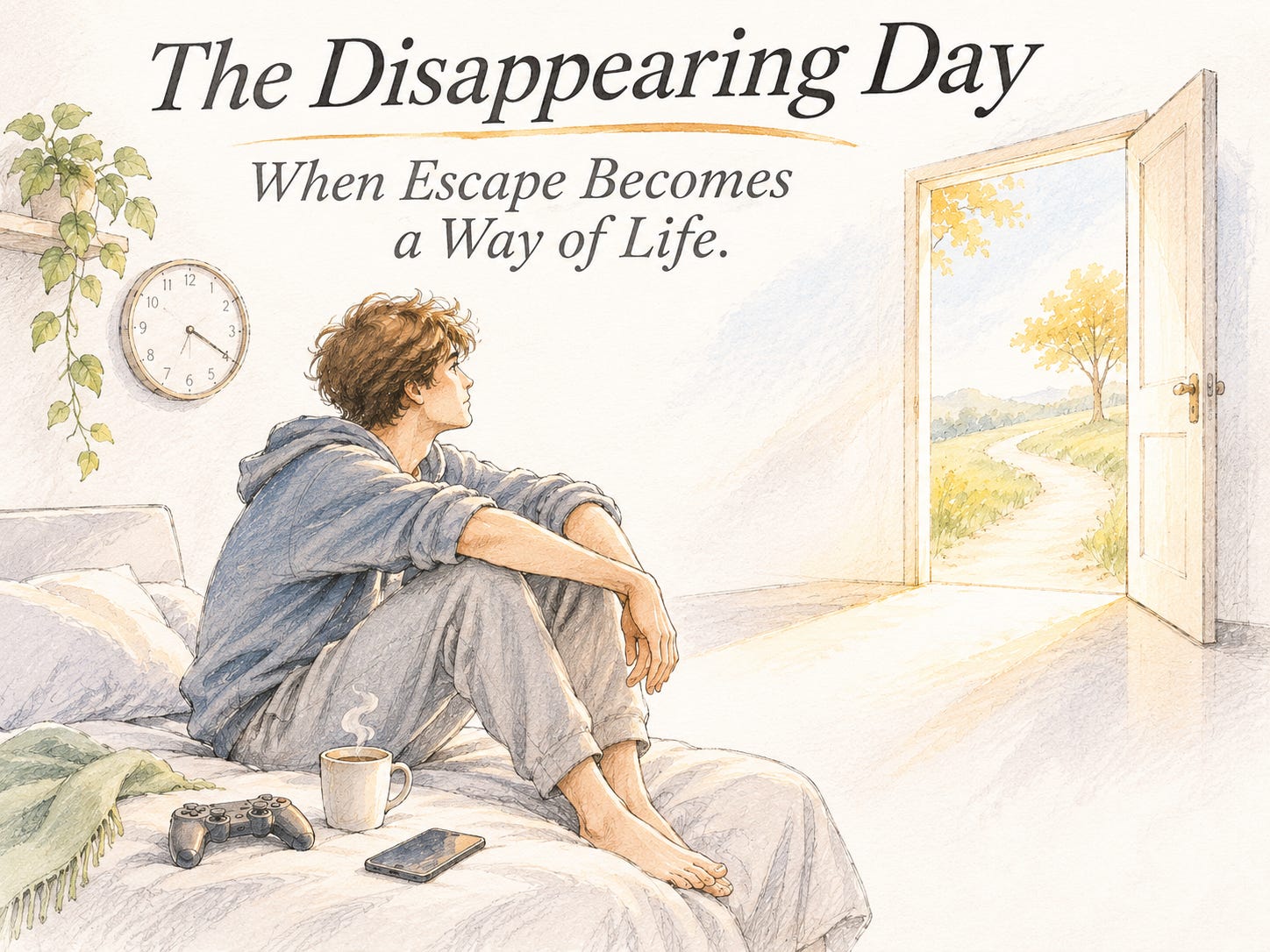
It doesn’t happen all at once.
An hour playing a video game becomes three. A little cannabis to relax becomes part of the daily routine. A few drinks help take the edge off. Another video, another episode, another online distraction, and suddenly it’s time to go to bed.
Tomorrow will be different.
Tomorrow there will be job applications, exercise, phone calls, household responsibilities, and perhaps an effort to reconnect with the world outside.
But tomorrow arrives with the same uncertainties and frustrations as yesterday. And the familiar activities are still there, ready to provide another few hours of relief.
Days become weeks. Weeks become months. Sometimes years pass.
From the outside, it looks like someone has stopped trying. But what if the things that make life more bearable today are gradually making it harder to build the life he wants tomorrow?
That’s the question I want to explore in this installment of The Lost Launch.
The Comfort of an Easier World
We’ve spent much of this series examining young men who are intelligent, educated, compassionate, and knowledgeable about the world yet struggle to establish careers, relationships, financial independence, and a sense of belonging.
Now consider the alternatives available to them.
In a video game, you can develop skills, complete objectives, earn recognition, and experience progress. Online communities provide friendships and shared experiences without requiring you to leave home.
Entertainment is available around the clock. Social media offers an endless stream of information and stimulation. Pornography provides sexual stimulation without the uncertainties of dating and intimacy. Gambling offers the possibility of a financial windfall without the long, uncertain process of building a career.
Alcohol and cannabis can provide temporary relief from anxiety, frustration, boredom, or emotional distress.
Each offers something different. Each has its own benefits, risks, and consequences. And many people enjoy these activities without experiencing serious problems.
But there’s a distinction between enjoying something and increasingly relying on it to get through the day.
The concern begins when immediate comfort consistently takes precedence over relationships, responsibilities, health, and opportunities to build a more satisfying life.
What happens when escaping the life you have becomes easier than working toward the life you want?
When Relief Becomes Another Obstacle
Imagine someone who is already discouraged about employment.
Applying for work means confronting uncertainty. He has to present his qualifications, explain gaps in employment, risk rejection, and perhaps begin questioning whether he’s capable of succeeding.
An afternoon gaming or watching videos offers a different experience. He understands the environment, knows what to expect, and can control much of what happens.
He feels competent. He experiences progress.
Meanwhile, the job application remains unfinished.
The next day, the unfinished application becomes another source of anxiety. Avoiding it provides temporary relief, making avoidance more appealing the next time.
Psychologists recognize this pattern as a form of negative reinforcement: avoiding an uncomfortable experience reduces distress in the short term, which can strengthen the tendency to avoid it again.
The original problem remains, but the emotional burden of confronting it can grow.
This isn’t evidence that gaming or entertainment caused the employment difficulty. The struggle may have existed long before the avoidance developed.
But the relationship can become self-reinforcing.
A person who feels increasingly unsuccessful in everyday life may spend more time in activities where he feels competent, comfortable, or temporarily relieved.
The fewer opportunities he has to experience success outside those activities, the more difficult it can become to change his routine.
And a day can disappear without anyone making a conscious decision to give up on the future.
Alcohol: The Escape We Barely Question
Alcohol has been woven into our social lives for generations.
We drink to celebrate, relax, socialize, relieve stress, and mark the end of a difficult day. Alcohol advertising has long connected drinking with friendship, excitement, success, and enjoyment.
Yet alcohol is a psychoactive drug with well-established effects on judgment, sleep, mood, and health.
According to the National Institute on Alcohol Abuse and Alcoholism, alcohol can temporarily relieve anxiety while contributing to greater anxiety over time, particularly with repeated heavy drinking or withdrawal. Alcohol also disrupts normal sleep physiology, even when someone believes drinking helps him fall asleep.
That’s an important distinction.
Someone who uses alcohol to unwind may feel better for a few hours while unintentionally making the next day more difficult.
Poor sleep affects concentration, energy, emotional regulation, and the ability to manage stressful situations. Those are precisely the abilities someone struggling with employment or social confidence needs to strengthen.
Alcohol use disorder is a medical condition, not a character defect. Its severity varies, and effective treatments are available.
But we should be examining the role alcohol plays long before severe dependence develops.
When does a drink after a difficult day become the way someone manages every difficult day?
And when does temporary relief begin interfering with the ability to address the problems that made relief necessary?
Cannabis: Legal, Available, and Increasingly Normal
Cannabis deserves equally serious examination.
As legalization has expanded across states, cannabis has become more accessible, commercially promoted, and socially accepted.
The products available today also differ considerably from what many older adults remember.
Modern cannabis includes concentrated oils, vaping products, edibles, and high-THC preparations that can deliver substantially greater doses than traditional plant products.
According to the CDC, frequent cannabis use and products with higher THC concentrations can increase the risk of cannabis use disorder. Cannabis can also affect attention, memory, learning, and emotional functioning.
The 2025 National Survey on Drug Use and Health estimated that 14.1% of Americans ages 18–25 had experienced cannabis use disorder during the preceding year.
That doesn’t mean most cannabis users have a disorder. Nor does it mean cannabis is responsible for every young adult’s lack of motivation.
But neither should we dismiss the potential effects of frequent use simply because cannabis has become more socially acceptable.
A young person using cannabis to manage anxiety, loneliness, or boredom may experience temporary relief without resolving the underlying problem.
For some, frequent use becomes part of a cycle involving disrupted routines, reduced concentration, difficulty sleeping without the substance, or increasing withdrawal from activities.
For others, substance use may be a consequence of an existing mental health problem rather than its original cause.
We need to examine those differences rather than assume everyone who uses cannabis is experiencing the same effects.
And we need to ask what happens when commercially promoted products become everyday coping tools for people who already feel disconnected from meaningful opportunities.
Gaming: A World Where Progress Is Possible
I don’t think we should underestimate what gaming provides.
Modern games can be intellectually challenging, creative, cooperative, competitive, and deeply social. Players develop strategies, solve problems, work with teams, form friendships, and achieve increasingly difficult objectives.
For someone struggling to find success elsewhere, those experiences can be especially meaningful.
A person who feels incompetent during a job search may experience genuine competence in a game. Someone who has difficulty meeting people in person may have longstanding online friendships.
Those relationships and accomplishments shouldn’t be ridiculed.
But the World Health Organization recognizes gaming disorder when impaired control, increasing priority given to gaming, and continued gaming despite negative consequences result in significant impairment.
The WHO also emphasizes that gaming disorder affects only a small proportion of people who play.
The question isn’t whether gaming is inherently harmful.
It’s whether gaming has become so central to someone’s life that activities he wants or needs to pursue are repeatedly displaced.
What happens when all the measurable achievements are inside a game while progress toward employment, relationships, and independence remains stalled?
And what can we learn from the qualities that make games engaging—clear objectives, achievable challenges, useful feedback, belonging, and visible progress?
Perhaps some of those same elements are missing from the paths we’re offering young adults into employment and independence.
Pornography, Gambling, and Other Forms of Escape
Pornography and online gambling raise different questions, and they deserve separate investigations.
Pornography is widely accessible, private, and available without the emotional vulnerability involved in developing an intimate relationship. For some people, its use is unproblematic. For others, persistent patterns that feel difficult to control can interfere with relationships, responsibilities, or emotional well-being.
We need to distinguish those experiences and examine the evidence without turning sexuality into another source of shame.
Gambling presents a more clearly established financial danger.
Online sports betting and casino platforms bring wagering into ordinary daily life. Gambling disorder is a recognized condition involving impaired control, increasing priority given to gambling, and continued participation despite harm.
Unlike many other forms of entertainment, gambling can destroy financial security while offering the illusion that one more successful wager will solve the problem.
And we shouldn’t overlook the appeal of financial speculation, whether involving stocks, cryptocurrency, or other assets. Investing and gambling aren’t the same thing, but speculative behavior can become harmful when someone repeatedly risks money in pursuit of excitement, escape, or quick financial rescue.
The boundaries between entertainment, coping, excessive use, and clinically recognized disorders matter.
They also make one question especially important: when someone repeatedly turns to a particular activity for relief, what is happening elsewhere in his life?
When the Risks Become Deadly
We also need to address harder drugs, including opioids, illicit stimulants, and counterfeit prescription pills.
These present dangers that go well beyond losing time or postponing responsibilities.
The Drug Enforcement Administration’s October 2026 report on counterfeit pills documented the continuing danger of tablets manufactured to resemble legitimate medications while containing fentanyl or other hazardous substances.
A person purchasing what appears to be a prescription medication outside a legitimate pharmacy may not know what the pill contains.
This is not simply another version of spending too many hours gaming or watching videos. The consequences can be immediate and fatal.
Substance use disorders require appropriate medical care, and overdose prevention, including access to naloxone, saves lives.
We will examine these risks more thoroughly in a separate article because they deserve focused attention rather than being lost within a general discussion of everyday habits.
Who Profits When We Keep Coming Back?
Here’s where this conversation connects to the larger mission of @DomesticAssault.
Behind many of these products and platforms are enormous commercial interests.
Alcohol manufacturers, cannabis businesses, gambling operators, gaming companies, pornography platforms, and social media companies have different products, business models, and legal obligations.
But many depend on repeat customers, sustained engagement, or continued consumption.
Some businesses employ sophisticated research, advertising, recommendation systems, rewards, and product design to encourage people to return.
There’s nothing inherently wrong with a business wanting satisfied customers.
But what responsibility does a company have when its profits increasingly depend on excessive consumption or behavior that harms vulnerable people?
When does encouraging engagement become exploitation?
What obligations do governments have to regulate potentially harmful products, require accurate information, restrict deceptive marketing, and ensure access to treatment?
And why do families so often become responsible for managing the consequences of problems they neither created nor have the resources to resolve?
We need to examine who makes money from the escape, who pays for the damage, and who is responsible for preventing it.
That is precisely the kind of institutional accountability Domestic Assault is meant to explore.
The Young Man Who Wants More
There’s a principle I keep returning to throughout The Lost Launch, inspired by Rosamund Stone Zander and Benjamin Zander’s The Art of Possibility.
These young men want meaningful lives. They want independence, happiness, relationships, accomplishment, and a sense of purpose.
Nobody wants those things more for them than they want them for themselves.
A young man who spends much of his day gaming, drinking, using cannabis, or pursuing other distractions hasn’t necessarily stopped wanting a better future.
He can want that future desperately while struggling to find a way out of the routines that have become familiar and comforting.
And he may be deeply ashamed of the amount of time that has passed.
Imagine wanting to change your life, waking up every morning intending to do something different, and repeatedly reaching the end of the day feeling that you’ve accomplished nothing.
Now imagine someone reminding you of your failures, questioning your character, or telling you how much better your life would be if you simply tried harder.
Does that create confidence?
Or does it make another few hours of escape even more appealing?
We need to understand what is sustaining the behavior, including the possibility of anxiety, depression, substance dependence, disrupted sleep, loneliness, or difficulty organizing daily activities.
And we need to listen to the person living through it.
Rebuilding a Day Before Rebuilding a Life
One of the most useful ideas from my years in nursing and wellness coaching is that change becomes more manageable when we stop trying to transform everything at once.
Someone who feels overwhelmed by the prospect of establishing a career, moving out, developing friendships, and becoming financially independent may find those goals almost impossible to approach.
But a day provides a smaller, more manageable place to begin.
What would make tomorrow slightly better than today?
Perhaps it’s establishing a consistent waking time, getting outside, taking a walk, preparing a meal, completing one necessary task, contacting someone, or spending a short period working toward a personally meaningful goal.
For someone experiencing problematic substance use, that first step may be talking with a healthcare professional or arranging an assessment. Significant alcohol dependence can make abrupt withdrawal medically dangerous, so changes in drinking need appropriate medical guidance.
For someone spending excessive time gaming or online, the answer may involve developing meaningful activities outside the screen rather than simply removing an important source of enjoyment and connection.
The goal isn’t to impose a schedule that someone else believes he should follow.
It’s to help him regain a sense of ownership over his time.
A person who begins experiencing success in small, meaningful ways has something to build on.
Progress doesn’t have to begin with a dramatic announcement, a new career, or an ultimatum.
Sometimes it begins with a better morning.
And another one after that.
Love Your Sons. Don’t Shame Them for Struggling.
Parents need boundaries. They have every right to protect their homes, financial security, and emotional well-being.
A parent doesn’t have to finance alcohol, cannabis, gambling, or other activities that are causing harm. Nor should a family be expected to tolerate threatening or abusive behavior.
But setting boundaries is different from humiliating someone or abandoning him because his progress doesn’t match our expectations.
Tough love should help someone develop responsibility, not strip away the dignity he needs to rebuild his life.
Mothers in particular can find themselves caught between concern for a struggling adult child and criticism from relatives who insist the solution is simply to throw him out.
That pressure can be exhausting, especially when the mother has spent years trying to understand the circumstances and encourage progress.
Love doesn’t mean ignoring addiction, excusing harmful behavior, or pretending that everything is fine.
It means refusing to confuse punishment with treatment, judgment with understanding, or anger with an effective plan.
And it means remembering that a person is far more than the habits or difficulties currently dominating his life.
A Health for Life Perspective
These questions also connect to the work I’ve been developing at TotalWellCoach.com through my Health for Life and other articles.
Sleep, nutrition, physical activity, emotional health, daily routines, and meaningful relationships influence our ability to function and make changes.
When those foundations begin to deteriorate, the effects can reach into employment, motivation, family relationships, and independence.
My approach to wellness coaching begins with understanding the whole person, identifying realistic opportunities for improvement, and helping people develop changes they can take ownership of.
For readers looking for practical health ideas or interested in discussing coaching options, I invite you to explore TotalWellCoach.com.
Coaching can complement medical and mental health care. It isn’t a substitute for addiction treatment, psychiatric care, or professional evaluation when those services are needed.
The goal is to help people discover what is possible and begin taking meaningful steps toward healthier, more satisfying lives.
The Disappearing Day
I keep thinking about how quietly time can slip away.
A young man doesn’t wake up one morning and decide to spend the next five years going nowhere.
He starts with an ordinary day.
Perhaps he’s discouraged, anxious, lonely, uncertain about employment, or frustrated that life hasn’t unfolded as expected.
He finds something that makes the day easier.
Then he does it again.
Eventually the routines become familiar, and the unfamiliar world outside feels increasingly difficult to enter.
We can criticize those routines, argue about what caused them, and demand that he change. But unless we understand what they’re providing and what is preventing him from moving forward, we’re unlikely to accomplish much.
We also need to recognize the industries, institutions, and economic circumstances influencing the choices available to him.
This isn’t simply a question of individual willpower.
It’s a question of health, opportunity, motivation, belonging, and the ability to imagine a future worth working toward.
Love your sons. Anger is not the answer. Trust that they want to succeed.
And when another day disappears, don’t begin by asking why he wasted it.
Ask what would make tomorrow worth getting up for.
Because the most important thing we can help him recover isn’t yesterday’s lost time. It’s the belief that tomorrow can be different.
Join the Conversation
The Lost Launch is an ongoing series on @DomesticAssault exploring the circumstances affecting young American men and the families supporting them.
Have you watched someone become increasingly dependent on gaming, alcohol, cannabis, gambling, or other forms of escape? Have you experienced that pattern yourself?
What helped restore a sense of purpose, confidence, or control over daily life? What approaches made things worse?
I’m particularly interested in hearing from young adults, parents, healthcare professionals, counselors, educators, and people with lived experience of addiction or recovery.
Share your experiences and ideas in the comments. We need thoughtful conversations that replace stereotypes with understanding and open the door to better solutions.
Subscribe to DomesticAssault.com to follow The Lost Launch, and please share this article with others who might benefit from the discussion.
If you or someone you love needs support for a substance use disorder, FindTreatment.gov provides a confidential treatment locator. In the United States, call or text 988 for an immediate mental health or substance use crisis.