


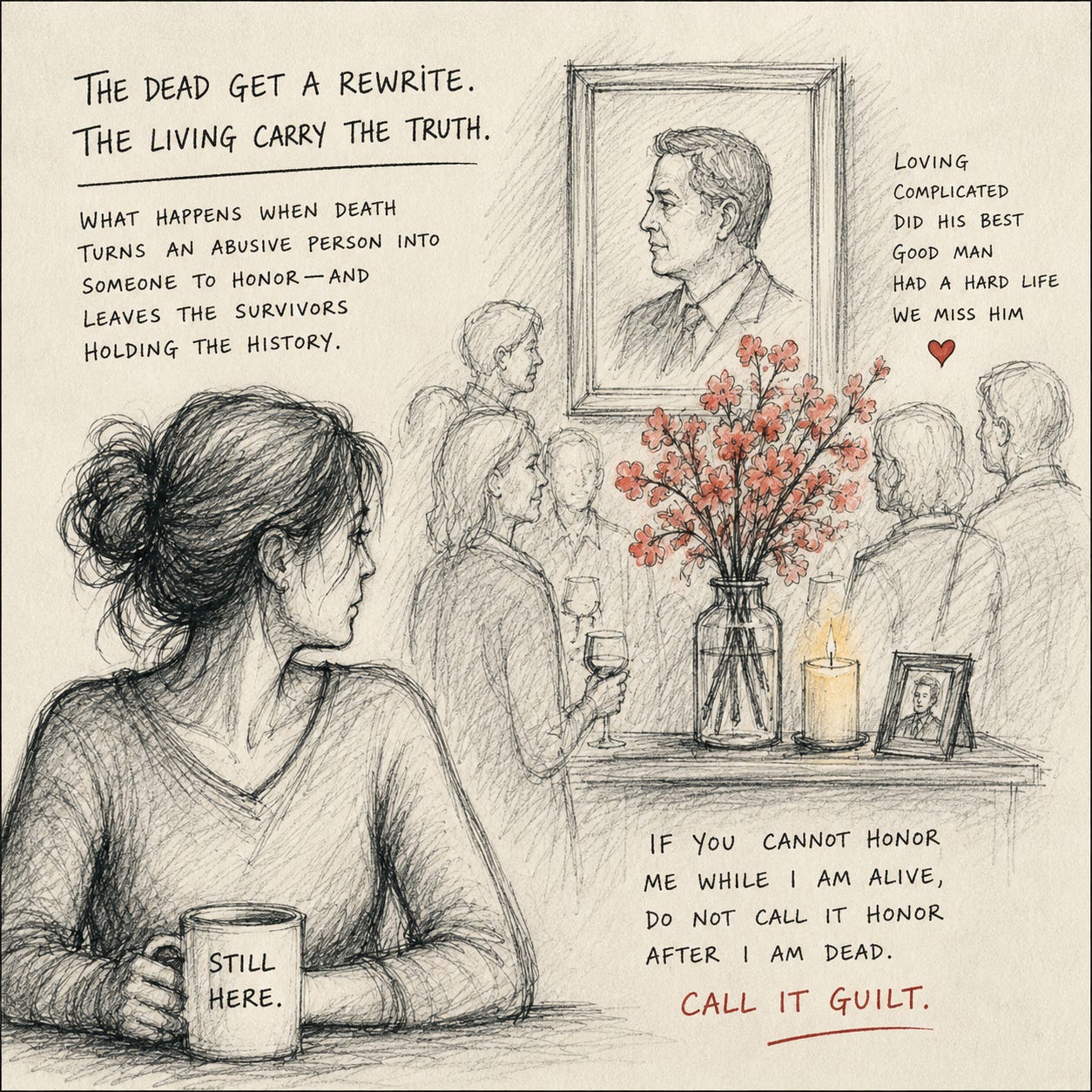
There is something deeply unsettling about the way death can rearrange a family story.
An abusive person dies, and over time the edges begin to soften. The cruelty becomes “complicated.” The fear becomes “a difficult time.” The damage gets folded into a larger story about who that person was supposed to have been.
And sometimes, little by little, the person who actually existed disappears.
In their place comes the parent, partner, or family member someone wished they had. The person they wanted to believe in. The person who was loving underneath it all. The person who “did the best they could.”
Maybe sometimes that is true. Sometimes it is not.
What can be painful to watch is not simply that someone remembers the good. People are allowed to remember good moments. They are allowed to love someone who hurt them. They are allowed to grieve someone complicated.
What hurts is when remembering becomes rewriting.
Because someone else usually remembers the whole story. Someone remembers the fear in the room, what had to be managed, covered for, explained and survived. Someone remembers who carried the bills, the children, the fallout, the embarrassment, the repair work and the responsibility.
That history does not disappear because the person who caused much of it is dead.
But families sometimes act as if it should.
There is something strange about how easy it can become to honor the dead while withholding tenderness from the living. The dead ask nothing of us. They do not call at the wrong time. They do not have needs. They do not contradict the version of events we have decided to live with.
The living are harder.
The living still need patience. They still want to be known. They still remember things differently. They may still want to talk about what happened, or simply be treated with some kindness while there is still time.
That is where this gets especially painful.
Because sometimes the person who caused the damage becomes easier to cherish once they are gone, while the person who stayed, survived and carried what was left behind becomes the easier person to blame.
Maybe that is because the living are still available.
Anger can still be directed at them. Distance can still be created from them. They can still be misunderstood, resented, dismissed or reduced to whatever role the family needs them to play.
The dead cannot push back.
So the dead get a cleaner story. The living get the consequences.
There is nothing wrong with loving someone who hurt you. There is nothing wrong with missing them. There is nothing wrong with holding onto the parts of them that were good.
But love does not require lying to yourself, and grief does not require rewriting history.
You can say: I loved this person, and this person hurt me. You can miss what you had while also mourning what you never had. You can wish the story had been different without pretending that it was.
What you cannot do, at least not without hurting someone else, is turn the dead into the person you needed them to be and then expect the living to silently carry the truth.
That is its own kind of cruelty.
And there is another piece of this that matters.
Honor people while they are alive.
If someone is still here, still reachable, still capable of hearing “I love you,” then that matters more than any tribute you may someday write.
If you dismiss someone while they are alive, distance yourself from them, blame them, make no room for them, and then honor them after they die, that is not honor.
That is guilt.
And if you rewrite the dead into who you needed them to be, that does not change who they were.
It only leaves someone else carrying what actually happened.
Join My Community
Domestic abuse does not necessarily end when the relationship ends, or even when the abuser dies. It can live on in families, memories, silence, blame and stories that get rewritten because the truth is harder to live with.
That is part of what I want this community to talk about: not only surviving abuse, but understanding what comes afterward—the things that are rarely said out loud and the experiences that can leave people wondering if anyone else understands.
If something here feels familiar, you are not the only one carrying it.
Join my community. Read, share your experience when you want to, listen when you don’t, and help make room for the truths families too often leave unspoken.