


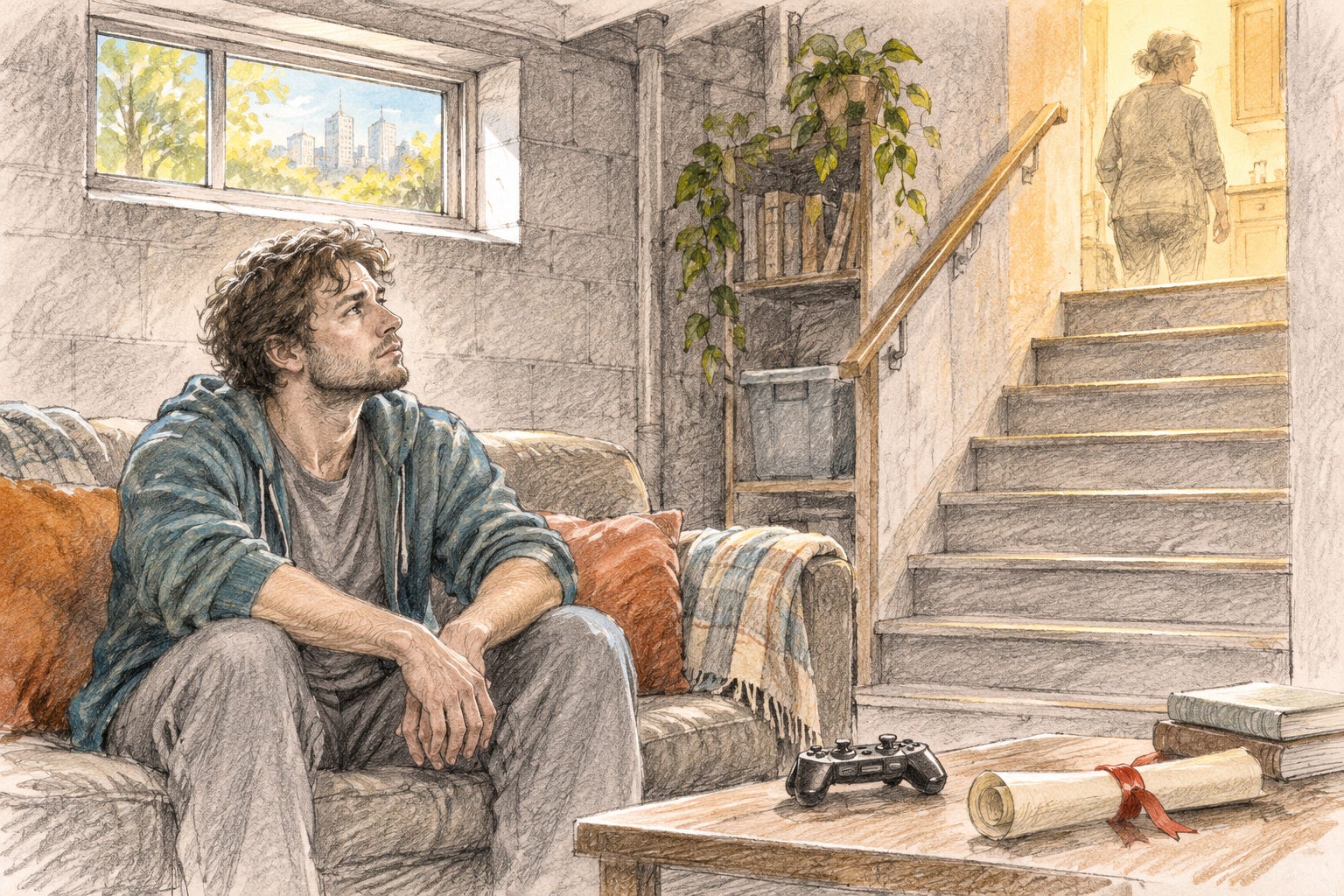
We’ve all heard the joke.
A grown man living in his parents’ basement, playing video games, eating their food, sleeping until noon, and showing little apparent interest in becoming a productive member of society.
Politicians use him as a warning. Commentators turn him into a punchline. Older generations shake their heads and wonder what happened to the American work ethic.
Get off the couch. Put down the controller. Get a job.
Simple enough.
Except it isn’t.
What if that young man has an engineering degree but hasn’t been able to establish a career?
What if he has exceptional practical abilities but struggles with learning disabilities, anxiety, or obsessive-compulsive disorder?
What if his childhood was marked by divorce, parental abandonment, financial instability, or years of emotional upheaval?
What if he’s intelligent, capable, increasingly isolated, and angry about a future that seems to be slipping away?
What if alcohol or cannabis has become part of his daily routine, offering temporary relief while potentially making it harder to move forward?
And what happens when his parents, now approaching retirement themselves, are still providing the financial and emotional support he needs to survive?
Who failed whom?
It’s a question we should be asking much more seriously.
Because this isn’t simply a story about young men who haven’t launched.
It’s a story about what happens to individuals, families, and entire communities when the pathways into adulthood begin to break down.
We Raised Them for a World That Kept Changing
Generation Z, commonly called the Zoomers, generally includes those born between 1997 and 2012. Their slightly older siblings belong to the youngest Millennials.
But the boundary between generations isn’t nearly as important as the circumstances in which they grew up.
For generations, American children were told that education, hard work, and personal responsibility would lead to financial independence.
Go to school. Get a degree. Find a job. Buy a home. Build a family.
That was the promise.
Then the world changed.
The Great Recession destabilized families. Smartphones transformed childhood. Social media changed relationships, communication, and expectations. Video games became sophisticated online worlds offering competition, friendships, recognition, and achievement.
The COVID-19 pandemic interrupted education, employment, and social development.
Housing became increasingly expensive. Educational credentials didn’t always translate into employment. Jobs changed or disappeared.
Now artificial intelligence is transforming the workplace before many young adults have established careers.
An August 2026 Stanford study found that employment among workers ages 22–25 in occupations highly exposed to AI was 19% below the level expected if it had kept pace with employment in less-exposed occupations.
The researchers found no widespread, economy-wide displacement, and their findings don’t establish that AI caused the entire difference. But they identified reduced hiring of younger workers as an important part of the pattern.
Think about that.
We tell young people to get experience while the entry-level jobs they need to acquire it may be disappearing or changing.
Then we criticize them for failing to establish careers.
The Basement Has Become a Convenient Scapegoat
According to the Federal Reserve, 49% of Americans under 30 lived with a parent in 2025, compared with 37% in 2019.
That doesn’t mean nearly half of young adults are unemployed or unwilling to work. Many are employed, attending school, saving money, caring for relatives, or living in multigenerational households by choice.
But it does raise an important question about the changing economics of independence.
When a young adult wants to leave home but cannot afford to, is that primarily an individual failure?
When someone spends years earning a degree but cannot secure meaningful employment, should we simply tell him to try harder?
And when learning differences, mental health challenges, substance use, or years of discouragement complicate the situation, what does useful help actually look like?
Instead of investigating these questions, we often reduce the entire problem to a stereotype.
The boy in the basement.
Lazy. Entitled. Unmotivated.
It’s a remarkably convenient explanation.
If the problem is entirely his character, nobody else has to examine their role.
Government policymakers, employers, educational institutions, technology companies, and healthcare systems escape scrutiny.
And the families left dealing with the consequences are expected to solve everything themselves.
We Gave Them a Digital World and Then Blamed Them for Living in It
Consider how dramatically childhood has changed.
We created an enormous digital economy built around capturing attention.
Games offer measurable progress, rewards, competition, and social belonging. Online platforms provide entertainment, endless content, and opportunities to build entire identities around digital communities.
For some young men, these environments provide genuine friendships and meaningful achievement.
For others, they may become places to retreat when the outside world feels overwhelming or unrewarding.
And then there’s the GameStop generation.
In 2021, online communities of retail traders challenged powerful financial institutions, turning an ordinary video-game retailer’s stock into a national spectacle.
The episode helped popularize an online culture of meme stocks, cryptocurrency speculation, and dreams of rapid financial independence.
Why spend decades struggling to get ahead when someone on the internet appears to have made a fortune in a week?
We should examine how those promises influence young people navigating an economy in which traditional financial security can feel increasingly distant.
Who profits from their attention?
Who benefits from their trading activity?
Who benefits from online gambling, constant engagement, and technologies designed to keep users returning?
And who bears the costs when these activities displace employment, education, physical activity, or real-world relationships?
Technology isn’t inherently the enemy.
But neither should the industries shaping young people’s behavior escape scrutiny.
When the Brain Doesn’t Fit the System
Not every young adult who struggles to establish independence lacks ambition.
Some have learning disabilities, ADHD, autism, obsessive-compulsive disorder, anxiety, depression, addiction or other conditions that make conventional career development more difficult.
A person may be intelligent enough to complete a demanding college program yet struggle with interviews, executive functioning, workplace communication, or the uncertainty of seeking employment.
Another may be resourceful and mechanically gifted but have difficulty with academic requirements or organizational demands.
These are different conditions, and they affect individuals differently.
Yet we frequently judge people’s capabilities by their ability to function within systems that offer limited flexibility.
Repeated rejection can erode confidence. Anxiety can interfere with attempts to move forward. Isolation can deepen the problem.
And from the outside, the result may look like someone who simply isn’t trying.
How many people are being judged for their apparent lack of effort when the real barriers have never been adequately identified or addressed?
Alcohol, Cannabis, and the Quiet Escape from Adulthood
We need to talk about alcohol and cannabis.
They’re widely available, socially accepted in many settings, and legal for adults under various state laws.
But legal doesn’t necessarily mean harmless.
What happens when a young man already struggling with employment, anxiety, isolation, or a loss of purpose begins using alcohol or cannabis regularly?
Perhaps alcohol helps him relax at the end of another disappointing day.
Perhaps cannabis temporarily makes his anxiety feel manageable.
Perhaps gaming, drinking, or getting high becomes the routine around which his days are organized.
And perhaps the routine itself makes change increasingly difficult.
According to the 2025 National Survey on Drug Use and Health, 13.1% of Americans ages 18–25 had experienced an alcohol use disorder during the previous year.
Another 14.1% met the criteria for cannabis use disorder.
These figures don’t mean every young person who drinks or uses cannabis has a problem. But they demonstrate why substance use deserves serious attention.
Alcohol can disrupt sleep, worsen anxiety and depression, impair judgment, and contribute to dependence.
Cannabis can affect attention, memory, learning, decision-making, and emotional functioning. Frequent use and high-potency THC products raise additional concerns about dependence and mental health.
And the relationship between substance use and emotional distress can run in both directions.
A person may drink or use cannabis because he feels anxious, discouraged, or unable to cope.
But continued use may interfere with the concentration, organization, sleep, emotional stability, and consistency he needs to improve his situation.
What begins as relief can become another obstacle.
This doesn’t mean cannabis automatically causes laziness or alcohol explains why someone hasn’t established a career.
It means we need to investigate the interaction between substance use, mental health, motivation, daily routines, and independence.
We also need to follow the money.
Alcohol is a major commercial industry. Cannabis has become an expanding legal marketplace in many states, with sophisticated products, marketing, and increasingly concentrated forms of THC.
Who is examining the consequences of normalizing frequent consumption?
How adequately are consumers informed about the risks?
And who pays when substance use begins interfering with employment, relationships, or independent living?
Families often recognize the problem long before they know how to address it.
One person sees someone who needs treatment.
Another sees someone who simply refuses to grow up.
And once again, the family becomes a battleground.
The Fathers Who Left and the Mothers Who Stayed
There is another part of this investigation that cannot be ignored.
The changing American family.
What happens to children when a parent leaves, becomes emotionally unavailable, or fails to contribute financially?
What happens when the remaining parent must provide income, housing, guidance, discipline, emotional stability, and support without a dependable partner?
Parental absence doesn’t determine a child’s future. Many children raised by single parents or extended families thrive.
But neither should we dismiss the consequences of financial insecurity, family conflict, disrupted relationships, and childhood adversity.
And we should examine something else.
The parent who leaves may eventually become a distant memory, sometimes preserved through affection, nostalgia, or idealization.
The parent who stays remains visible.
Every mistake, every decision, every argument, and every disappointment becomes part of the family’s history.
Sometimes the absent or deceased parent is remembered primarily for what was loved or missed.
Meanwhile, the parent who shouldered the daily responsibilities continues to face judgment for everything that went wrong.
The absent parent may become a cherished memory. The present parent remains the one everyone holds accountable.
How does that unequal accounting shape family relationships?
And why do we so often overlook the financial, emotional, and personal sacrifices of the parent who stayed?
When Older Siblings Become the Judges
Here’s another family dynamic that deserves attention.
Imagine several children raised by the same mother.
The older children establish careers, become financially independent, and build successful adult lives.
The younger children struggle.
Now the older siblings begin asking why their brothers haven’t accomplished what they did.
They worked hard. They overcame obstacles. They became independent.
Why can’t their younger siblings do the same?
Their frustration may be understandable. They may worry about their parents’ finances, fear becoming responsible for their siblings, or believe continued support is making matters worse.
But somewhere along the way, concern can become contempt.
And the parent becomes the target.
She’s enabling them.
She’s making excuses.
She’s responsible for their failure to launch.
Yet when the older children succeeded, was she credited for raising capable, independent adults?
Or does the mother become responsible only when one of her children struggles?
How convenient that the same parent can be irrelevant to her children’s successes and entirely responsible for their failures.
Children raised in the same family don’t necessarily experience the same childhood.
Birth order, family finances, parental relationships, individual temperament, developmental challenges, and the economic conditions awaiting them in adulthood can differ substantially.
An older sibling who entered the workforce under one set of conditions may have little understanding of the obstacles facing a younger sibling years later.
But the consequences of judgment extend well beyond hurt feelings.
Older siblings may distance themselves. Younger siblings may become defensive or resentful. Family gatherings turn into confrontations. Parents become trapped between defending vulnerable adult children and maintaining relationships with the others.
Support systems begin to fracture precisely when they may be needed most.
Sometimes the resulting estrangement becomes another enduring family injury.
When one adult child cannot find a path forward, how do we keep the entire family from falling apart?
The Parents Who Cannot Retire
We also need to follow the money.
What happens when parents provide financial assistance for decades longer than they anticipated?
Housing. Food. Utilities. Insurance. Transportation. Education. Healthcare.
Some parents make substantial sacrifices to help young adults establish themselves.
They may postpone retirement, deplete savings, take on debt, or forgo opportunities to secure their own futures.
These sacrifices aren’t always visible.
A family member may see an adult child receiving inexpensive housing without recognizing the parent’s mortgage payments, property taxes, maintenance expenses, financial risks, or lost investment opportunities.
Generosity can become an expectation.
And when the parent reaches a point where continued support is difficult or unsustainable, the family may disagree bitterly about what should happen next.
Some relatives demand that the adult child be forced out.
Others believe support should continue.
The parent providing the housing and paying the bills is left managing the practical consequences.
It is easy to declare what someone else should do with their adult children.
It is considerably harder to live with the consequences of that decision.
And what happens when the parent dies?
Who takes responsibility for an adult child who has never achieved financial independence?
Are siblings prepared to help?
Are adequate community services available?
Or does the family crisis simply become someone else’s emergency?
When Anger, Loneliness, and Despair Take Over
We also need to examine what prolonged uncertainty and dependency can do to emotional health.
Some young men withdraw.
Some become angry.
Some lose confidence, friendships, and hope.
Others find online communities that help them feel understood, while some encounter influencers who encourage resentment and hostility.
We shouldn’t assume that every angry or isolated young man is depressed, or that everyone who plays video games is psychologically unwell.
But we cannot ignore the warning signs.
According to CDC figures for 2024, the suicide rate among American men ages 25–44 was 28.5 deaths per 100,000. Among males ages 15–24, it was 20.2.
Both rates declined from 2023, but the numbers remain deeply concerning.
And suicide is only one part of a larger health picture.
The illicit drug supply has become extraordinarily dangerous.
The CDC estimated 69,973 drug overdose deaths in 2025, even after a substantial decline from the previous year.
Fentanyl, counterfeit prescription pills, methamphetamine, cocaine, and other substances introduce risks that go well beyond the effects of alcohol or cannabis.
A counterfeit pill can contain an unexpected opioid. Combining substances can increase impairment and other health risks. People may underestimate the danger because they don’t know what they’re consuming.
We cannot treat every substance as equally dangerous, but neither can we ignore the cumulative risks when substance use, emotional distress, unemployment, and social isolation intersect.
These problems cannot be traced to one cause.
But they deserve attention long before a family reaches a crisis.
What happens when a young man has lost his sense of purpose, feels judged by the people closest to him, and sees no clear pathway toward independence?
And what should families, healthcare providers, communities, and government do before despair becomes deadly?
Who Taught Them That Cheating Is the Way to Get Ahead?
There’s another part of this story that may be even more disturbing.
The example set by the people who hold power.
We tell children to tell the truth, honor their commitments, work hard, respect others, and accept responsibility for their actions.
Then they grow up watching a world in which those principles can appear negotiable.
Political leaders accused of corruption remain influential. Corporations that violate rules may treat penalties as costs of doing business. Financial markets reward sophisticated players who understand how to exploit advantages unavailable to ordinary investors.
And some of the most visible examples of extraordinary wealth come from speculation, inherited privilege, connections, and carefully manufactured online images of success.
Honest work still matters. Many people achieve success through talent, persistence, and integrity.
But what happens when young people begin to question whether those qualities are enough?
What happens when they see people breaking promises, escaping accountability, or benefiting from questionable conduct while ordinary families struggle to pay their bills?
We should be deeply concerned about the message that sends.
What happens when young people begin to believe that cheating is the only way to get ahead?
We need to examine how political leadership, institutional accountability, financial inequality, and public trust influence younger generations.
The argument isn’t that one politician or one government caused an entire generation’s difficulties.
The question is what kind of moral example our institutions provide—and what happens when the expectations imposed on ordinary people appear very different from those applied to the powerful.
We cannot expect young people to develop faith in responsibility while treating accountability as optional for those at the top.
And we cannot overlook the connection between private and public failures of responsibility.
A father who abandons his obligations leaves others carrying the costs.
An institution that evades accountability may do the same thing on a much larger scale.
The circumstances differ enormously, but the underlying moral question remains:
Who is allowed to walk away, and who is left paying the price?
Why This Investigation Belongs in Domestic Assault
Domestic assault doesn’t begin and end with physical violence.
Families can suffer profound harm through abandonment, neglect, financial deprivation, coercive control, emotional cruelty, and the consequences of institutions failing to meet their responsibilities.
Those harms can echo across generations.
A father walks away from his financial and emotional responsibilities. A mother remains to raise the children, pay the bills, and manage the consequences.
Years later, when some of those children struggle to establish independent lives, who gets blamed?
Sometimes the parent who stayed.
Meanwhile, government and corporate institutions may make decisions that place additional pressures on families already stretched to their limits.
Employers restructure. Healthcare becomes difficult to navigate. Housing costs rise. Digital platforms compete for attention. Public leaders offer moral judgments while avoiding difficult questions about their own responsibilities.
The burdens fall on individuals and households.
But what happens when the household can no longer absorb them?
What happens when an adult child’s struggles become ammunition for blame, humiliation, and family division?
What happens when siblings turn against one another, aging parents sacrifice their financial security, and the family support system collapses?
We must distinguish ordinary family disagreements, economic hardship, and genuine abuse. They are not interchangeable.
But we also need to recognize that harm can accumulate quietly, long before anyone identifies a crisis.
Domestic Assault examines what happens when power, responsibility, and accountability become dangerously unequal—within families and across the institutions that shape their lives.
The common thread is the abandonment of responsibility by people or institutions that have the power and obligation to exercise it.
And perhaps the most troubling question of all is this:
How do we teach our children that honesty, responsibility, and hard work matter when the world around them so often appears to reward the opposite?
That’s why The Lost Launch belongs in Domestic Assault.
Who Benefits? Who Pays?
Two questions will guide this investigation.
Who benefits?
Who benefits when technologies capture more of our attention?
Who benefits from financial products and online platforms that encourage speculative behavior?
Who profits from the commercialization of alcohol and cannabis?
Who benefits when employers reduce entry-level hiring?
Who benefits when public figures turn struggling young adults into convenient examples of personal failure rather than examining the conditions affecting their opportunities?
And who benefits when responsibility can be abandoned without meaningful consequences?
Who pays?
The young man whose education doesn’t lead to a career.
The adult struggling with anxiety or developmental challenges that interfere with employment.
The person whose substance use becomes another barrier to moving forward.
The children whose parents failed to provide dependable support.
The family providing years of financial and emotional assistance.
The mother watching her retirement security disappear.
The siblings whose relationships deteriorate.
And ultimately, a society losing the potential contributions of people who might flourish under different circumstances.
There is individual responsibility here, too.
Young adults have obligations to themselves and others. Financial assistance cannot continue indefinitely in every family. Parents need boundaries. Progress requires effort.
But shame isn’t a vocational rehabilitation program.
Ridicule isn’t mental healthcare.
And threatening to throw someone out of the house isn’t a substitute for understanding what has prevented that person from moving forward.
Introducing The Lost Launch
This article begins an ongoing investigation into the young men struggling to establish independence and the families living with the consequences.
We’ll examine the Zoomers and younger Millennials, employment, artificial intelligence, education, video games, social media, the GameStop generation, financial speculation, father absence, learning differences, anxiety, alcohol, cannabis, addiction, anger, loneliness, suicide, dangerous drugs, parental financial sacrifices, sibling resentment, and family estrangement.
We’ll also examine government accountability, corporate incentives, and the moral examples being set for younger generations.
We’ll challenge assumptions, examine the evidence, follow the money, and investigate how failures of personal and institutional responsibility can compound across generations.
And we’ll look for solutions.
What helps young people develop confidence, competence, meaningful work, and independence?
What helps families preserve relationships without sacrificing their own financial or emotional security?
And what would genuine accountability look like—from individual parents all the way to the institutions governing American life?
Because these young men are not disposable.
Their families are not inexhaustible safety nets.
And an entire generation deserves more serious consideration than another joke about a boy playing video games in his mother’s basement.
Before we decide who failed to launch, perhaps we should investigate who built the runway—and what happened to it.
Join the investigation.
Have younger family members faced obstacles their older siblings never encountered? Have alcohol, cannabis, gaming, or mental health difficulties become part of the struggle? Has disagreement over supporting an adult child divided your family?
What have you seen when someone with power or responsibility walks away, leaving others to manage the consequences?
Share your perspective in the comments.
Subscribe to Domestic Assault to follow The Lost Launch, an ongoing investigation into the forces shaping our families, our institutions, and our future.
And please share this article widely—on Substack, Facebook, Instagram, LinkedIn, and anywhere people are willing to have a serious conversation about what is happening to America’s young men.
The next generation deserves our attention.
This article breaks me. We have to be concerned about these young people. Add pornography to the big issues.
The truth is - we can’t handle the truth. Too complex, too hard, too expensive. In my generation young people formed communes and started from the basics. Could we start there lol