


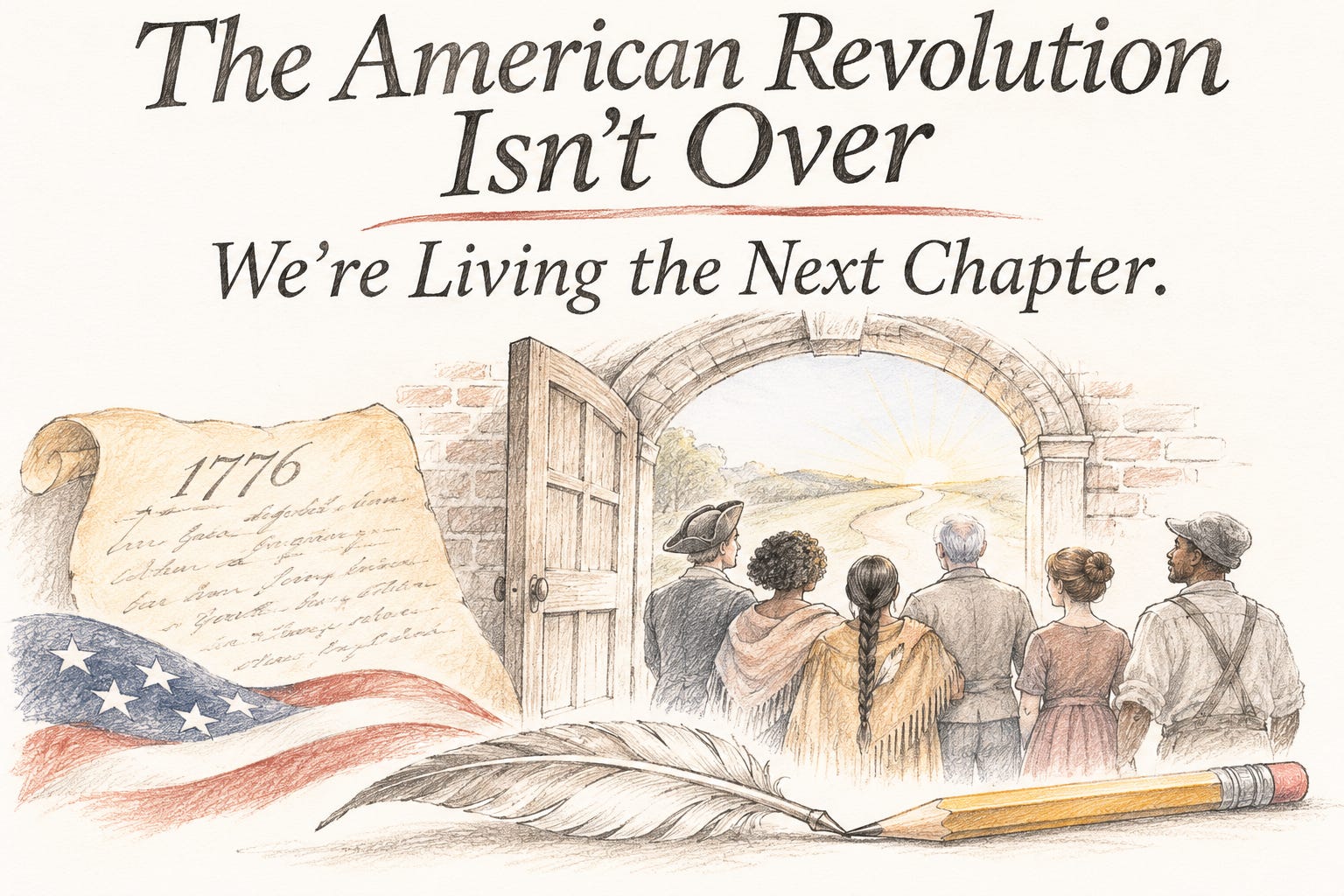
Sometimes I feel as though I’m watching the most extraordinary reality television series ever produced, except there are no actors, no rehearsals, and nobody knows how the story ends.
We’re living it.
Two hundred and fifty years after the Declaration of Independence, Americans are once again confronting fundamental questions about freedom, equality, constitutional government, the concentration of wealth, and the abuse of power.
We know what happened during the American Revolution. We know about the Declaration of Independence, the Constitution, the Civil War, emancipation, Reconstruction, women’s suffrage, and the civil rights movement.
We know the names of the people who helped shape those events. We know who prevailed in many of the battles, who suffered, and what consequences followed.
But the people living through those extraordinary times didn’t know how their stories would end.
Neither do we.
And I find that both frightening and exhilarating.
We’re not simply studying another consequential moment in American history. We’re participating in one.
The decisions we make, the abuses we tolerate, the truths we preserve, and the responsibilities we accept will become the history future generations inherit.
What will they say about us?
The Announcement That Gave Me Goosebumps
Recently, I listened to retired federal Judge J. Michael Luttig discuss a remarkable new initiative at Colonial Williamsburg.
His reverence for American constitutional history, his evident belief in the responsibilities of citizenship, and his enthusiasm for the possibilities ahead brought tears to my eyes.
I felt something I haven’t felt often enough during these difficult years: genuine excitement about what Americans might accomplish together.
Judge Luttig and his wife, Elizabeth, are providing a $10 million founding gift for the new National Institute for the Constitution and Civic Virtue at Colonial Williamsburg.
Constitutional scholar Jeffrey Rosen, former president and CEO of the National Constitution Center, will serve as the institute’s founding director. The Colonial Williamsburg Foundation, led by President and CEO Carly Fiorina, is undertaking a much larger investment in historical interpretation and civic education as it enters its second century.
The institute will bring scholars with differing perspectives together for public discussions about constitutional principles, citizenship, liberty, and the responsibilities of self-government.
I wrote about my reaction in an earlier article on @joycemstrong, Divine Providence and the Renewal.
But as I continued thinking about that announcement, I began to see something even larger.
What if this historic investment becomes an opportunity to examine not only the extraordinary ideals of our founding but the ways America has repeatedly betrayed them?
What if we use our 250th anniversary to confront the entire American story?
And what if that understanding helps us recognize the abuses of power unfolding around us today?
We have an opportunity to recover the ideals of our founding without resurrecting the myths that have too often concealed its failures.
Whose Freedom? Whose Revolution?
There’s something profoundly dishonest about celebrating the American Revolution without confronting the people who were denied the freedom it proclaimed.
The Declaration of Independence announced the principle that all men are created equal.
Yet slavery remained embedded in American society. Some of the very men responsible for articulating revolutionary principles enslaved other human beings.
Human beings were bought, sold, inherited, separated from their families, exploited for labor, and deprived of the freedom the Revolution claimed to defend.
And the injustice extended far beyond enslavement.
Indigenous nations faced dispossession, broken treaties, forced removal, and repeated attacks on their sovereignty. Women were denied political equality and important legal and economic rights. Religious minorities and people without property faced restrictions that varied across the states and changed over time.
The founders challenged hereditary monarchy while establishing a nation that preserved hereditary slavery.
Think about that contradiction.
They rejected the notion that a king possessed an inherent right to govern them, yet many accepted a system in which some people were born into ownership by other human beings.
The founding principles were extraordinary.
The failures to apply them were profound.
Both truths belong in American history. Neither cancels the other.
And neither should be hidden to make us feel better about the past.
Slavery Ended. Racial Subjugation Did Not.
We cannot understand the American struggle for freedom by studying slavery and then skipping ahead to the present.
Emancipation did not end the ideology of racial superiority or the institutions built around it.
After the Civil War, the Reconstruction amendments established the constitutional foundations for abolishing slavery, recognizing citizenship and equal protection, and prohibiting racial discrimination in voting.
But those promises encountered ferocious resistance.
Reconstruction gave way to Jim Crow laws, racial terror, disenfranchisement, segregation, and systems designed to preserve white political and economic dominance.
Black Americans were denied opportunities to accumulate wealth, obtain education, purchase homes in many communities, participate equally in political life, and exercise rights the Constitution was supposed to protect.
The denial of freedom took different forms across generations.
Some were written into law. Others were enforced through violence, intimidation, exclusion, discriminatory lending, employment practices, and unequal access to public resources.
The effects did not disappear simply because particular laws were repealed.
Nor is slavery the only subject we need to examine when discussing race in American history.
We need to understand how racial categories were created and used, how theories of inherited superiority became political and economic tools, and how those ideas shaped institutions long after emancipation.
We need to understand the history of Indigenous peoples as nations with their own governments and sovereignty, rather than treating them as supporting characters in the story of European settlement.
And we need to teach the history of resistance.
Enslaved people who sought freedom. Abolitionists. Black educators and community builders. Indigenous leaders defending their peoples’ rights. Women demanding equality. Civil rights organizers. Ordinary Americans who challenged systems that denied them dignity and opportunity.
They weren’t peripheral to the American experiment. They were among the people who fought to make its promises real.
Their courage belongs at the center of our history.
History Must Be Recovered, Not Sanitized
This is one reason I find the work underway at Colonial Williamsburg so meaningful.
The Foundation has already undertaken significant efforts to recover stories neglected in older historical interpretations.
The Williamsburg Bray School, where enslaved and free Black children were educated in the eighteenth century, has been restored and interpreted.
The African Baptist Meeting House, associated with one of America’s oldest Black congregations, was reconstructed and rededicated in October 2026 through work involving Colonial Williamsburg, the congregation, and community partners.
That history matters enormously.
The original congregation emerged in the Revolutionary era, when Black worshippers faced laws and restrictions governing their gatherings. The church’s later building was removed by Colonial Williamsburg during the twentieth century, illustrating how institutions once determined which parts of history were worth preserving.
Now that history is being restored to the landscape.
That’s not a minor accomplishment.
It’s a correction of the historical record.
Colonial Williamsburg has also examined slavery, the contradictions of revolutionary liberty, Indigenous experiences, and the competing interests of people who lived through America’s founding.
The new National Institute for the Constitution and Civic Virtue builds on an institution already engaged in this broader historical work.
That deserves recognition.
It also creates an obligation.
As the institute develops its programs, I want to see honest examinations of race, slavery, constitutional exclusion, economic power, civic resistance, and the generations that struggled to expand American rights.
I want the founders’ achievements studied seriously.
I want their failures studied just as seriously.
And I want Americans of every background to recognize that their history belongs in the story of this nation.
Patriotism that cannot withstand the truth is too fragile to sustain a democracy.
“I Believe in Blood”
There’s another reason this moment feels so consequential.
We have a president who repeatedly invokes bloodlines, genetics, and inherited qualities when discussing human beings.
On September 10, 2026, during remarks at the National Medal of Honor Museum in Arlington, Texas, Trump praised the foundation chair’s genetics and blood, declaring:
“I’m a big blood person; I believe in blood.”
Those were his words.
This wasn’t his first public reference to inherited traits.
In December 2023, he spoke about immigrants poisoning the blood of the country. In October 2024, he connected criminal behavior to genes while discussing immigrants.
His supporters may understand some of these remarks as expressions of concern about immigration, national identity, or inherited family characteristics.
But the language itself deserves serious scrutiny.
Human beings have a long and ugly history of being classified according to supposed biological superiority or inferiority.
American slavery, racial segregation, discriminatory immigration policies, and the eugenics movement were justified in different ways through ideas about ancestry, race, and inherited traits.
Those claims were used to decide who deserved opportunity, who could exercise power, whose rights could be restricted, and whose lives could be controlled.
We know where such thinking can lead.
No person is born with a greater claim to human dignity because of ancestry, wealth, family name, race, or political power.
A democracy cannot remain true to that principle while treating inherited superiority as a measure of human worth.
From Chattel Slavery to Wage Slavery: The Freedom We Still Haven’t Secured
There’s another form of dependence I believe we need to confront.
The term wage slavery has been used for generations to describe workers who are legally free but economically trapped by circumstances that leave them little practical ability to refuse exploitative conditions.
I want to make an important distinction.
Modern wage labor is not equivalent to chattel slavery. Enslaved people were treated as property, subjected to forced labor, denied fundamental freedoms, and exposed to violence and family separation.
We must never diminish those atrocities through careless comparisons.
But recognizing that distinction doesn’t mean ignoring the systems of economic dependence operating in our own time.
What does freedom mean to someone who works full time yet cannot afford housing, food, transportation, and healthcare?
What kind of bargaining power does an employee have when losing a job could mean losing health insurance?
How independent is someone carrying student debt, medical debt, credit card debt, and housing expenses that consume nearly every dollar earned?
And what does it mean for a society when millions of people have so little financial security that one illness, accident, or lost paycheck can threaten everything they’ve built?
Legal freedom matters enormously.
But legal freedom alone does not guarantee economic independence or meaningful control over one’s life.
A person can possess constitutional rights and still lack the resources necessary to exercise those rights effectively.
That’s a contradiction worth confronting.
Keeping People Ignorant, Unwell, and Dependent
As a nurse and wellness coach, I’ve spent decades seeing how education, health, financial security, and personal autonomy influence one another.
People struggling with preventable illness, inadequate healthcare, poor nutrition, financial insecurity, or limited educational opportunities often have fewer resources to advocate for themselves.
Someone exhausted from working multiple jobs may have little time to investigate public policy or participate in civic life.
A person frightened of losing employer-sponsored health insurance may feel unable to challenge unfair workplace conditions.
Someone facing crushing debt may be forced to prioritize immediate survival over education, preventive care, or long-term planning.
And when institutions benefit financially from those circumstances, we need to examine their incentives.
I believe an unhealthy, poorly informed, economically desperate population is easier to control than a healthy, educated, financially secure one.
Who benefits when preventive healthcare is neglected?
Who benefits when education fails to prepare people for meaningful participation in the economy?
Who benefits when workers lack bargaining power, families lack financial reserves, and essential services become increasingly expensive?
And what responsibility do policymakers bear when evidence of harm is available but meaningful reforms are repeatedly delayed or rejected?
When institutions know that their decisions perpetuate hardship, the absence of an openly stated intention to harm doesn’t erase their responsibility to answer for the results.
This is why I continue writing about healthcare, finance, education, and government as connected issues.
They are different subjects, but they all influence the amount of control people have over their own lives.
A government committed to freedom should be interested in helping its people become healthier, more knowledgeable, more secure, and more capable of exercising independence.
That should be a measure of national success.
The Domestic Assault of Institutional Power
Why does this history belong at DomesticAssault.com?
Because the story of American freedom is inseparable from the story of power.
Who possesses it? How is it exercised? Who is protected? Who is excluded? Who benefits? And who suffers when authority is used to dominate rather than serve?
In families, coercive control can involve intimidation, manipulation, financial restrictions, threats, humiliation, and isolation.
At the institutional level, different mechanisms can produce restrictions on autonomy through discriminatory laws, exploitative economic arrangements, suppression of rights, and abuses of public authority.
This is what I mean when I write about domestic assault at scale.
A country’s institutions can influence what happens inside homes without ever entering them.
Government decisions affect healthcare, income, housing, education, family stability, and the opportunities available to children.
Political leaders also help establish standards of behavior.
When they normalize contempt, humiliation, attacks on critics, or the idea that certain people are inherently worth less than others, those messages become part of the environment in which our children develop their understanding of authority and responsibility.
We cannot teach our children that bullying is wrong while excusing it from powerful adults.
We cannot insist that young men accept accountability while applauding leaders who evade it.
And we cannot celebrate constitutional equality while treating some human beings as less deserving of dignity.
Power should never become permission to abuse.
The Revolution Challenged Power. The Constitution Was Supposed to Restrain It.
The American Revolution challenged the right of a distant monarchy to govern people without their consent.
The Constitution that followed established a framework for dividing government authority, limiting its exercise, and creating mechanisms of accountability.
Those limits were never sufficient on their own.
Slavery survived the founding. Political participation remained restricted. Rights promised in principle were denied in practice.
But the constitutional framework also became a vehicle through which later generations challenged exclusion, fought injustice, and expanded protections.
That tension is central to the American story.
The Constitution is neither a magical guarantee of liberty nor a document whose ideals can be dismissed simply because its authors failed to honor them consistently.
Its effectiveness depends on the people and institutions responsible for interpreting, protecting, and applying it.
Courts matter. Congress matters. Elections matter. A free press matters.
And an informed public matters enormously.
When citizens don’t understand how government works, what powers officials possess, or which protections the Constitution provides, it becomes more difficult to recognize when those limits are being challenged.
Civic ignorance creates opportunities for abuses of authority.
That’s why the new institute at Colonial Williamsburg interests me so much.
It offers an opportunity to make constitutional education part of a larger public conversation about responsible citizenship.
But education must do more than teach people to admire the founders.
It must help them recognize the consequences when constitutional promises are ignored—and understand their own responsibility for holding government accountable.
We’re Living History Without Knowing the Ending
Imagine standing in Williamsburg in 1776.
You hear debates about liberty, independence, loyalty, government, and the rights of the people.
You don’t know whether the Revolution will succeed.
You don’t know what form of government will emerge.
And if you’re enslaved, Indigenous, a woman, or otherwise excluded from political power, your understanding of what freedom might mean may be very different from that of the men arguing in the assembly.
Your future is being shaped by decisions in which you may have little or no voice.
Now think about the United States in 2026.
We’re watching fierce arguments over presidential authority, constitutional limits, civil rights, economic power, public education, healthcare, and the responsibilities of citizenship.
We have the advantage of knowing what happened during earlier struggles.
We have the accumulated knowledge of 250 years.
We have access to scholarship, historical documents, public records, and technologies that previous generations couldn’t have imagined.
Yet we’re still confronting fundamental questions about who holds power and whose freedom matters.
The circumstances are different. We’re not fighting the Revolutionary War again.
But the struggle to establish and preserve accountable government remains unfinished.
And here’s what strikes me most.
Future generations will know how this chapter ended. We don’t.
They’ll examine the decisions made by our leaders, the institutions that defended constitutional principles, the people who challenged abuses of power, and those who remained silent.
They’ll ask what we knew and what we did with that knowledge.
They may wonder why we tolerated certain conditions for so long.
And they’ll judge whether we used this extraordinary anniversary to deepen our understanding of freedom or simply celebrate a more comfortable version of the past.
The Revolution’s Most Important Work May Still Be Ahead
I don’t want a sanitized American history.
I don’t want monuments and celebrations that erase the people who suffered under the systems we’re commemorating.
I don’t want slavery reduced to a footnote, racial injustice treated as something that ended with emancipation, or Indigenous peoples written out of their own history.
And I don’t want economic exploitation and institutional dependence ignored because they’re inconvenient subjects during a patriotic celebration.
I want the whole American story.
The ideals. The courage. The cruelty. The exploitation. The contradictions. The resistance. The reforms. The failures. And the unfinished work.
That’s why I find Judge Luttig’s constitutional education initiative so promising.
Under Jeffrey Rosen’s direction and Carly Fiorina’s leadership at Colonial Williamsburg, there is an opportunity to connect the extraordinary principles of the founding with the full human history of the people who lived through it—and those who spent generations struggling to make those principles meaningful.
The success of that work will depend on the honesty and depth of what is taught.
But the opportunity is real.
And at this moment in our history, I believe it matters enormously.
We’re standing 250 years from the Declaration of Independence, still struggling to reconcile the promises of freedom with the realities of power.
We know the founders’ words.
We know the suffering that followed when those words weren’t applied equally.
We know what courage and civic responsibility have accomplished across generations.
Now it’s our turn.
The American Revolution challenged who had the right to govern us. Our unfinished responsibility is to make sure that freedom belongs to all the people—not merely those with the right bloodline, the greatest wealth, or the power to control someone else’s life.
History isn’t happening somewhere else.
We’re making it.
And we will be accountable for the chapter we leave behind.
Join Our Domestic Assault Community
DomesticAssault.com is a specialized Substack community within @joycemstrong, devoted to understanding abuse, power, and coercive control in families, institutions, corporations, and government.
I want this to be a place for learning, sharing experiences, questioning authority, exploring reliable educational resources, and holding power accountable.
What does freedom mean to you? How do we confront the injustices of our history without losing sight of the principles that have inspired generations to fight for greater equality? And how can we make those principles meaningful in the lives of ordinary Americans today?
I welcome your thoughts and experiences in the comments.
Help Keep This Work Independent
I’m one independent writer, researcher, and educator, living primarily on Social Security while continuing to create, publish, and contribute what I’ve learned over a lifetime.
I keep my articles accessible because I believe education and meaningful public discussion shouldn’t depend on someone’s ability to pay.
Please join Domestic Assault as a free or paid subscriber using the subscription button below.
A paid subscription helps support the time and expense of producing this work. A free subscription helps our community grow. Every thoughtful comment, restack, recommendation, and share helps bring more people into the conversation.
Your support helps me remain independent, productive, and connected to work that gives my life purpose.
Thank you for being part of it.
Sources and Further Reading
The New Constitutional Initiative
National Institute for the Constitution and Civic Virtue — Colonial Williamsburg
Colonial Williamsburg’s Centennial Expansion — November 16, 2026, Washington Post
The Complete American Story
Trump’s Bloodline Remarks