


There is a kind of apology I learned to accept in childhood, and somehow I have kept running into versions of it right up to the present.
It usually sounds reasonable. Sometimes loving. Sometimes even self-aware.
The reason I did that thing that hurt you was because I thought I was honoring you. I misunderstood what you wanted. I thought I was doing the right thing. I’m sorry.
And because I learned very early to look for the explanation behind someone else’s behavior, I understand. I make room for it. I tell myself they didn’t mean to hurt me.
Then, not long afterward, they do it again.
Maybe not the identical thing. That would almost be easier to recognize. It may come dressed a little differently, under different circumstances, with another perfectly reasonable explanation available for why this time wasn’t really the same thing.
And this is where I think something important happens.
I don’t necessarily get angry. I don’t necessarily say, Wait a minute. We just talked about this.
Instead, I understand again.
Oh. That’s just how he is.
I have done this for a very long time, and I suspect a lot of other people have too, particularly people who learned early in life to understand everyone else’s behavior before trusting their own reaction to it.
We call it compassion. We call it accepting people for who they are. We remind ourselves that nobody is perfect and relationships require forgiveness. All of those things are true, which is exactly why this can become so insidious.
Because somewhere along the way, understanding why someone hurts you can quietly turn into accepting that they will.
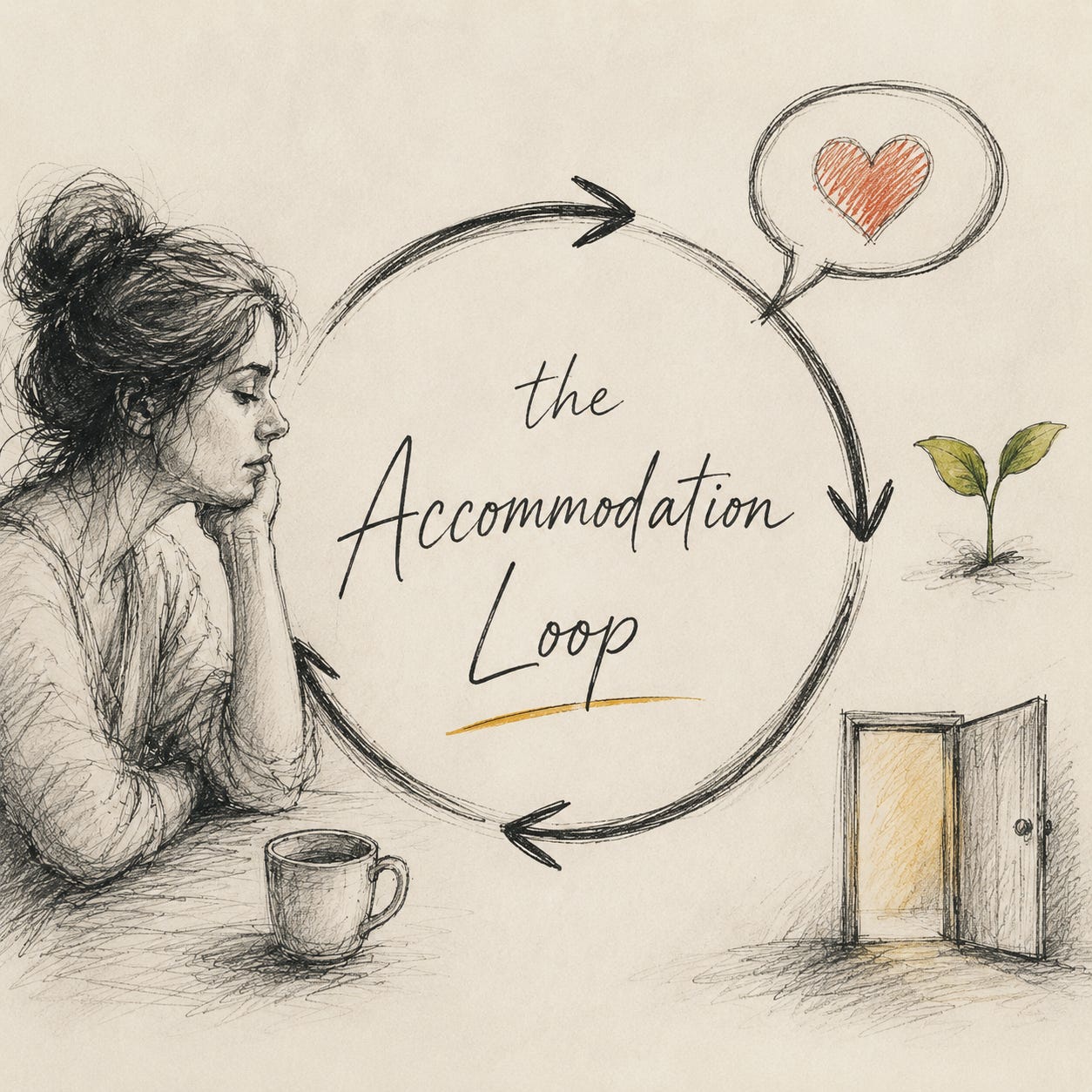
I think of it as the accommodation loop
I don’t mean that as a clinical diagnosis. I mean it as a name for something I recognize in my own life and am only now beginning to see clearly.
Someone does something that hurts you. You say so. They explain why they did it, and the explanation gives the behavior a more generous meaning than the one you experienced. They apologize. You understand. You forgive.
Then it happens again.
But now you have their explanation stored in your own head. They may not even have to give it to you again because you can do that part yourself.
He didn’t mean to hurt me. He thought he was helping. He doesn’t understand these things. That’s just how he is.
There is nothing inherently wrong with thinking about someone’s intentions. Intent matters. Context matters. People make mistakes, and none of us should be condemned forever because we got something wrong.
But repetition matters too.
If I tell you something hurts me and you tell me you understand, then what you do with that information matters more to me than how good the apology sounded.
An apology isn’t repair.
Changed behavior is repair.
I think I have spent far too much of my life confusing the two.
Look at who keeps moving
This is the part I didn’t see for a long time.
When I say, that’s just how he is, he doesn’t have to change.
I do.
Not all at once. That’s probably why it is so difficult to see. I adjust what I expect. I make a little more room. I reconsider whether what happened was really as hurtful as I thought it was. I remind myself of the explanation and decide that intention should count for something.
Eventually, I may stop bringing it up because we’ve already had this conversation. He already apologized. I already said I understood. Bringing it up again can somehow begin to feel unfair.
So the person whose behavior caused the hurt stays pretty much where he was, while the person who was hurt keeps moving the boundary.
I didn’t think of that as accommodation. I thought I was being understanding.
There is an enormous difference.
When empathy starts working against you
I have always wanted to know why.
Why did somebody behave that way? What happened to them? What were they thinking? What did they intend? What are they afraid of? What part of their own history are they carrying into this?
Understanding people has served me well throughout my life. I don’t want to lose that part of myself.
But there is a danger in becoming very good at understanding other people. You can construct such a good explanation for somebody else’s behavior that you explain yourself right out of your own experience.
Their intention becomes more important than the effect on you.
I don’t want to do that anymore.
I can understand why someone behaves the way they do and still say the behavior isn’t acceptable to me. I can believe someone loves me and still believe something they did hurt me. I can accept an apology without agreeing in advance to accept the same behavior again.
Those things aren’t contradictions.
Maybe that’s something I should have understood a long time ago. I didn’t.
“That’s just how he is”
I hear that sentence differently now.
Sometimes it really does mean acceptance. We all have quirks, faults and habits that the people who love us learn to live with. I certainly have mine.
But sometimes that’s just how he is means something considerably more troubling.
Sometimes it means I have stopped expecting him to care enough about the effect on me to change what he is doing.
That’s harder to admit.
Because then the question is no longer whether he meant to hurt me. The question becomes why his intention keeps getting more weight than my experience.
I am writing about this from my own life, but I don’t believe for a minute that it belongs only to me. I think people do this in marriages, families, friendships and workplaces. I think children learn to do it with parents long before they have words for what they’re doing, and sometimes they carry that accommodation with them into adulthood because it feels less like surrender than love.
Maybe that is why it can last so long.
The apology comes. The explanation makes sense. We forgive. We understand.
And then it happens again.
The question isn’t whether we should stop forgiving people. I don’t want to live that way either.
The question is whether we have mistaken forgiveness for an obligation to keep making room for the same injury.
I am learning that I can understand someone without accommodating everything they do. I can love someone without explaining away what hurts me. I can believe an apology was sincere and still pay very close attention to what happens after it.
And now, when I hear myself thinking, that’s just how he is, I want to ask myself something else.
Then what am I being asked to become in order to live with how he is?
If you recognize yourself somewhere in this, I hope you’ll join this community. Some of these patterns are remarkably difficult to see when we’ve been living with them since childhood. Sometimes another person putting words around the experience is what finally helps us recognize it in our own lives.
If you find value in my work, subscribe and support me. It allows me to keep writing about the things we learn to excuse, minimize and accommodate, and to keep building a community where we can talk about them without pretending they don’t hurt.