


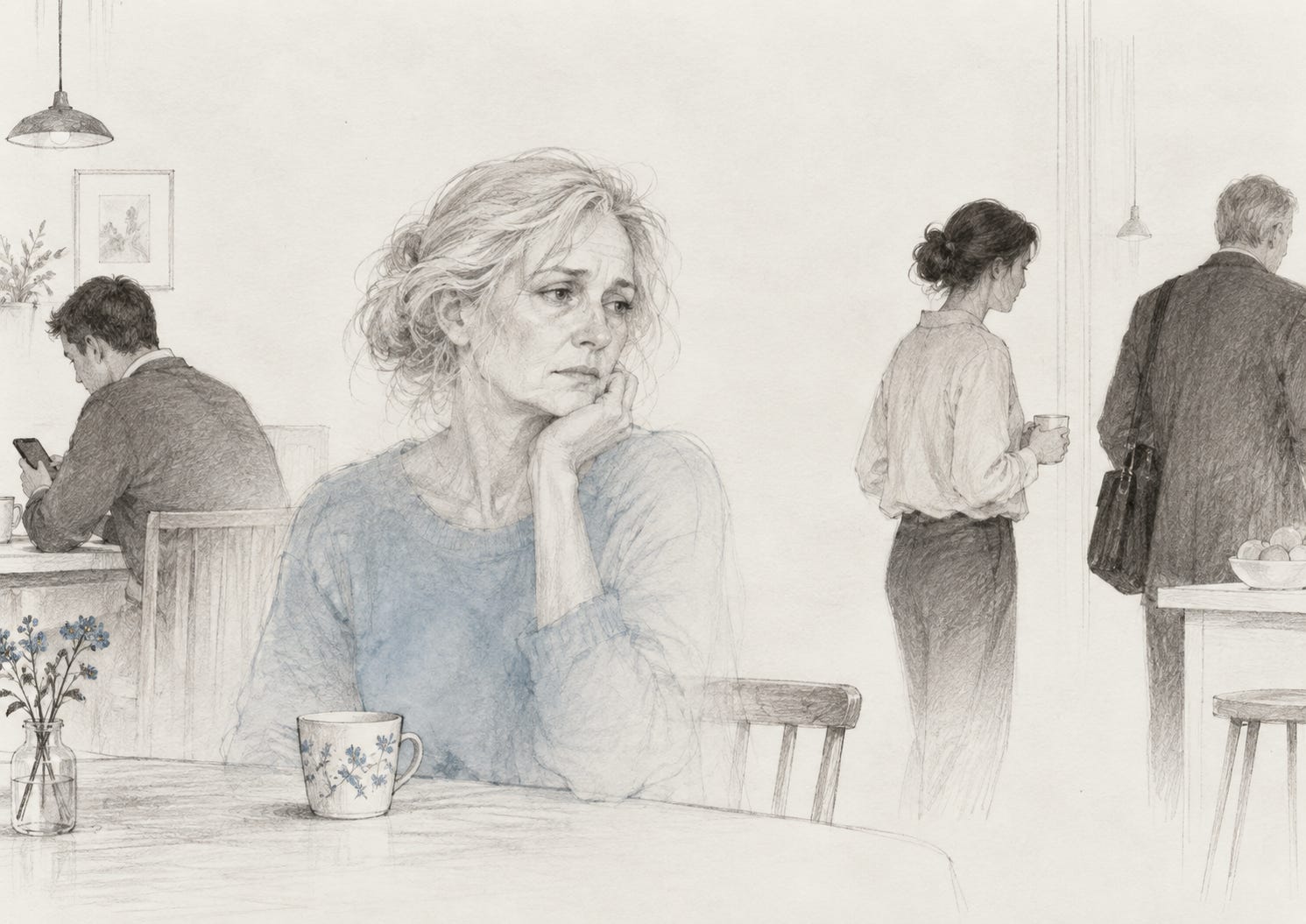
We usually think of gaslighting as words: That never happened. You’re imagining things. You’re too sensitive. You’re overreacting. But sometimes nobody says any of those things. Sometimes you tell someone you are hurting and they give you nothing. No acknowledgment. No curiosity. No comfort. No protection. No attempt at repair.
Maybe they simply go silent. Maybe they continue with their lives as though nothing happened. Maybe they become irritated because your pain is making things uncomfortable. Maybe they chastise you for being depressed instead of asking why you are hurting. And slowly, something very strange begins to happen.
You become invisible.
When Silence Becomes the Message
Silence is not always abusive. People need time to cool down. People become overwhelmed. People sometimes don’t know what to say. Healthy relationships can contain silence. But healthy silence eventually makes room for connection: I wasn’t ready to talk yesterday, but I’m ready now. I know you’re hurting. Help me understand. I may see this differently, but I care about what this has done to you.
Silent gaslighting feels different.
You say, “You hurt me.” The answer may be, I did nothing wrong. And then nothing. Or perhaps there isn’t even an argument. You are visibly struggling and nobody responds. Life simply continues around you.
The dishes get washed. The television comes on. People talk about tomorrow. Everybody behaves as though the person standing in the middle of the room with a broken heart isn’t bleeding at all. There may be no sentence to argue with.
The silence itself becomes the sentence.
Your pain isn’t important. Your experience doesn’t require acknowledgment. Your distress is inconvenient. Deal with it yourself.
Existential Gaslighting
Eventually this isn’t only about questioning what happened. You begin questioning your significance.
I think of it as existential gaslighting.
Not simply, Did that really happen? but Do I matter? Not merely, Am I remembering this correctly? but Would anybody care if I disappeared?
You are not seen. You are not validated. You are not protected. You are not cared for. You are standing right there, yet somehow you have become a ghost.
The Walking Dead
There is language we use for emotional pain that sounds melodramatic until you’ve lived it: dead inside, walking dead, a ghost. I understand those words differently now.
They don’t necessarily mean someone wants their physical life to end. Sometimes they describe what happens when a human being repeatedly reaches toward the people they love and discovers there is nobody reaching back.
You continue functioning. You make coffee, pay bills, answer messages, work, and maybe even laugh. People looking at you see a living person. But inside, something has gone terribly quiet.
Human beings don’t only need food, shelter and oxygen. We need to experience ourselves as existing in the minds and hearts of other people, especially the people who tell us they love us.
The Second Injury
There is another cruel part of this pattern. Eventually the person who has been ignored may become desperate to be heard. They explain again. They cry harder. They raise their voice. They send another message. They become angry. They say things with more intensity because saying them quietly accomplished nothing.
Then suddenly that reaction becomes the problem.
Now everyone can see something, but they don’t see the months or years of indifference that preceded it. They don’t see the repeated attempts to communicate or the original injury. They see the crying, the anger, the desperation, the depression.
And the question becomes: Why are you behaving like this?
That can deepen the gaslighting because the response to being chronically unheard becomes evidence that you are the difficult one. The wound disappears. Only your reaction remains visible.
Being Unseen Is Not the Same as Being Unworthy
This may be the hardest distinction of all. When people repeatedly fail to see your pain, it is very easy to conclude that your pain isn’t worth seeing.
Those are not the same thing.
Someone else’s unwillingness or inability to acknowledge you does not determine your significance. Their silence doesn’t rewrite what happened. Their indifference doesn’t make your pain imaginary. And someone refusing to protect you does not mean you weren’t worth protecting.
Sometimes healing begins with something much smaller than forgiveness or reconciliation. It begins by refusing to participate in your own erasure.
This happened. It hurt. I know what I experienced. I am allowed to care that it happened. And I am still here.
Recognize the Pattern
Abuse isn’t always screaming. Control isn’t always a threat. Gaslighting isn’t always somebody telling an elaborate lie. Sometimes the most destabilizing message in a relationship is delivered without words at all.
You are hurting. You look toward the people who are supposed to care. And nobody comes.
If you have lived that experience, you may know exactly what I mean when I say it can make a living person feel like a ghost.
But a ghost has no voice.
You do. Use it.
Join My Community
Domestic Assault is about recognizing the patterns that are hardest to name — coercion, control, manipulation, gaslighting, triangulation, emotional abuse and the injuries that leave no visible bruise.
If something here gave language to an experience you have struggled to explain, consider subscribing and sharing this work with someone who may need those words too.
And because what happens emotionally does not stay neatly separated from the rest of our health, I also write about stress, resilience, sleep, nutrition, aging and whole-person wellness at TotalWellCoach.com. Our relationships are part of the environment our bodies live in, and sometimes understanding the pattern is only the beginning of healing from what it has done to us.
Recognize the pattern. Trust what you experienced. Find your voice again.
Joyce, this is so right!! I can definitely relate to this “silent gaslighting” from my ex-husband (notice, EX-husband). I didn’t know what it was that was making me feel invisible and so unhappy in that marriage, all I knew was it was wrong for me.