


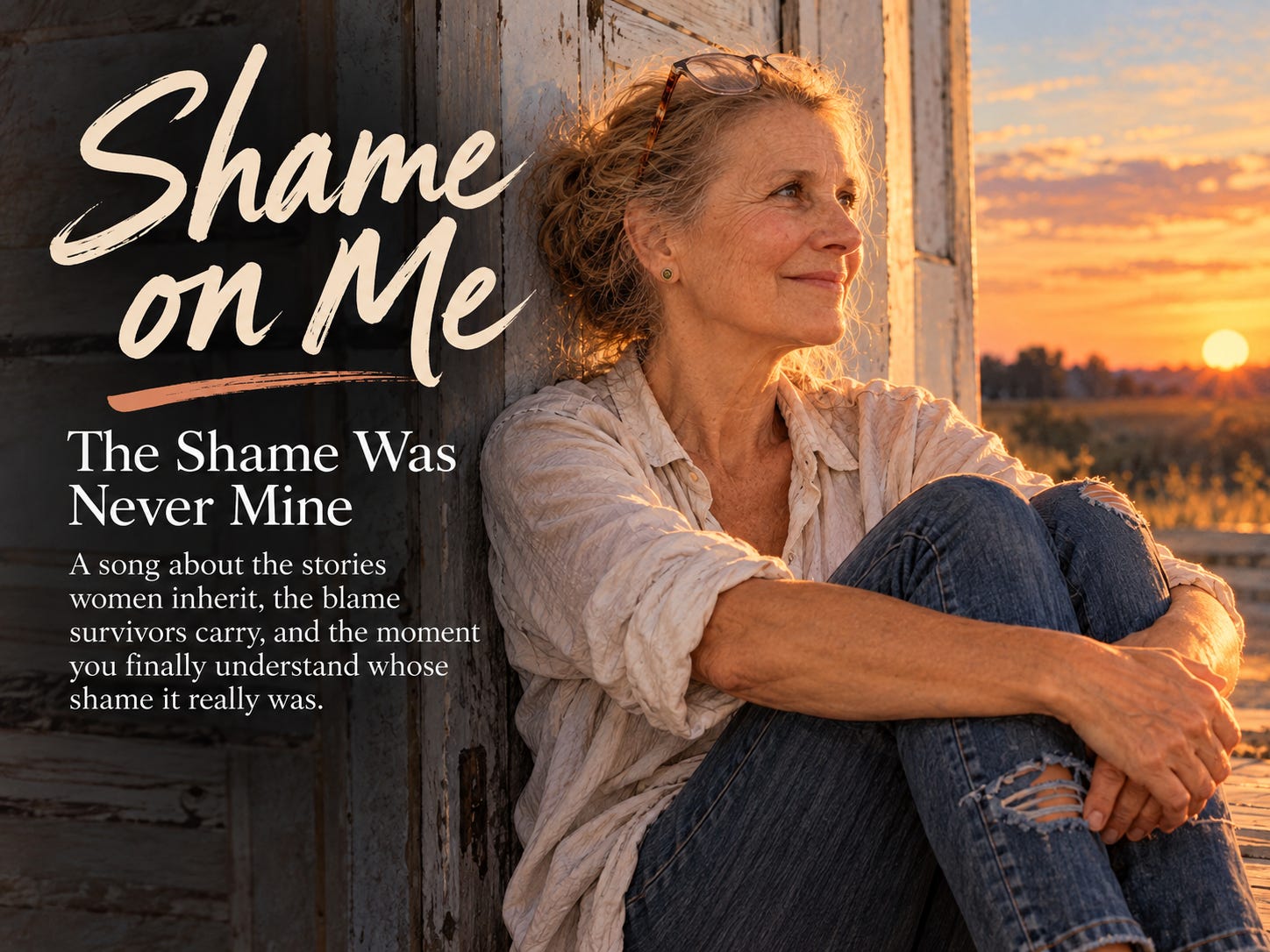
There is a double meaning in the title of my song “Shame on Me.”
Most of us hear those words and understand them immediately.
Shame on me.
I should have known better. I should have seen it sooner. I shouldn’t have stayed. I shouldn’t have believed him. I shouldn’t have tolerated that. I should have been stronger. Smarter. Less trusting. Less forgiving.
For a long time, that is exactly how shame worked in my own life.
But that isn’t what the title ultimately means.
The deeper meaning is this:
I feel the shame that other people put on me.
It was handed to me. Taught to me. Reinforced in me. And eventually I learned to carry it so naturally that I mistook it for something that belonged to me.
That is what this song is about.
We learn the rules before we understand the consequences
The song begins with messages that sound almost ordinary:
“Daddy said I was born for making babies.
Mama said to keep the house clean.”
Those lines are deliberately simple because conditioning often is.
Be a good girl. Take care of everybody. Don’t complain. Don’t ask too many questions. Don’t make trouble. Keep the peace. Make your marriage work. Take care of your husband. Put the children first. Be grateful for what you have.
And certainly don’t talk publicly about what happens behind closed doors.
None of those instructions has to arrive accompanied by violence to become dangerous.
They can become the soil in which coercive control later grows.
If you have already learned that your value comes from keeping everyone else comfortable, it becomes easier to believe that someone else’s anger is your responsibility.
If you’ve been taught that a successful woman keeps her family together no matter what, leaving can feel like failure.
If you’ve learned that endurance is strength, you may not recognize when endurance has become self-erasure.
That is why one of the most important lines in the song is:
“I carried the weight as if it was glory.”
I did.
Many women do.
We are praised for how much we can withstand.
When suffering gets confused with love
The first chorus says:
“Shame on me for believing the story
They handed down so easily
That love was something you earned by suffering
And silence was dignity.”
That is the heart of the song.
Some of us were taught, directly or indirectly, that love required sacrifice. Then sacrifice became suffering. And suffering became proof that we loved enough.
We tolerated what should never have been tolerated because we believed perseverance was honorable.
We stayed quiet because we thought silence was dignity.
We protected people who were hurting us because exposing what was happening felt like betraying the family.
And when things went wrong, we looked inward.
What did I do?
What could I have done differently?
Why wasn’t I enough?
That is one of the cruelest accomplishments of coercive control: eventually, the person being harmed becomes responsible for explaining the harm.
Shame keeps survivors quiet
Abuse does not survive only because abusers are powerful.
It also survives because shame is powerful.
Shame tells you nobody will believe you.
Shame tells you people will ask why you stayed.
Shame tells you your children will blame you.
Shame tells you admitting what happened means admitting your life wasn’t what you pretended it was.
Shame tells you that if you were really strong, you would have prevented it.
And shame can linger long after the relationship itself ends.
You can leave the person and still carry his accusations around inside your own head.
You can understand intellectually that something wasn’t your fault and still feel emotionally responsible for it.
That is why healing is not simply about getting away.
Sometimes it is about identifying all the things you carried out the door with you.
The title changes as the song changes
When the song begins, “Shame on Me” sounds like an accusation directed inward.
By the end, I hope it sounds different.
Because the shame belongs somewhere else.
The shame belongs to the person who abused trust.
The shame belongs to the person who frightened, controlled, demeaned or abandoned someone who loved them.
The shame belongs to systems and families that demanded silence.
The shame belongs to the people who saw what was happening and looked away.
What belongs to the survivor is the life that remains.
The strength.
The knowledge.
The ability to finally say:
That happened to me. But it was never who I was.

“Shame on Me” — Lyrics
Daddy said I was born for making babies
Mama said to keep the house clean
Don’t ask questions about money
Don’t go chasing bigger dreams
I saw what they allowed me to see
Blue collar means working hard every day
Keep my man happy so he won’t hurt me
Taking the blame when he went astray
Shame on me for believing the story
They handed down so easily
That love was something you earned by suffering
And silence was dignity
I carried the weight as if it was glory
Like a plaque I’d hang on the wall
All those years I blamed myself
Shame on me
For believing it all
Their dad abandoned all our needs
Hardly gave his time or a single dime
I raised the kids, I paid the bills
Why do they act like the shame was mine?
Shame on me for believing the story
They handed down so easily
That love was something you earned by suffering
And silence was dignity
I carried the weight as if it was glory
Like a plaque I’d hang on the wall
All those years I blamed myself
Shame on me
For believing it all
Funny how the road teaches
Things no classroom ever could
Somehow the shape of broken promises
Survives in me as something good
Turns out the heart gets stronger
From every storm it sees
The only thing I had trouble learning
Was asking people to be kind to me
Shame on me for believing the story
They handed down so easily
That love was something you earned by suffering
And silence was dignity
I carried the weight as if it was glory
Like a plaque I’d hang on the wall
All those years I blamed myself
Shame on me
For believing it all
If this sounds familiar
If you recognize yourself somewhere in this song, I hope you hear the second meaning of the title.
Not shame on you.
Not anymore.
Look carefully at the shame you’re carrying and ask yourself where it actually came from.
Who handed it to you?
Who benefited when you accepted it?
Who taught you that suffering was love?
Who taught you that silence was dignity?
You may discover that some of what you’ve carried for years was never yours in the first place.
And putting it down may be one of the most important things you ever do.
Listen to “Shame on Me”
You can listen to “Shame on Me” on YouTube here:
The song is also streaming on your favorite music platforms.
If this song speaks to you, please subscribe to @JoyceStrongMusic on YouTube. I’m building a growing catalog of original music about survival, heartbreak, healing, family, politics, place, hope, humor and all the complicated things we carry through life.
And if you know someone who may still be carrying shame that was never theirs, please share this song with them.
Join this community
Domestic Assault exists to talk honestly about coercive control, emotional abuse, family dynamics, survival and what happens after you finally begin to see the patterns clearly.
If my writing or music helps you put words around something you have lived through, please subscribe. If you can become a paid subscriber, your support helps keep this work independent and allows me to continue writing about subjects that too often remain hidden behind closed doors.
Sometimes hearing one person’s story is what finally allows another person to recognize her own.