


We tend to think of domestic assault as something that happens in one primary relationship. A husband. A wife. A partner. Somebody who controlled us, frightened us, manipulated us or slowly taught us not to trust what we knew.
So when we begin to heal, that relationship becomes the crime scene we keep returning to. What did that person do? Why did I stay? Why did I keep explaining myself? Why didn’t I leave sooner? Why didn’t I listen to that little voice that kept telling me something wasn’t right?
I’ve spent plenty of time asking those questions. But lately I’m wondering whether we can get so focused on understanding the person who hurt us that we miss the part that actually matters now: what did that experience teach us to do, and where are we still doing it?
Because whatever made it possible for me to override myself in one relationship probably didn’t magically disappear when that relationship ended. Some of it was there long before. Some of it goes all the way back to childhood. And if I only look for it when somebody is obviously controlling or manipulative, I’m going to miss all the quieter places where it still shows up.
That’s what I mean when I say make your healing global.
Look at all of it.
Look at what happens with family, friends, colleagues and people you’ve barely met. Look at those little moments when you know what you want and then immediately begin talking yourself out of it.
I had one of those recently.
I met someone for the first time at an event. We had a perfectly pleasant conversation and she suggested exchanging phone numbers and getting together socially sometime.
There was nothing wrong with that. Nothing inappropriate about her. She was simply more comfortable than I was with moving from nice to meet you to let’s get together.
I’m not.
My life is already full. I don’t get enough time with the people in my own family whom I love and want to see. Starting a new social relationship with somebody I just met isn’t a priority for me. It isn’t even particularly in my comfort zone.
That’s not a judgment about her. It’s information about me.
And I knew it immediately.
The whisper wasn’t whispering much at all.
No. I don’t want to do this. Go away.
Yet almost as quickly, another part of me went to work.
She seems nice. You don’t want to hurt her feelings. What reason do you have to say no? Maybe you’re being antisocial. Maybe you should just give her your number. Maybe you could get together once. What’s the harm?
There I was again, one foot on the brake and one foot on the gas.
And that’s the part I’m interested in now. Why did I need something to be wrong with her before I could honor what I wanted? Why wasn’t I don’t want to sufficient information?
I think I know at least part of the answer.
Somewhere very early in my life, I learned to give other people’s feelings a lot of weight. Sometimes more weight than my own. I learned that saying no could require an explanation, and that the explanation had better be good enough. I learned to anticipate disappointment and try to prevent it before it happened.
That’s a useful skill when you’re a child trying to navigate people more powerful than you. It isn’t always such a useful skill when you’re an adult deciding whether you want to give somebody your phone number.
But those old lessons don’t come with expiration dates. They can sit there quietly for decades and turn up in places that don’t look remotely like abuse.
They can even look like kindness.
That’s what makes this complicated. I don’t want to become someone who doesn’t care about other people’s feelings. I do care. I don’t want to use “boundaries” as an excuse to become harsh or suspicious or closed off from everyone I meet.
But there has to be room in that equation for me.
The woman I met can be lovely. Her invitation can be completely reasonable. She can genuinely enjoy meeting new people and be perfectly comfortable making a new friend on the spot.
And I can genuinely not want that.
Neither of us has to be wrong.
That’s a surprisingly difficult thing to absorb when you’ve spent years believing that a no requires a defendant.
Maybe that is one of the residual scars we don’t talk about enough. We become very good at studying other people’s behavior because we had to. Is this safe? Is this manipulation? Is this person trying to control me? Is that a red flag?
Those are useful questions, but there’s another one I need to ask.
What am I doing with my own voice?
Because I can learn every word associated with abuse. I can recognize coercive control. I can identify gaslighting and manipulation. I can understand exactly what somebody else is doing and why, and still override myself.
That’s why I don’t think healing can stop with learning how to recognize the person who won’t take no for an answer.
I have to notice when I’m the one who won’t take my own no for an answer.
That means catching myself before the explanation begins. Before I manufacture a reason. Before I leave the door open because closing it makes me uncomfortable.
It means asking myself what I think is going to happen if I simply listen.
Will somebody think I’m unfriendly? Maybe. Will somebody be disappointed? Possibly. Will somebody misunderstand me? Probably, eventually. That’s part of being alive around other people.
The question is why I have believed that preventing all of that was somehow my responsibility.
I’m beginning to think that is where some of the deepest healing lives. Not in becoming harder. Not in assuming everybody has bad motives. Not in constructing a fortress around ourselves.
It’s in becoming someone who trusts her own voice.
When something inside me says, I don’t want this, maybe I don’t immediately put it on trial. Maybe I don’t cross-examine it or demand supporting evidence before I’m allowed to act on it.
Maybe I listen.
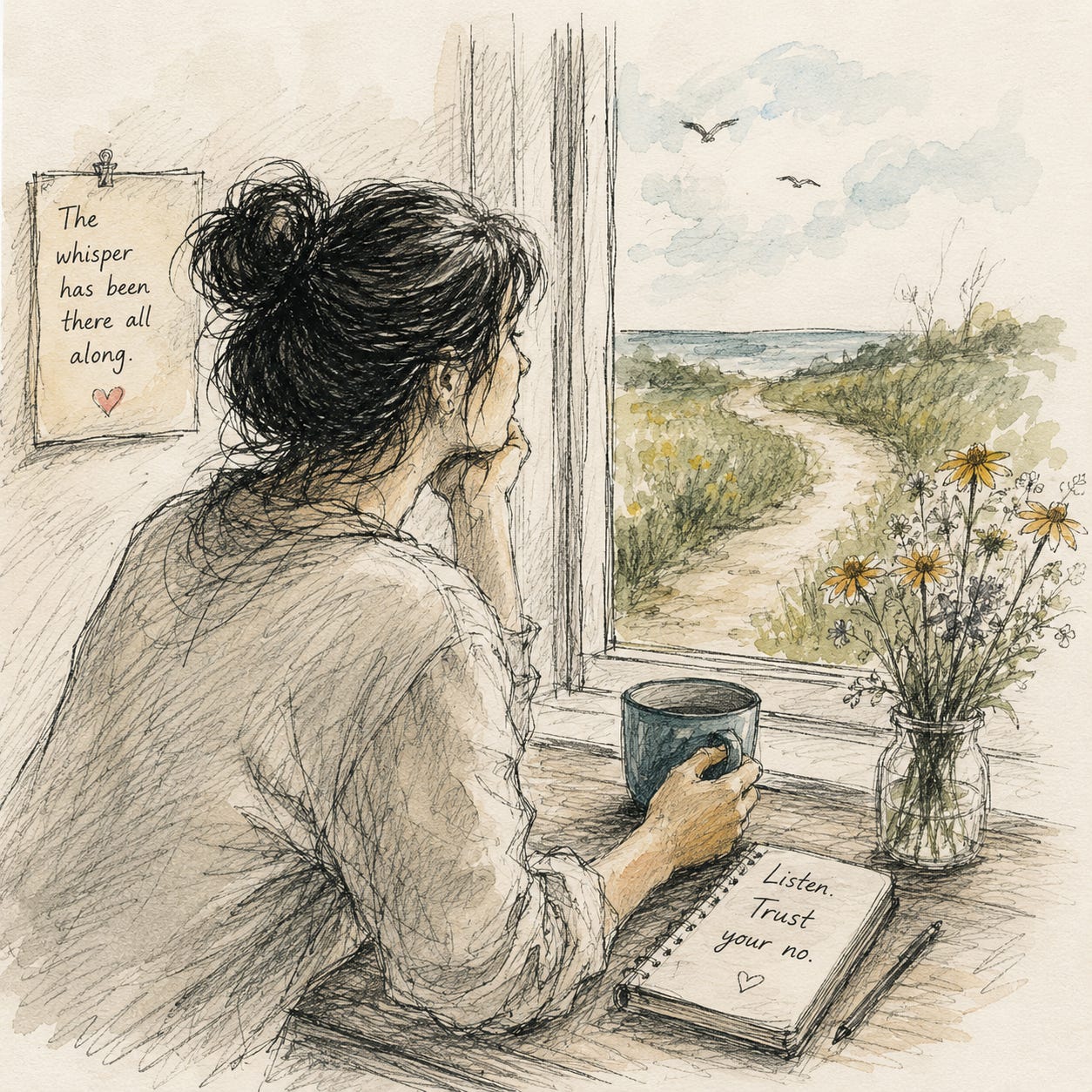
The whisper has been there all along.
My work now is to stop arguing with it.
If this piece felt familiar, you’re not alone.
Domestic Assault is where I write about the part that comes after survival too: learning what we carried forward, where we still override ourselves, and how we begin trusting our own voice again.
If you want to keep walking through that with me, join the community.
Listen to the whisper. Trust your no. Make your healing global.