


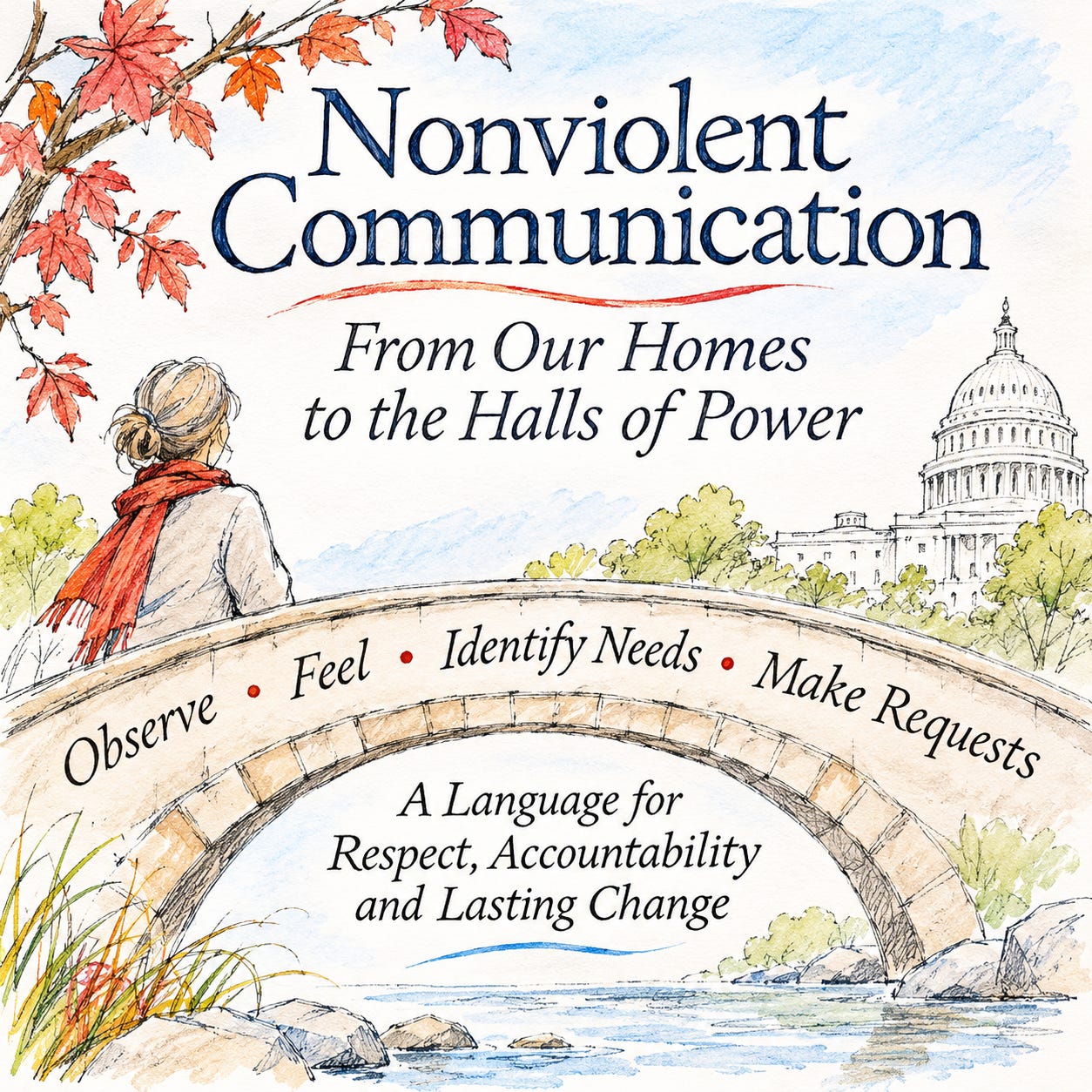
JOIN US LIVE — FRIDAY, NOVEMBER 20, 2026, AT 12:00 NOON ET
Margaret Williams, MS, ACC and I will be hosting an interactive Substack Live, “Nonviolent Communication: From Our Homes to the Halls of Power,” exploring Marshall Rosenberg’s work and how we can move from conflict and coercion toward cooperation, accountability, and meaningful solutions.
The article below introduces the ideas we’ll explore together, particularly the critical difference between a request and a demand—and what that distinction reveals about power and abuse in our relationships, institutions, and government.
What Happens When You Say No?
There is a question I wish everyone would ask themselves, particularly people in positions of authority:
When you ask someone to do something, what happens if they say no?
Does the conversation continue?
Do you ask questions, listen, and try to understand?
Or do you become angry, withdraw affection, threaten consequences, ridicule the person, or attempt to force compliance?
The answer tells us something fundamental about the difference between a request and a demand.
And that difference can tell us a great deal about the presence of respect, coercion, or abuse in a relationship.
It applies to spouses, parents, children, neighbors, employers, teachers, police officers, elected officials, and presidents.
It also helps explain why so many of our public disagreements have become destructive contests over power rather than opportunities to solve problems.
We have become accustomed to a political culture where insults are mistaken for strength, threats for leadership, and submission for cooperation.
We need a different approach.
One that allows us to disagree, defend ourselves, establish boundaries, and demand accountability without turning every conflict into a contest of domination.
Marshall Rosenberg spent much of his life teaching such an approach.
Marshall Rosenberg and Nonviolent Communication
Years ago, during my professional coach training, I studied Marshall Rosenberg’s work in Nonviolent Communication, commonly called NVC. I also read his book, Nonviolent Communication: A Language of Life.
As a nurse, wellness coach, and student of human behavior, I found his approach particularly valuable because it challenged some deeply ingrained assumptions about how people communicate and how change occurs.
Rosenberg understood that much of what we call communication is actually judgment, accusation, blame, and attempts to control another person’s behavior.
We criticize when we want understanding.
We accuse when we feel hurt.
We threaten when we feel powerless.
We demand obedience when what we really want is cooperation.
And often, the very language we use makes the outcome we desire less likely.
Rosenberg developed NVC through work influenced by the civil-rights movement, including efforts related to school desegregation.
His approach rests on four elements:
Observation. Describe what actually happened, without immediately assigning motives or making judgments.
Feelings. Recognize and communicate what we are experiencing emotionally.
Needs. Identify the underlying needs and values involved, such as safety, understanding, autonomy, dignity, respect, or security.
Requests. Ask clearly for a specific action that could help meet those needs.
It sounds simple.
Practicing it, especially when we are frightened, angry, hurt, or dealing with someone exercising power over us, can be challenging but gets better with practice.
And the fourth element—making requests rather than demands—deserves particular attention.
The Difference Between a Request and a Demand
Imagine a wife says to her husband:
“You never listen to me. You don’t care about anything I have to say.”
He becomes defensive.
“That’s ridiculous. I listen to you all the time.”
Now they are arguing about whether he listens rather than discussing the original concern.
Consider another approach:
“When I was talking earlier and you interrupted me several times, I felt frustrated because I wanted to be heard. Would you be willing to let me finish before responding?”
That is a specific observation, an expression of feeling, an underlying need, and a request.
It offers an opportunity for cooperation.
But here is where Rosenberg’s teaching becomes especially important.
A request is not necessarily a genuine request simply because it ends with a question mark or includes the word please.
Imagine the husband responds:
“No, I don’t want to talk about this right now.”
What happens next?
Does she ask when he might be available?
Does she try to understand whether he is exhausted, distracted, or overwhelmed?
Or does she say:
“If you loved me, you would listen. You’re a terrible husband.”
The request has become a demand backed by guilt.
Rosenberg emphasized that the distinction becomes apparent in how we respond when another person declines.
When refusal results in blame, humiliation, punishment, or intimidation, we are no longer simply inviting cooperation.
We are attempting to compel it.
And when someone fears the consequences of refusing, what looks like agreement may be nothing more than submission.
When Demands Become Coercive Control
This distinction is particularly important in understanding domestic abuse.
Coercive control is not limited to physical violence.
It can involve intimidation, isolation, humiliation, surveillance, financial restrictions, threats, manipulation, and repeated efforts to deprive another person of independence.
An abusive partner may make demands that sound perfectly reasonable to an outsider.
“Would you please tell me where you’re going?”
“Could you let me know who you’re talking to?”
“Would you mind giving me access to your phone?”
The words may sound polite.
But what happens if the partner refuses?
Will there be accusations, interrogation, financial punishment, threats, or retaliation?
Does the person have the freedom to say no?
The true nature of the communication is revealed by the consequences attached to refusal.
Of course, every relationship involves responsibilities, agreements, and boundaries.
A person has the right to say, “I will not remain in a relationship where I am threatened or physically harmed.”
That is a boundary, not an abusive demand.
The distinction is between establishing what we will accept and attempting to control another person’s autonomy through fear.
And we must be absolutely clear about something else: Nonviolent Communication is not a treatment for abuse that requires a victim to communicate more skillfully with an abuser.
When threats, violence, or coercive control are present, safety and protection come first.
The responsibility for abusive behavior belongs to the person engaging in it.
From Our Homes to Our Communities
Now imagine a disagreement between neighbors.
One neighbor believes another has cleared a trail across private property.
The first response might be:
“Stay off my land! You’re trespassing!”
Perhaps the boundary is exactly where the owner believes it is. Perhaps it isn’t.
The accusation could turn a solvable problem into a bitter, prolonged dispute.
An alternative:
“I noticed that a trail has been cleared near what I understand to be our property boundary. I’m concerned because I want to protect my property. Would you be willing to look at the survey with me before any further clearing takes place?”
This doesn’t surrender property rights.
It creates an opportunity to establish facts, understand the situation, and resolve the disagreement.
If the neighbor refuses and continues trespassing, the property owner still has the right to pursue appropriate legal remedies.
Nonviolent communication doesn’t eliminate boundaries or consequences.
It gives us a way to avoid unnecessary hostility while addressing problems.
What Happens When the Person Making the Demand Has Power?
This is where the discussion becomes much more consequential.
A disagreement between two neighbors is not the same as a confrontation between a police officer and a citizen.
An exchange between an employer and an employee is not the same as a discussion between two friends.
And a president speaking to the American public is not simply another person expressing an opinion.
Authority changes the meaning and potential consequences of communication.
When a person controls someone’s employment, income, safety, liberty, or access to essential services, a request can carry the force of a demand even when it is expressed politely.
Consider a supervisor who says:
“I’d really appreciate it if you worked this weekend.”
If declining means losing a promotion, being assigned undesirable work, or facing retaliation, the employee may not experience that as a genuine choice.
Now consider law enforcement.
Police officers sometimes have the legal authority to issue commands. Public safety can require immediate action.
But lawful authority is not unlimited authority.
The exercise of that power should be constrained by law, necessity, proportionality, respect for constitutional rights, and accountability.
Officers can be trained to explain, listen, de-escalate, and distinguish between genuine threats and people who are frightened, confused, angry, or exercising their rights.
The goal is not to eliminate legitimate authority.
It is to prevent authority from becoming an excuse for intimidation, humiliation, or abuse.
The greater the power, the greater the responsibility to exercise it with restraint.
What About Our Government?
Consider how frequently our political conversations begin with accusations rather than observations.
How often do elected officials insult opponents rather than respond to their arguments?
How often do congressional hearings become performances of anger and humiliation?
How often are citizens encouraged to fear, hate, or distrust people who disagree with them?
And how often do political leaders confuse loyalty with obedience?
The language matters.
When a president ridicules critics, threatens opponents, demands unquestioning loyalty, or treats disagreement as betrayal, we are witnessing communication shaped by power and domination.
Those behaviors deserve examination regardless of who holds office.
In the Trump era, the normalization of personal attacks, public humiliation, threats of retaliation, and demands for loyalty has made this question especially urgent.
Are we being invited to participate in a democracy, or are we being conditioned to obey authority?
Democratic leadership requires more than persuasive speeches.
It requires truthful communication, respect for rights, responsiveness to criticism, willingness to negotiate, and accountability for the use of power.
We should expect elected officials to explain their decisions, acknowledge the needs of the people affected, listen to legitimate objections, and offer solutions that can be evaluated.
We should expect Congress to examine evidence and negotiate legislation rather than turn every disagreement into a test of personal loyalty.
And we should expect law enforcement and government agencies to serve the public, not demand personal submission.
Rosenberg’s work cannot substitute for constitutional safeguards, independent courts, enforceable laws, and democratic institutions.
But it offers us a useful way to recognize the language of coercion and to imagine something better.
From Political Threats to International Conflict
The same questions extend beyond our borders.
Countries have competing interests, security concerns, territorial disputes, economic needs, and political differences.
Too often, those disagreements are expressed primarily through threats, ultimatums, humiliation, and demonstrations of military power.
Nonviolent Communication invites us to identify underlying human needs rather than treating another party’s demands as the entire story.
Security is a human need.
So are freedom, safety, stability, dignity, and self-determination.
Recognizing another population’s needs does not require endorsing its government’s actions.
And negotiating with an adversary does not require abandoning international law, human rights, or accountability for aggression.
Diplomacy must include verifiable commitments and enforceable protections.
Understanding what people need is one part of making lasting agreements possible.
Rosa Parks and the Courage to Say No
My friend and fellow coach Margaret Williams, MS, ACC recently raised Rosa Parks during a conversation about nonviolence.
It was an important connection.
Rosa Parks refused to surrender her bus seat in Montgomery, Alabama, on December 1, 1955.
Her resistance helped ignite the Montgomery Bus Boycott and challenge an unjust system of racial segregation.
Parks was an experienced civil-rights activist. Earlier that year, she had attended a workshop at the Highlander Folk School focused on desegregation and social change.
Rosenberg’s development of NVC was connected to civil-rights work in the following years, although there is no established basis for claiming that he worked directly with Parks.
Their contributions were distinct, but they share an important moral principle.
Nonviolence does not mean obedience to injustice.
Rosa Parks did not resolve the conflict by complying with an unjust demand.
She refused.
Her example reminds us that peaceful resistance and firm boundaries can be essential to social change.
We can reject violence while refusing submission.
We can insist on our rights without dehumanizing others.
And we can recognize that achieving justice sometimes requires changing the institutions that make unjust demands possible.
New Ground Rules for Our Country
What would happen if we adopted some basic expectations for how people in positions of power communicate?
Imagine seven ground rules:
Tell the truth. Distinguish established facts from opinions, allegations, and speculation.
Listen before responding. Show that you understand the concern, even when you disagree.
Address the problem. Stop substituting personal humiliation for substantive arguments.
Recognize human needs. Consider safety, security, dignity, freedom, health, and economic stability.
Make constructive proposals. Explain what action you want, why it matters, and how it would work.
Respect boundaries and rights. Authority never grants unlimited permission to intimidate or coerce.
Accept accountability. Correct mistakes, repair harm, and accept appropriate legal and institutional consequences.
These are proposed standards for civic leadership, inspired in part by NVC. They are not a replacement for Rosenberg’s original four components.
And they are not merely suggestions for being nicer to one another.
They are standards that could help make public institutions more honest, responsive, and effective.
An Invitation: Let’s Talk About This Together
Margaret Williams, MS, ACC and I will be hosting an upcoming Substack Live devoted to Marshall Rosenberg’s Nonviolent Communication.
Here’s the link to the LIVE: https://open.substack.com/live-stream/460768
Margaret brings her experience in coaching and personal relationships. I will draw on my study of NVC during professional coach training, Rosenberg’s work, and my experience as a nurse, wellness coach, and student of human behavior.
We’ll begin with the familiar conflicts people encounter in their homes and relationships.
We’ll explore the four elements of NVC and devote special attention to the difference between requests and demands.
Then we’ll expand the conversation to families, neighbors, communities, law enforcement, elected officials, government, and international conflict.
We want this to be an interactive discussion with real-life examples and opportunities for audience participation.
The goal isn’t to make everyone agree.
It’s to learn how to communicate honestly, resolve disagreements where possible, establish healthy boundaries, recognize coercion, and create better ways to solve problems.
The live will be on Friday, November 20, 2026 at 12:00 Noon ET.
In the meantime, I invite you to consider a question:
When someone asks you to do something, how free do you feel to say no?
And just as importantly:
When you ask something of another person, how do you respond when their answer is no?
Those two questions can reveal a great deal about our relationships, our institutions, and our society.
We have become far too comfortable with the language of domination.
It’s time to learn the language of cooperation.
And it’s time to demand accountability from the people who hold power over our lives.
Join the Domestic Assault Community
Domestic Assault is a place to examine abuse, power, coercive control, and the patterns that connect private relationships with institutional and government behavior.
We explore how abuse develops, how it becomes normalized, and how people can recognize it, challenge it, and protect their rights.
All my writing remains free to read. Free subscriptions, thoughtful comments, shares, and restacks help make this work visible. Paid subscriptions, for those who can comfortably afford them, help sustain this independent publication.
Subscribe, join the conversation, and share this article with someone who might benefit from understanding the difference between a request and a demand.
Understanding abuse is the beginning. Changing how power is exercised is the work ahead.
Further Reading
Marshall B. Rosenberg, Nonviolent Communication: A Language of Life