


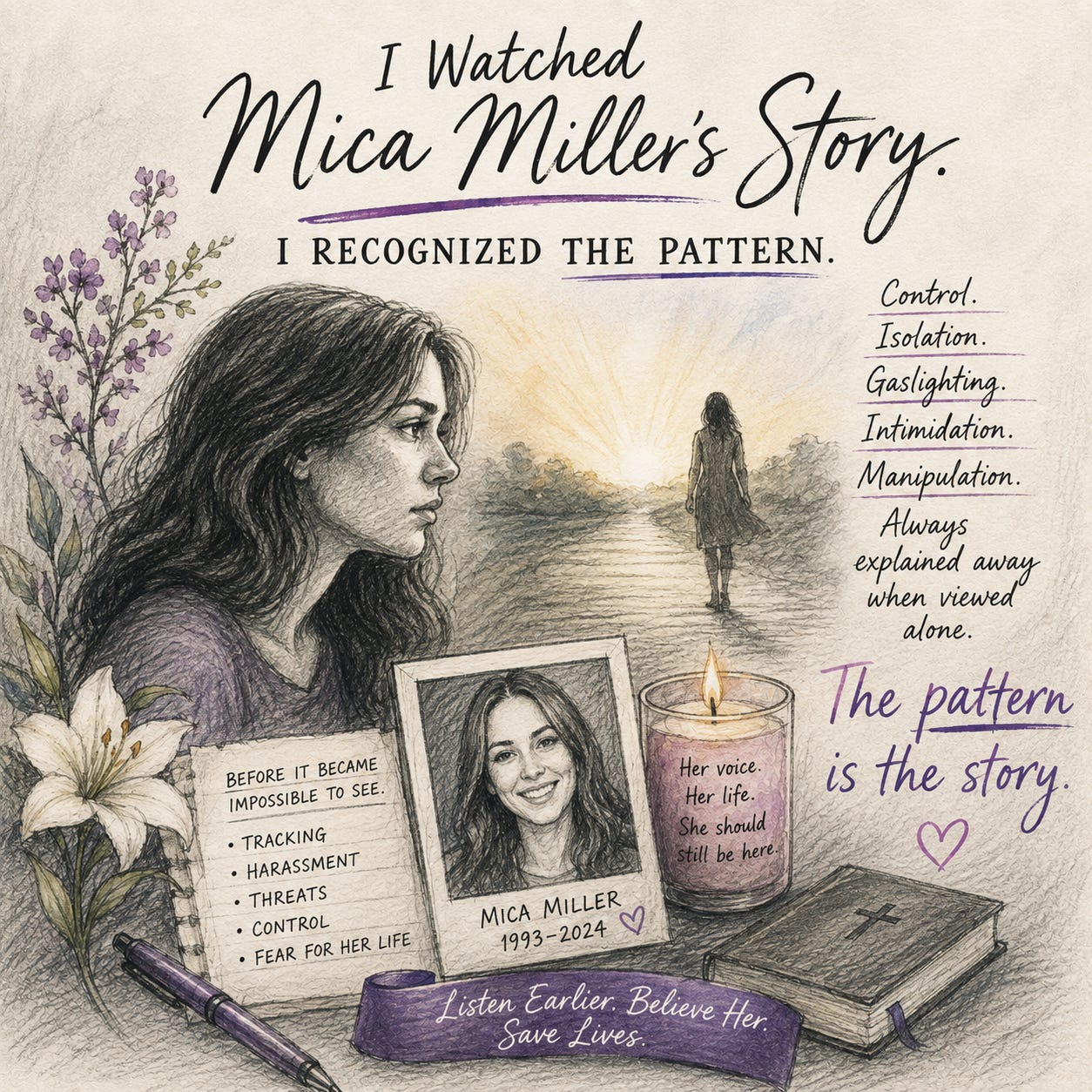
I watched all three episodes of Netflix’s Death of the Pastor’s Wife. I knew something about Mica Miller’s story before I started. I knew how she died. I knew there had been allegations of abuse and coercive control involving her husband, pastor John-Paul Miller.
What I wasn’t prepared for was how familiar parts of it would feel.
I am a survivor of domestic abuse. My relationship began in the 1970s. I married in 1981. Mica Miller belonged to another generation entirely—different time, different circumstances, different technology. Religion and church authority were central to Mica’s story; they played no role in mine.
And still, I recognized the pattern.
I Kept Watching the People Around Her
That is what got me.
I wasn’t watching this mainly as a true-crime mystery. I kept watching what was happening around Mica before she died. Who saw pieces of it? Who understood what they were seeing? Who didn’t? Who believed her? Who looked away? Who had the authority to intervene?
What happens when someone keeps trying to tell the world something is wrong, but what she is describing doesn’t fit neatly into the boxes people know how to respond to?
Mica told police she was afraid for her life. Her family and friends have described a long pattern of control and manipulation. The documentary examines allegations involving tracking, harassment and other forms of coercive behavior. Her husband has denied wrongdoing and has not been charged in connection with her death.
That distinction matters. So does everything that happened before her death.
We Are Still Too Interested in the Incident
When I was living through abuse, the world was different. Police responses in the 1970s and 1980s were different. Too much of what happened inside a marriage was treated as private. If an officer didn’t witness something, meaningful intervention could be hard to get.
We’ve changed laws since then. We’ve changed terminology. We know far more about domestic violence and coercive control.
What I kept wondering while I watched Mica’s story was whether we have actually gotten much better at recognizing the pattern before the catastrophe.
Coercive control is rarely one clean event. It is who you talk to, where you go, what money you can access, whether you’re being watched, whether someone else is defining reality for you, whether resistance brings punishment, whether the people around you see a charming and respected person while you experience someone entirely different behind closed doors.
And after enough time, whether you begin to question your own judgment.
Take each thing separately and someone can explain almost all of it away. Put the pieces together and the picture changes.
The pattern is the story.
The People Around the Abuse Matter Too
This may be one of the hardest parts of domestic abuse to explain. The relationship does not exist in isolation.
There are family members, friends, neighbors, coworkers, churches, doctors, police officers, lawyers, judges and entire communities around it. Some know very little. Some know pieces. Some suspect. Some don’t want to get involved. Some believe the person with more power. Some simply cannot imagine that the person they know could possibly be the person you know.
And sometimes the victim is trying desperately to explain something that is almost impossible to communicate one incident at a time.
That is why learning to recognize patterns matters.
Mica’s Story Should Make Us Better at Seeing
Mica Miller died on April 27, 2024. Her death was ruled a suicide. Her family continues to seek answers and advocate for changes in the law. John-Paul Miller has denied allegations of abuse. He was federally indicted in December 2025 on charges of cyberstalking and making false statements to investigators, has pleaded not guilty, and is scheduled for trial in October.
Those legal proceedings will establish what can be established in court. But we do not have to wait for a courtroom to learn something from Mica’s life.
We can learn to listen differently. We can stop waiting for one spectacular incident to give us permission to take someone seriously. We can pay attention when the pieces keep accumulating. We can understand that leaving an abusive relationship is not one simple act and can be dangerous, complicated and hard to explain to people standing outside of it.
The question that stayed with me through Death of the Pastor’s Wife was this:
What are we seeing before it becomes impossible not to see it?
I couldn’t watch Mica Miller’s story without thinking about the decades separating her experience from mine. We know more now. We have words we didn’t have then. We understand coercive control better.
That knowledge should matter.
Mica Miller should still be here. The next person trying to tell us what is happening to her is.
We need to learn how to hear her.
Join This Community
Domestic Assault exists so we can get better at recognizing what we are seeing—while it is happening, after someone has left, and sometimes years later when the pieces finally make sense.
You don’t have to tell your story to belong here. You can read, learn, recognize something, share when you want to, and help someone else see what they may not yet have words for.
Everything I publish here will remain free to everyone. Paid memberships support the research, writing and time it takes to build this community while keeping the work open to everyone.
If this work matters to you, subscribe and stay with me.