


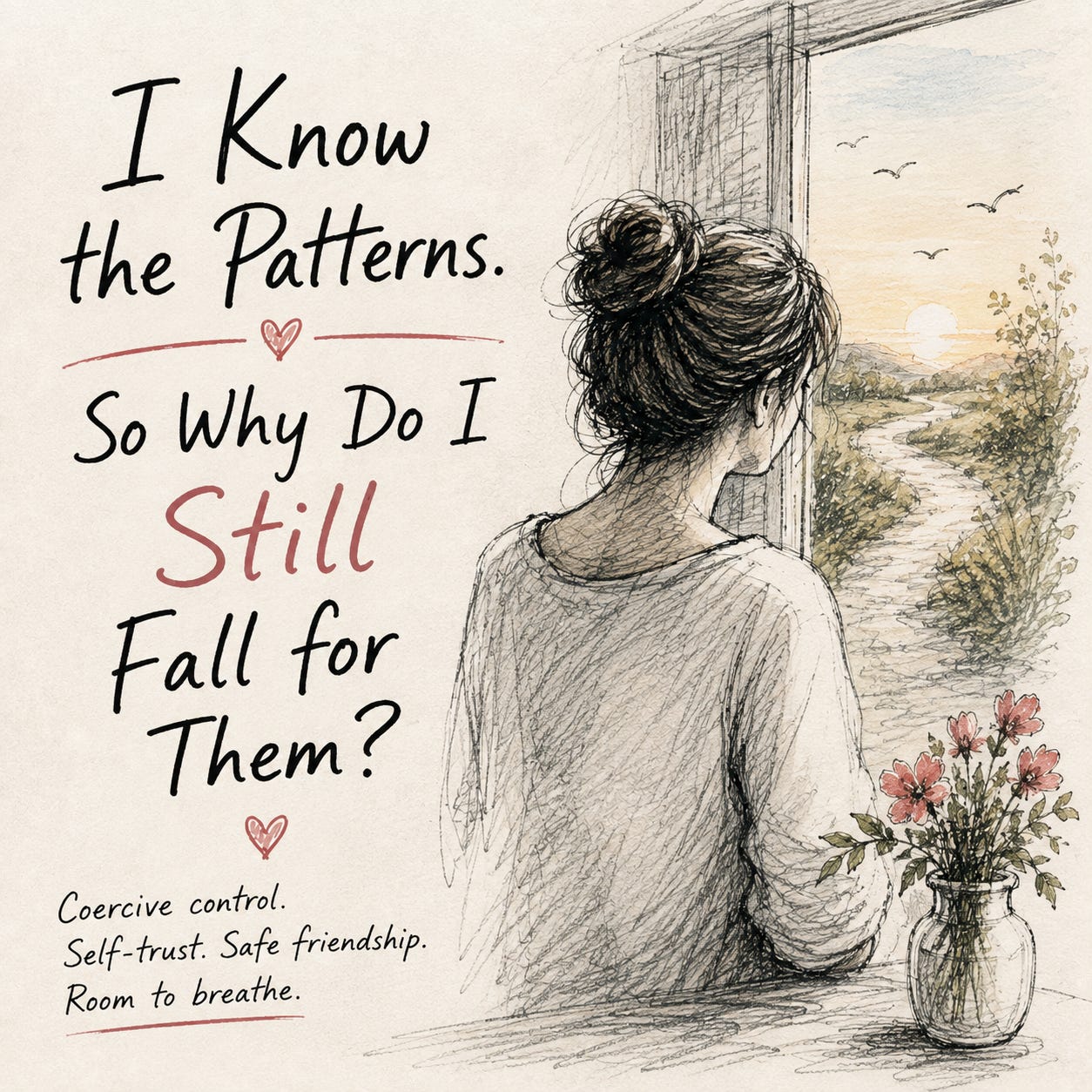
I know what coercive control looks like.
I know about gaslighting, guilt, obligation, keeping score, moving the goalposts and making someone feel responsible for another person’s feelings.
I can recognize manipulation.
So why can I still fall for it?
That question has been bothering me, because awareness is supposed to protect us. And it does. But I’m beginning to understand that knowing the playbook and being immune to it are two very different things.
The problem may begin with the question I instinctively ask when something feels wrong:
What is it about me?
Did I misunderstand? Am I being unfair? Should I give this person another chance? Maybe they didn’t mean it that way. Maybe I owe them something because they were kind to me. Maybe I should explain myself better.
Those can sound like thoughtful questions.
They can also keep me in relationships where I spend far too much time explaining away what my instincts noticed immediately.
Awareness Isn’t Enough
Knowing the terminology doesn’t necessarily change the reflexes we developed long before we had words for them.
If you learned to keep the peace, accommodate, forgive quickly, explain yourself, anticipate someone else’s reaction or make things okay again, those responses can feel like kindness.
Sometimes they are.
Sometimes they make you exceptionally easy to manipulate.
And that distinction can be surprisingly difficult to see from inside the relationship.
Maybe the better question isn’t Why do I keep falling for this?
Maybe it’s:
What happens inside me when I sense that something isn’t right—and why do I so quickly talk myself out of it?
What Does Safe Friendship Feel Like?
I’ve been thinking about this, too.
I don’t want friendships built on accounting.
I don’t want I did this for you, therefore you owe me that.
Real friendship has give and take, but it breathes.
Sometimes one person gives more. Sometimes the other does. Nobody is standing there with a ledger.
You can say no without being punished.
You can disagree without fearing what comes next.
You can take some space without being pursued, guilted or made responsible for somebody else’s reaction.
A favor is a favor, not a down payment on a future obligation.
Kindness doesn’t arrive with an invisible invoice.
And perhaps most importantly, you don’t have to surrender pieces of yourself to prove that you care.
Maybe This Is What I Need to Practice
Not becoming suspicious of everyone.
Not building walls so high nobody gets through.
Just slowing down.
When something feels off, I don’t have to decide immediately whether the other person is good or bad, manipulative or misunderstood.
I can simply notice.
I can wait.
I can say no to something small and watch what happens.
I can disagree and see whether the relationship survives it.
I can stop explaining every boundary as though I need permission to have one.
And I can pay attention to whether someone’s kindness leaves me feeling cared for—or indebted.
Maybe discernment isn’t learning how to read another person perfectly.
Maybe it’s learning to trust myself enough that I don’t have to.
I don’t need proof that someone intends to control me before I’m allowed to protect my peace.
And I don’t need to stop being generous, trusting or openhearted.
I just need to leave enough room in every relationship for me to remain myself.
Maybe that is what safety feels like.
Room to breathe.
Join My Community
If this work speaks to you, I hope you’ll join me here.
A free subscription keeps you connected to new writing and conversations about coercive control, boundaries, safety and rebuilding trust in yourself.
A paid subscription does something more. It helps support my work, but it also helps me keep it available to people who may need these words and cannot afford to pay for them.
That matters to me.
If you can become a paid subscriber, you are not only supporting me. You are helping hold the door open for someone else.
Join the community. Help me keep the door open.