


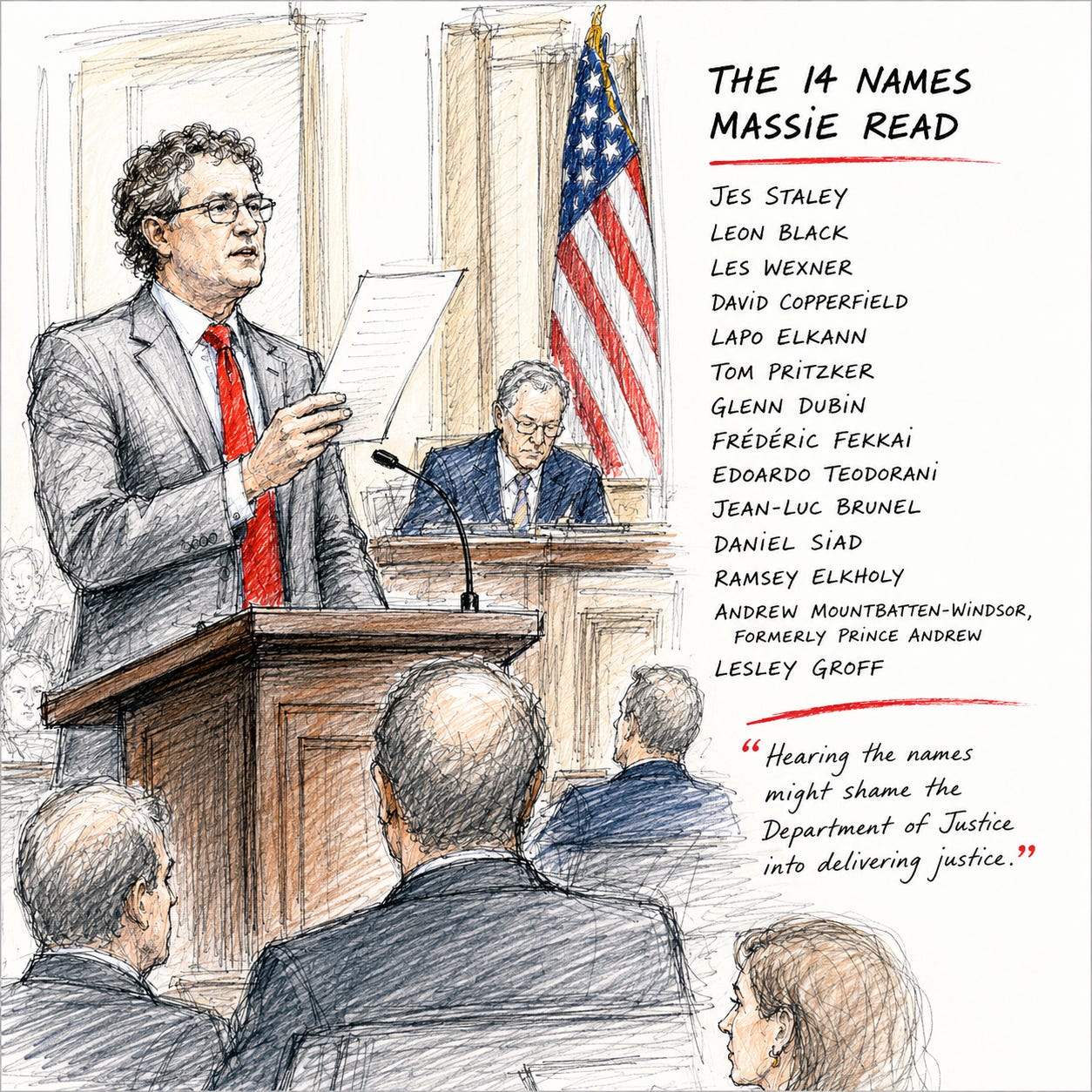
On August 31, 2026, Republican Congressman Thomas Massie stood on the floor of the United States House of Representatives and read 14 names into the record. He described the people he named as Jeffrey Epstein’s “co-conspirators” and called for them to be investigated and prosecuted. Massie was also beginning another effort to force the release of additional Epstein records still being withheld from the public.
The distinction here is important: these are Massie’s allegations. Being named by a member of Congress, appearing in Epstein-related records or having associated with Epstein does not establish that someone committed a crime. Several of the people Massie named have never been charged with an Epstein-related offense. But Massie’s decision to stand on the House floor and say the names publicly raises a different question, one that has been hanging over this case for years: How did Jeffrey Epstein continue for as long as he did, surrounded by people, businesses and institutions that encountered pieces of what was happening?
THE 14 NAMES MASSIE READ ON THE HOUSE FLOOR
Jes Staley
Leon Black
Les Wexner
David Copperfield
Lapo Elkann
Tom Pritzker
Glenn Dubin
Frédéric Fekkai
Edoardo Teodorani
Jean-Luc Brunel
Daniel Siad
Ramsey Elkholy
Andrew Mountbatten-Windsor, formerly Prince Andrew
Lesley GroffMassie described these people as Epstein “co-conspirators” and called for investigation and prosecution. His statement is an allegation, not a finding of criminal guilt.
Massie said he hoped that hearing the names might shame the Department of Justice into delivering justice. What makes that statement remarkable is the date. This isn’t 2008, when Epstein pleaded guilty in Florida and emerged from a prosecution involving minors with a deal that would later become infamous. It isn’t 2019, when Epstein was arrested again. It is August 31, 2026, and a member of Congress is still standing on the House floor arguing that the federal government has not adequately accounted for the people who may have helped Epstein operate.
This is why I called this publication Domestic Assault
When I started Domestic Assault, the name obviously referred to what happens inside relationships, marriages and families. Abuse is often hidden inside a home, where the person being abused lives in one reality while the outside world sees another. But the word domestic has another meaning too. It means our country, our government, our institutions and our United States of America.
That connection matters because abuse rarely survives solely through the power of the person committing it. It also survives because of what happens around that person. Someone sees something but doesn’t understand what it means. Someone else understands more but has a reason not to get involved. Another person accepts an explanation because questioning it would require doing something. Sometimes money is involved. Sometimes reputation is involved. Sometimes people simply don’t want to know.
Anyone who has lived through domestic abuse may recognize that structure. Eventually you discover that there were conversations you were never in. Someone was explaining you to other people. Someone was explaining himself. Different people were given different pieces of the story, and each piece could be made to sound reasonable when separated from all the others. The whole picture existed, but almost nobody was looking at the whole picture.
That is what interests me about Epstein now. Not just another breathless hunt through files looking for a famous name, but the much harder question of what happened among all the people and institutions surrounding him. Who knew something? What exactly did they know? When did they know it? What did they do afterward? And how many people possessed one piece of information without ever putting their piece beside somebody else’s?
The network is the story
The recent developments involving the banks make that question particularly difficult to dismiss. Bank of America agreed to a $72.5 million settlement with women who accused the bank of facilitating their sexual abuse by Epstein. A federal judge gave the settlement final approval on August 27. The settlement resolves the allegations without establishing that the bank committed the conduct alleged, but the case points toward something important: the infrastructure surrounding abuse can matter almost as much as the person committing it.
Then there is Jes Staley, one of the names Massie read. Staley was once one of JPMorgan’s most powerful executives and had a longstanding relationship with Epstein. In testimony released by Congress on August 26, Staley acknowledged that he had argued for JPMorgan to retain Epstein as a client after Epstein’s 2008 conviction. He also acknowledged sharing confidential and market-sensitive bank information with Epstein. Staley has maintained that he did not know Epstein continued abusing minors.
That doesn’t mean Staley is responsible for Epstein’s crimes. It does mean we are entitled to ask why a convicted sex offender remained valuable enough to powerful people and institutions that maintaining relationships with him continued to make sense.
This is the part that feels familiar to anyone who has tried to explain abuse from the inside.
The failure isn’t necessarily one grand conspiracy. It can be a series of smaller decisions made by people who never think of themselves as protecting an abuser. They protect a relationship, a client, a reputation, a business interest, an institution or simply their own comfort. Enough of those decisions can give the person causing harm more room to continue.
That is why I keep coming back to The Conversations You Were Never In. In domestic abuse, those conversations can create an entirely different version of reality around the person being abused. With Epstein, I want to know about the people on the receiving end of those conversations. What did the banker hear? What did the employee know? What did prosecutors and law enforcement have? What did wealthy friends observe? What did the people arranging travel or handling money understand about the world they were helping maintain?
One fragment may prove nothing. Even several fragments may prove nothing criminal. But at some point, if enough fragments exist, somebody has an obligation to put them on the same table and look at the picture they create.
Massie saying 14 names on the House floor doesn’t establish what any of those people did or didn’t do. Investigation is how we establish that, and due process matters just as much when an accusation is politically explosive as it does anywhere else.
But due process for individuals cannot become an excuse for institutional secrecy.
There are survivors who have waited years for answers. There are government records that remain beyond public view. There are legitimate questions about who knew what, when they knew it and what they did with that knowledge. Those aren’t questions driven by celebrity gossip. They are questions about accountability and about the environment that allowed a serial sexual abuser to operate for years despite encounters with law enforcement, prosecutors, banks and some of the most powerful people in the world.
That is why this belongs in Domestic Assault.
The publication is about what happens when abuse enters a home and distorts the lives of the people inside it. But it is also about what happens when secrecy, money, reputation and power create room for abuse to continue on a much larger scale.
Domestic means home.
It also means country.
And if we are going to understand abuse, we have to be willing to examine not only the person who commits it, but the people and institutions that make it easier for that person to keep going.
If you find value in this work, join my community, subscribe and support Domestic Assault. This publication is about understanding abuse in all the places it hides — inside homes, inside relationships, and inside the institutions that can make it easier for powerful people to avoid accountability.
Your subscriptions, shares, comments and financial support make it possible for me to keep following these stories, asking the questions that are too often left unanswered, and connecting the pieces instead of allowing them to disappear into separate headlines.
Thank you for reading, for being here and for helping me build a community willing to look directly at what abuse does, how it survives and who helps make its survival possible.
Please he needs to say more names 🙏