


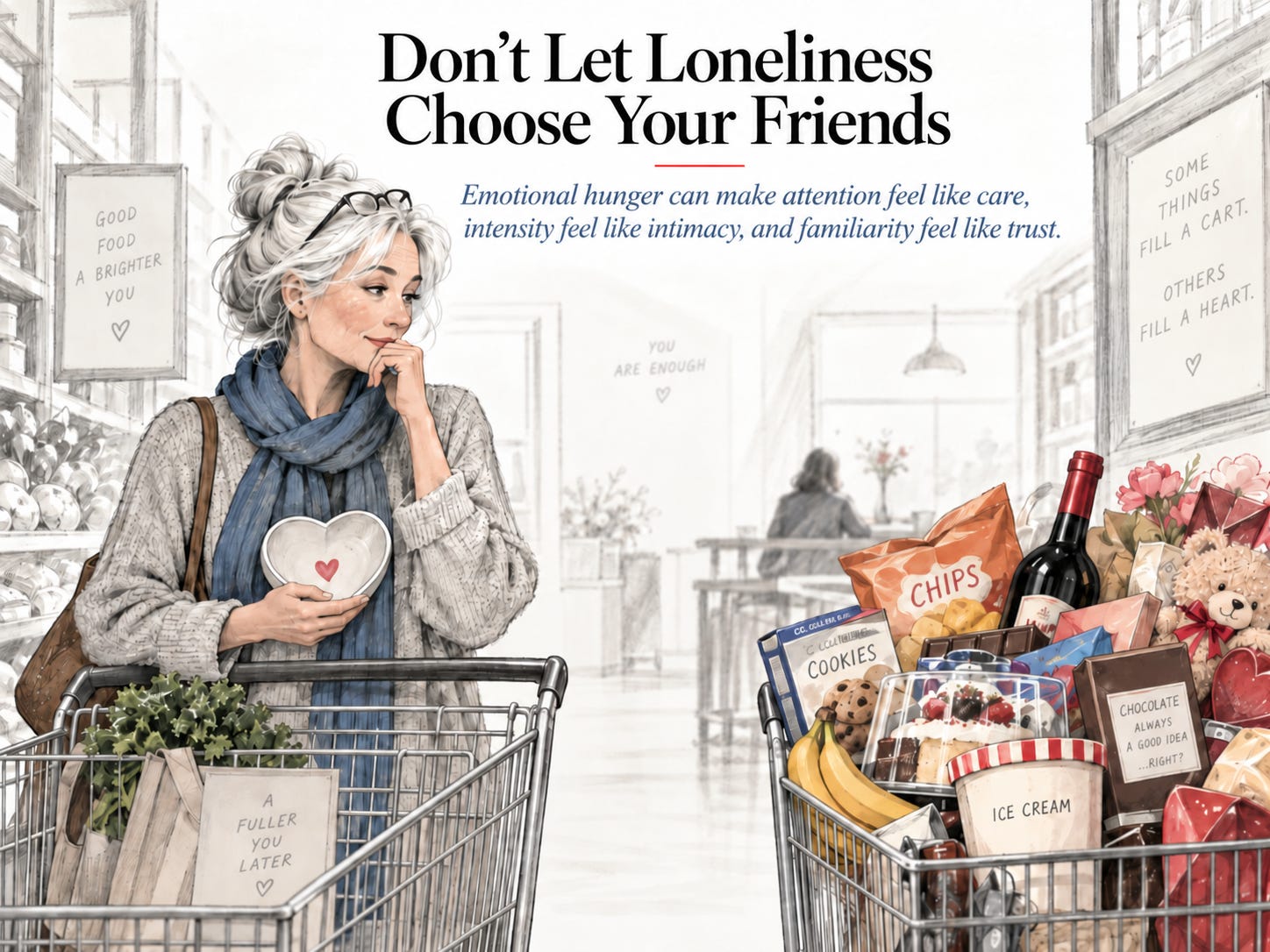
There is an old piece of advice that says: don’t go grocery shopping when you’re hungry. The reason is simple. When you are hungry, everything looks good. You buy too much, reach for things you would not normally choose, and make decisions based on an immediate need instead of what will actually nourish you.
I think relationships can work the same way. When you are lonely, unseen, depleted, grieving, insecure, or simply starved for connection, attention can feel much more valuable than it really is. Someone notices you, listens to you, seems fascinated by you, wants to talk every day, or tells you how much they understand you. Before you know it, they may have been given access to parts of your life that they have not yet earned.
Emotional Hunger Changes Judgment
Loneliness is powerful because it can change the value we place on attention. An ordinary amount of interest can suddenly feel extraordinary. Intensity can feel like intimacy. Validation can feel like love. Familiarity can feel like safety.
That does not mean lonely people should avoid relationships. We need one another, and connection is part of being human. But emotional hunger can influence judgment just as physical hunger can influence what lands in your grocery cart.
When your emotional reserves are empty, the question can quietly shift from “Is this person good for me?” to “Does this person want me?” Those are very different questions, and the second one can make us overlook things we would normally see much more clearly.
Familiar Does Not Mean Safe
For people who grew up around narcissistic, entitled, controlling, volatile, dismissive, or emotionally manipulative people, certain behaviors can feel strangely familiar. You may know instinctively how to manage someone who needs constant reassurance, how to calm someone who becomes defensive, or how to tolerate someone who monopolizes conversations, turns disagreements into battles, needs to be right, or expects you to validate every grievance.
You know the dance, and that can be precisely the problem. What is familiar to us can feel comfortable even when it is unhealthy. Sometimes we recognize a personality long before we consciously understand what we are recognizing.
We may think, I really connect with this person. But underneath that connection may be something very different: I know how to survive this person.
Attention Is Not Care
One of the most dangerous substitutions in relationships is confusing attention with care. Attention is easy. Someone can text constantly, compliment you, praise you, confide in you, tell you that you are special, and want immediate emotional closeness. None of that proves they care about your well-being.
Care reveals itself over time. Care respects your boundaries. It does not punish you for disagreeing. It does not require you to constantly soothe someone’s ego, take sides in every grievance, or become responsible for another person’s emotional regulation. Care does not become hostile when you say no.
The difference matters because someone can make you feel intensely seen while still being primarily focused on what they are getting from the relationship.
Watch What Happens When You Disappoint Them
We often judge relationships by how someone treats us when everything is going well, but that is not enough. Pay attention to what happens when you disagree, correct them, tell them no, become unavailable, support someone they dislike, fail to provide the validation they were expecting, ask them to explain themselves, or set a boundary.
That is where you learn much more about the relationship. A person may be charming while receiving what they want from you. The more important question is what happens when they do not.
Do they remain respectful? Can they tolerate being wrong? Can they hear your perspective without turning it into a fight? Can they accept that your attention belongs to you? Those moments tell you far more than compliments ever will.
Let Trust Be Earned
You do not have to become suspicious of everyone, and you do not have to build walls so high that nobody gets through. But you can slow the process down. Friendship does not require immediate emotional access, and neither does romance, an online connection, or a professional relationship.
Someone can be interesting without becoming intimate. Someone can be supportive without becoming central. Someone can be kind without immediately becoming trusted. Trust should be built through repeated evidence.
Watch how they respond to boundaries, how they talk about people who have disappointed them, whether they take responsibility when they are wrong, and whether they constantly need reassurance or validation. Notice whether they involve you in conflicts that have nothing to do with you. Most importantly, notice how you feel after interacting with them. Do you feel steadier, or do you find yourself exhausted, anxious, obligated, or rehearsing conversations afterward?
Your body often notices the cost of a relationship before your mind is ready to name it.
Keep Your Own Bucket Full
One of the best protections against unhealthy relationships is not becoming better at diagnosing other people. It is becoming less desperate for what they are offering.
Keep your own bucket as full as you reasonably can. Not perfectly full, because that is not realistic, but full enough. Build connection with more than one person. Maintain work that matters to you, interests that belong to you, quiet that you can tolerate, confidence that does not depend entirely on someone else’s approval, and communities where no single person controls your sense of belonging.
The fuller your life becomes, the easier it is to notice when someone is offering attention without respect, intimacy without trust, or connection with strings attached. You become less likely to think, At least somebody wants me, and more able to ask, Do I actually want this person in my life?
That is a powerful shift.
Hunger Is Not Shameful
There is nothing shameful about wanting friendship. There is nothing weak about wanting someone to see you. There is nothing wrong with wanting companionship, affection, recognition, or belonging.
The danger comes when hunger becomes the reason we ignore information. We explain away the defensiveness, excuse the entitlement, tolerate the constant conflict, accept being pulled into other people’s grievances, ignore how depleted we feel afterward, or convince ourselves that having someone is automatically better than having no one.
Sometimes loneliness is painful. But the wrong relationship can make loneliness feel peaceful by comparison.
Recognize the Pattern Before You Have to Escape It
The goal is not to become afraid of people. The goal is to become slower about granting access. Let people reveal themselves over time. Let them disappoint you a little. Let them encounter a boundary. Let them hear the word no. Let them see you disagree, and then watch what happens.
You do not need to diagnose anyone. You only need enough information to decide whether the relationship is healthy for you.
Don’t go shopping when you’re hungry. And when your heart is hungry, be especially careful about who you invite home.
Join My Community
Domestic Assault is about recognizing patterns before they become cages. If this work helps you understand a relationship in your own life, consider subscribing and joining this community. Paid subscriptions help support the time and independence required to keep writing about coercion, control, manipulation, boundaries, recovery, and the quieter warning signs that are so easy to miss.
Sometimes the most important thing we can learn is not how to survive another unhealthy relationship. It is how to recognize one before we let it all the way in.