


Most of us know someone who has experienced domestic abuse. Many of us have experienced it ourselves.
And yet we still have trouble recognizing it while it is happening.
We look for the incident. The bruise. The threat. The moment when something becomes bad enough that everyone agrees it is abuse.
But abuse often doesn’t work that way.
It develops as a pattern: control, manipulation, intimidation, isolation, gaslighting, financial dependence, surveillance, punishment for resistance, escalating violations of boundaries. One thing happens, then another, then another. Each can be explained away when viewed alone.
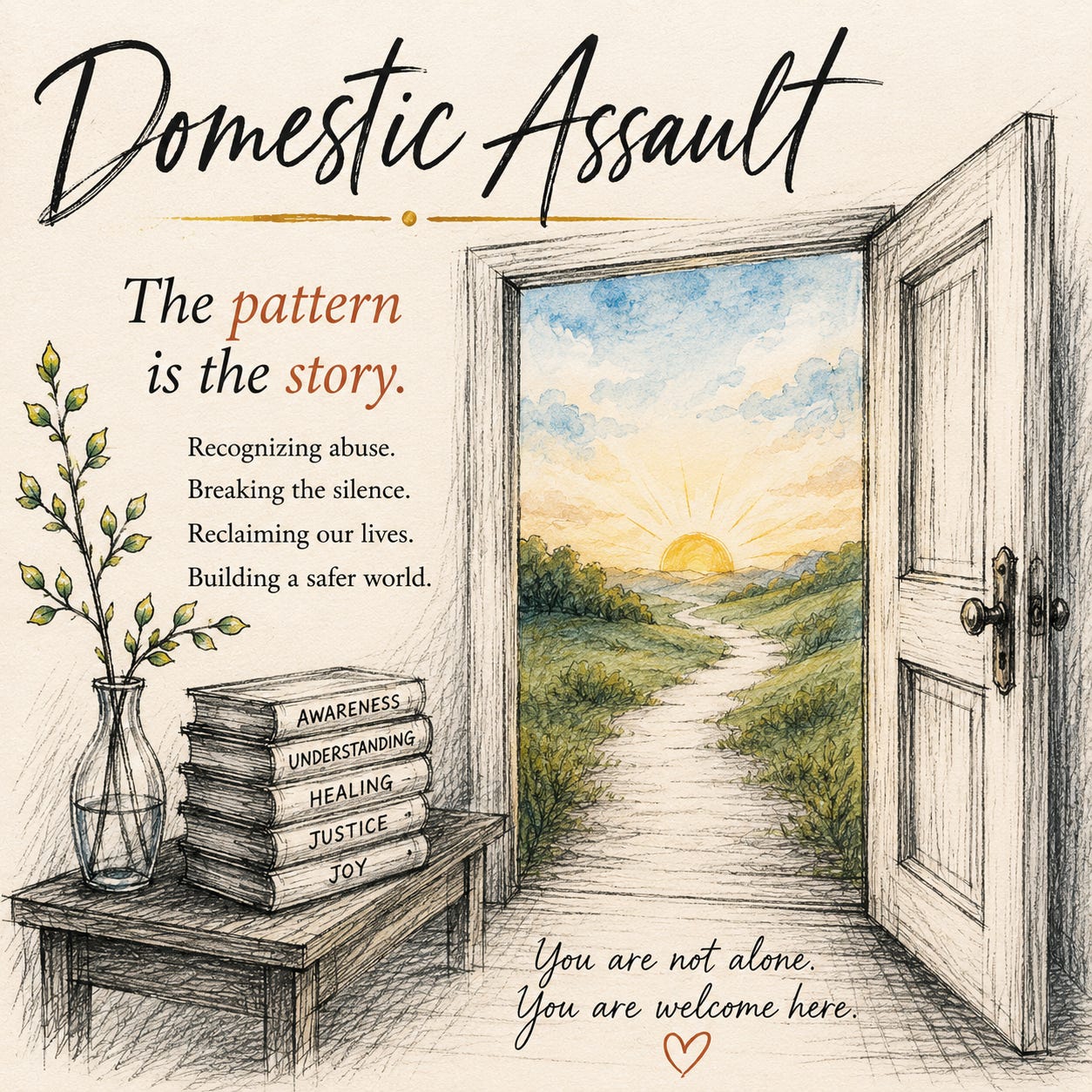
The pattern is the story.
I created Domestic Assault because I want a place where we can learn to recognize those patterns and talk about what they do to people—not only while they are living through abuse, but afterward.
Sometimes long afterward.
I survived an abusive marriage. My experience began in the 1970s, when domestic violence was understood very differently than it is today. I left decades ago.
Leaving didn’t make everything that happened disappear.
There are things I understand now that I couldn’t understand then. There are things I still recognize in myself. There are things I see differently because I lived through them.
That’s part of what we’ll talk about here.
We’ll look at coercive control, gaslighting, manipulation and escalation. We’ll talk about laws and institutions, families and bystanders, films and documentaries, books and news. We’ll talk about what happens when someone tries to leave, what happens after they do, and what it means to reclaim a life that has been organized around someone else’s power.
And we’re going to look beyond intimate relationships.
Those patterns do not stop at the front door.
The same mechanisms of coercion and control can operate in families, churches, workplaces, institutions and governments. Understanding how power works in one setting can help us recognize it in another.
Domestic means what happens inside our homes.
It also means what happens inside our country.
This is a community, not simply a collection of resources. You don’t have to be experiencing abuse now to belong here. You may have left yesterday or forty years ago. You may be worried about someone you love. You may be trying to understand something that happened to you years ago. You may simply want to become better at recognizing abuses of power when you see them.
And you never have to tell your story to belong here.
You can simply read.
Everything I publish here will remain free to everyone, regardless of ability to pay. Paid memberships are a way for people who are able and want to support the research, writing and work of building this community.
There will be difficult things here.
But I don’t want Domestic Assault to become a place devoted only to what was done to us.
I want us to talk about what comes after recognition, too: rebuilding trust in ourselves, finding our voices, understanding what happened, keeping ourselves and one another safer, and making room again for something abuse works very hard to take from us.
Our ability to fully engage in the joy of life.