


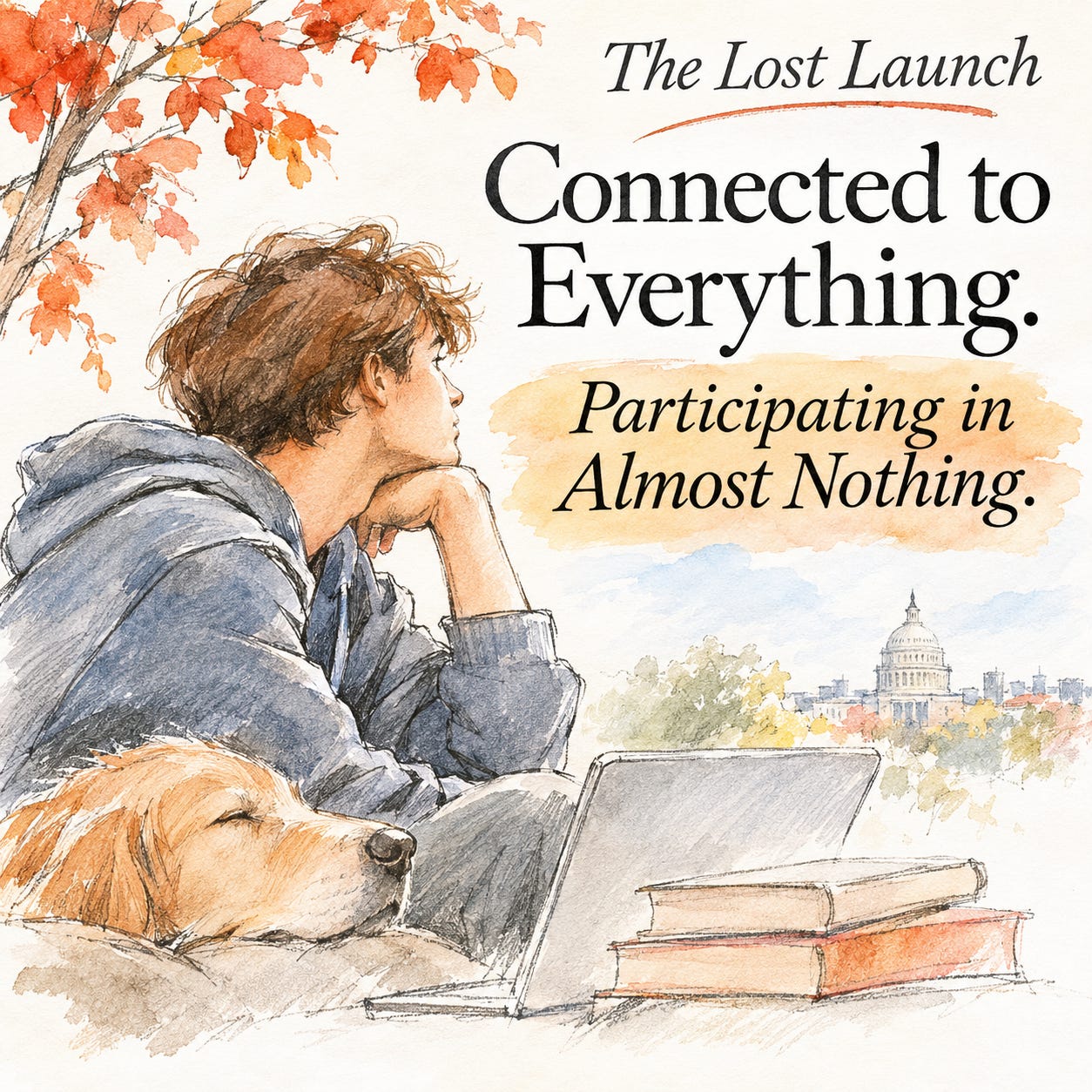
There is something deeply troubling about a young man who knows what’s happening throughout the world but seems unable to find his place in it.
He follows current events, understands technology, discusses politics, recognizes injustice, and has strong opinions about the future. He may be intelligent, well educated, funny, loving, and remarkably compassionate toward others.
Yet he may have little social life outside his family, no romantic relationship, no established career, and no clear direction toward independence.
He knows what’s happening in Washington, Ukraine, the Middle East, and the financial markets. He can discuss developments in artificial intelligence or explain complicated political events.
But arranging a job interview, meeting someone new, joining a community activity, or making a significant change in his own life can seem impossible.
How does someone become so knowledgeable about the world while remaining so disconnected from participating in it?
And how do we begin to understand that contradiction without turning another intelligent, caring human being into a stereotype?
When Knowing Replaces Doing
We have extraordinary access to information. A person can spend an entire day reading news, researching subjects, participating in online discussions, watching videos, and learning about developments thousands of miles away.
That can be valuable intellectual activity. Curiosity, knowledge, and informed opinions are strengths.
But being informed and being engaged in the activities of everyday life require different abilities.
A person can understand the complexities of an international conflict without feeling comfortable initiating a conversation with a stranger. He can recognize the importance of financial independence while struggling to apply for employment. He can understand why relationships matter without knowing how to begin one.
Knowledge doesn’t automatically produce confidence. Intelligence doesn’t guarantee social ease. And wanting something doesn’t mean a person knows how to obtain it.
We tend to overlook these distinctions because we judge people by their outward accomplishments.
If someone can master difficult academic material or discuss complex political issues, why can’t he simply get a job, meet people, or establish an independent life?
That’s precisely what we need to investigate.
The World Outside Has Become Harder to Enter
Consider how people ordinarily develop confidence in unfamiliar situations.
They go to school, meet classmates, participate in activities, make friends, experience rejection, resolve disagreements, and gradually learn to navigate relationships beyond their families.
Employment provides another environment for developing those skills. Coworkers become acquaintances and sometimes friends. Supervisors provide feedback. People learn to handle professional expectations, collaborate, and recognize their own contributions.
Dating introduces different experiences involving attraction, vulnerability, uncertainty, communication, and emotional intimacy.
None of these experiences is guaranteed to be easy. Some people develop confidence more quickly than others, and some prefer smaller social circles.
But what happens when opportunities for these ordinary interactions become increasingly limited?
A young adult who isn’t employed loses an important source of regular contact with others. Without those relationships, he may have fewer opportunities to meet friends or romantic partners.
As time passes, entering unfamiliar environments can become increasingly uncomfortable.
And when those experiences disappear from everyday life, the idea of returning to them can feel overwhelming.
The problem is no longer simply a missing job or a limited social calendar.
It can become a growing distance between the person and the world he wants to enter.
The Invisible Barrier of Social Anxiety
The National Institute of Mental Health describes social anxiety disorder as involving intense fear of situations in which a person expects to be judged, evaluated, embarrassed, or rejected.
Those situations can include job interviews, meeting new people, dating, speaking in groups, asking for help, or interacting with coworkers.
Think about how many of those activities are involved in establishing independence.
Finding employment requires approaching strangers and presenting your abilities. Developing friendships involves initiating conversations and risking rejection. Dating requires emotional vulnerability.
For someone who experiences significant anxiety in these situations, ordinary steps toward adulthood can become enormous obstacles.
Avoidance offers temporary relief. A person who postpones an interview doesn’t have to experience the anxiety associated with it that day. Someone who avoids a social gathering escapes the immediate discomfort of entering an unfamiliar group.
But avoidance can reinforce the fear. Without opportunities to discover that uncomfortable situations are manageable, confidence doesn’t develop.
The next attempt can feel even more intimidating.
And from the outside, that pattern can look remarkably like a lack of motivation.
The person doesn’t apply. Doesn’t call. Doesn’t attend. Doesn’t follow through.
Everyone sees what he isn’t doing.
Few people consider what he might be experiencing when he tries.
Social anxiety is a recognized, treatable condition, not simply a personality flaw. Cognitive behavioral therapy, including carefully structured exposure to feared situations, can help people develop greater confidence and participation.
But not every socially withdrawn person has an anxiety disorder. Depression, neurodevelopmental differences, difficult experiences, and other circumstances can also affect someone’s ability to connect.
We need to understand the individual before deciding what kind of help is appropriate.
Qualified on Paper. Uncertain in Person.
A college degree demonstrates that someone completed an academic program. It doesn’t necessarily mean he feels prepared to enter a professional workplace.
A technically capable graduate may understand the subject matter but worry about whether his abilities are sufficient for an actual job.
What if he makes a mistake? What if the employer expects more than he knows? What if his coworkers discover that he’s inexperienced? What if he fails?
These concerns can grow with time.
A few months outside the workforce become a year. Then the employment gap itself becomes another source of embarrassment.
The person who once expected to begin a promising career may become increasingly uncertain about his ability to succeed.
And confidence isn’t restored by reminding someone how much money he could be earning or how many opportunities he’s wasting.
Those observations may be financially accurate, but they do little to address the obstacle preventing action.
We need to distinguish between the ability to perform work and the confidence to pursue it.
Sometimes the missing ingredient is practical experience. Sometimes it’s a supportive employer, mentoring, professional evaluation, or help managing anxiety.
And sometimes the first meaningful accomplishment is considerably smaller than obtaining a full-time professional position.
It may be making an appointment, contacting someone in the industry, completing a project, or taking a manageable step that begins restoring confidence.
The point is to develop the ability to act, not simply to keep reminding someone of everything he hasn’t done.
Where Did the Friendships Go?
Friendship is another part of adult development that deserves much more attention.
During childhood and adolescence, schools and organized activities bring people into regular contact. College can provide another ready-made social environment.
But those environments eventually disappear.
Friendships change as people move, establish careers, marry, have children, or develop different interests.
For someone without regular employment or independent activities, opportunities to establish new relationships can become limited.
Family members may remain loving and supportive, but family relationships aren’t a complete substitute for developing an independent identity in the wider world.
Friends introduce us to different perspectives and experiences. They help us discover interests, develop confidence, and become comfortable with people who don’t already know our entire history.
And friendships often lead to additional opportunities, including employment contacts, recreation, community involvement, and romantic relationships.
Without those connections, life can become increasingly confined to familiar surroundings.
In 2023, the U.S. Surgeon General issued an advisory describing loneliness and social isolation as significant public health concerns. The report emphasized the importance of meaningful relationships and community participation for physical and emotional well-being.
We should pay attention to that finding when discussing young adults who have difficulty establishing independent lives.
The problem isn’t the number of friends someone has. Meaningful relationships matter more than popularity.
The concern is whether someone wants greater connection but feels increasingly unable to develop it.
Dating, Intimacy, and the Fear of Rejection
We rarely discuss dating when examining the difficulties some young men face establishing independence.
Perhaps we should.
Dating involves the willingness to approach another person, express interest, accept uncertainty, and risk disappointment.
It also involves developing confidence in one’s identity and recognizing what one has to contribute to a relationship.
What happens when someone already feels unsuccessful in other areas of life?
A young man who is unemployed or financially dependent may assume that he has little to offer a potential partner. He may feel embarrassed about his living arrangements or uncertain about how to explain his circumstances.
The fear of rejection can make avoiding relationships seem easier than pursuing them.
But loneliness can deepen when the possibility of intimacy begins to feel increasingly remote.
We shouldn’t assume everyone wants to date or that marriage and romantic relationships are necessary measures of success.
The issue is whether people can pursue the relationships they want.
And again, we’re looking at the difference between desire and the ability to act.
Politically Aware but Politically Disconnected
There’s another contradiction worth examining.
Young people can be knowledgeable about government, elections, public policy, and world events while remaining disconnected from formal political participation.
We often interpret not voting as a lack of interest or civic responsibility.
But research suggests the picture is more complicated.
In a survey conducted after the 2024 presidential election, Tufts University’s Center for Information & Research on Civic Learning and Engagement, known as CIRCLE, found that 24% of young nonvoters said they disliked the candidates and 20% said voting wasn’t important to them.
Other young people reported difficulties involving registration, information, scheduling, and access.
Perhaps more revealing, only 13% of the young people who didn’t vote felt they belonged to a group or movement that expressed itself politically.
That raises a question about belonging.
A young adult can have strong political opinions and still feel that the political system offers no meaningful place for him.
He may distrust candidates, question the fairness of institutions, or believe that his participation won’t influence the outcome.
We cannot assume that everyone who declines to vote has the same reasons. But dismissing young nonvoters as ignorant or apathetic overlooks the differences between being informed, feeling represented, and participating.
I want to understand whether the same sense of disconnection that affects employment and relationships can also influence civic participation.
When people feel they have little control over their own circumstances, how does that affect their confidence in the institutions governing their lives?
And what helps them develop the sense that their participation matters?
Caring Deeply Can Be Exhausting
There is something else we need to recognize about these young men.
Some are extraordinarily sensitive to the world around them. They care deeply about family, friends, animals, injustice, suffering, and the future.
They notice things. They think about them. They worry about people they love.
Their compassion is one of their greatest strengths.
Yet we rarely include compassion when evaluating a young adult’s progress toward independence.
We count earnings, employment history, educational credentials, and financial assets. We look at whether someone has moved out, established a relationship, or begun a career.
Those are useful measures of certain kinds of independence.
They tell us very little about a person’s kindness, integrity, intelligence, emotional depth, or potential contribution to society.
And I worry about what happens when people are repeatedly judged by what they haven’t accomplished while their best qualities go unrecognized.
A loving, compassionate young man can become discouraged. An intelligent person can lose confidence. Someone deeply concerned about others can struggle to care for his own needs.
Anger and withdrawal may become the behaviors everyone notices, while the tenderness and vulnerability beneath them are overlooked.
We should be far more interested in understanding the whole person.
The Fear We Don’t Always Talk About
There’s a reason I take these questions seriously.
When I think about young adults who are isolated, discouraged, and uncertain about their futures, I sometimes remember the cultural phenomenon known as the 27 Club, associated with talented musicians and artists whose lives ended tragically young.
The age itself carries no special predictive significance. There is no reason to believe that turning 27 creates a particular danger.
What unsettles me is the reminder that talent, intelligence, youth, and being loved do not automatically protect someone from profound emotional suffering.
In 2024, according to the CDC, the suicide rate among American males ages 25–44 was 28.5 deaths per 100,000, compared with 20.2 among males ages 15–24. Both rates declined from the previous year, but they remain deeply concerning.
These are human beings, not just statistics.
I don’t want us to become so preoccupied with careers, financial independence, and outward accomplishments that we overlook emotional distress.
A person can appear physically healthy and intellectually capable while struggling privately. Someone who seems angry may be carrying grief, fear, shame, or despair that he doesn’t know how to express.
And while isolation doesn’t mean someone is suicidal, significant withdrawal, hopelessness, or changes in behavior deserve attention.
We need to make it easier for young men to talk about what they’re experiencing and obtain meaningful support without being humiliated for needing it.
We also need to recognize that asking someone directly about their emotional well-being, including thoughts of suicide when warning signs are present, is an act of concern. It isn’t something families should avoid out of fear of having a difficult conversation.
If someone expresses suicidal intent or appears in immediate danger, that calls for prompt professional or emergency help, not another argument about motivation.
A young man’s life is worth infinitely more than the career he hasn’t established or the milestones he hasn’t reached.
What Actually Helps Someone Reconnect?
If we’re serious about helping these young men move forward, we need to stop treating every difficulty as a problem of willpower.
People need opportunities to develop competence, autonomy, and connection. These are central principles of self-determination theory, developed by psychologists Edward Deci and Richard Ryan.
A person needs to experience himself as capable, make meaningful decisions about his own direction, and develop relationships that provide a sense of belonging.
Constant criticism undermines those foundations.
So does trying to control every decision about someone’s future.
The goal isn’t to force someone into a particular occupation, social activity, relationship, or lifestyle.
It’s to make possibilities available and help him develop confidence in pursuing the ones that matter to him.
That may involve professional help with anxiety or depression, mentoring, voluntary community involvement, recreational activities, practical projects, or opportunities to work alongside others in supportive environments.
Some people benefit from structured assistance. Others begin moving forward when they discover an interest or relationship that gives them a reason to engage.
What matters is that the progress becomes their own.
We can encourage someone to take manageable steps while respecting his autonomy. We can offer opportunities without turning every suggestion into another demand.
And we can recognize that meaningful participation in life doesn’t begin and end with earning a paycheck.
Tough Love Requires Understanding
Parents and families have legitimate responsibilities and limits. They cannot necessarily provide housing and financial support indefinitely. Adult children must develop practical skills and assume responsibility for their choices.
But we need to distinguish setting reasonable expectations from treating someone as a failure.
If a young man is struggling to interact socially, establish confidence, or navigate unfamiliar situations, telling him to get out and figure it out isn’t a meaningful strategy for addressing those difficulties.
Neither is comparing him with siblings who followed different paths.
Love doesn’t require pretending there isn’t a problem. It requires being willing to understand the problem before deciding how to respond.
Parents can establish financial boundaries, expect respectful behavior, encourage appropriate professional support, and make room for the young adult to participate in developing a realistic plan.
What they cannot do is manufacture confidence, belonging, or purpose through anger and humiliation.
And mothers who have spent years learning their children’s strengths, vulnerabilities, and needs should not be bullied into abandoning their judgment by relatives who believe harshness is the only form of accountability.
Tough love should build the capacity for independence. It should never become an excuse for emotional cruelty.
Why This Belongs in Domestic Assault
The broader mission of Domestic Assault is to examine power, coercive control, abandonment, emotional harm, and the consequences of responsibility being misused or neglected.
Social isolation itself is not abuse. Neither is unemployment, not dating, or declining to participate in an election.
But the responses of families and institutions can either help people regain their footing or make existing difficulties worse.
Repeated humiliation, coercive pressure, and efforts to undermine someone’s dignity can damage relationships and deepen vulnerability.
Institutions also have responsibilities. Educational systems, employers, healthcare providers, government agencies, and communities all influence the opportunities people have to develop confidence, independence, and belonging.
I want to examine how those systems can better recognize individuals whose abilities aren’t reflected in conventional measures of success.
We should also ask how a society that provides unlimited digital connection can leave so many people struggling to establish meaningful participation in their communities.
And why families are expected to solve complicated social and psychological problems without adequate understanding or support.
Love Them. Listen to Them. Help Them Find Their Way.
There is a principle from Rosamund Stone Zander and Benjamin Zander’s The Art of Possibility that continues to guide this investigation.
People want to succeed. They want meaningful lives, independence, relationships, and the satisfaction of contributing something worthwhile.
These young men want those things more than anyone else wants them for them. They’re the ones who have to live their lives.
When someone appears disengaged, we need to understand what is standing between him and the life he wants.
Perhaps he’s uncertain about his abilities. Perhaps he’s struggling with anxiety, depression, loneliness, grief, or a loss of confidence. Perhaps he doesn’t know where to begin, or the familiar world has become easier to navigate than the unfamiliar one beyond it.
Whatever the circumstances, we accomplish nothing by stripping away his dignity.
We can help create opportunities, support appropriate treatment, encourage meaningful participation, and make room for small accomplishments to develop into greater confidence.
We can also recognize the remarkable qualities that don’t appear on a résumé: compassion, curiosity, loyalty, creativity, intelligence, humor, and love.
Those qualities have enormous value.
Love your sons. Anger is not the answer. Trust that they want to succeed.
And perhaps most importantly, ask them what kind of lives they want to build, then listen carefully enough to understand what is making those lives difficult to reach.
They already know what’s happening in the world. What they need is the confidence, opportunity, and sense of belonging to become part of it.
Join the Conversation
The Lost Launch is an ongoing exploration on Domestic Assault of the challenges facing young American men, the families supporting them, and the social and institutional conditions influencing their lives.
I’m particularly interested in hearing from young men themselves, as well as parents, educators, employers, mental health professionals, and people who have experienced prolonged periods of isolation or difficulty entering adult life.
Have you experienced the gap between knowing what you want and being able to take the steps toward it? Has isolation affected your confidence? What helped you develop friendships, find meaningful work, or begin participating in your community?
And for parents, what have you found helpful when someone you love seems to be withdrawing from the world?
Please share your experiences and ideas in the comments. The conversation will be more useful when we listen to the people living through these challenges.
Subscribe to DomesticAssault.com to follow The Lost Launch, and share this article with people who can contribute their knowledge and experiences.
We need more understanding, better opportunities, and less judgment.
For anyone experiencing a mental health crisis or concerned about suicide: In the United States, call or text 988 for confidential crisis support. Call 911 for an immediate life-threatening emergency.