


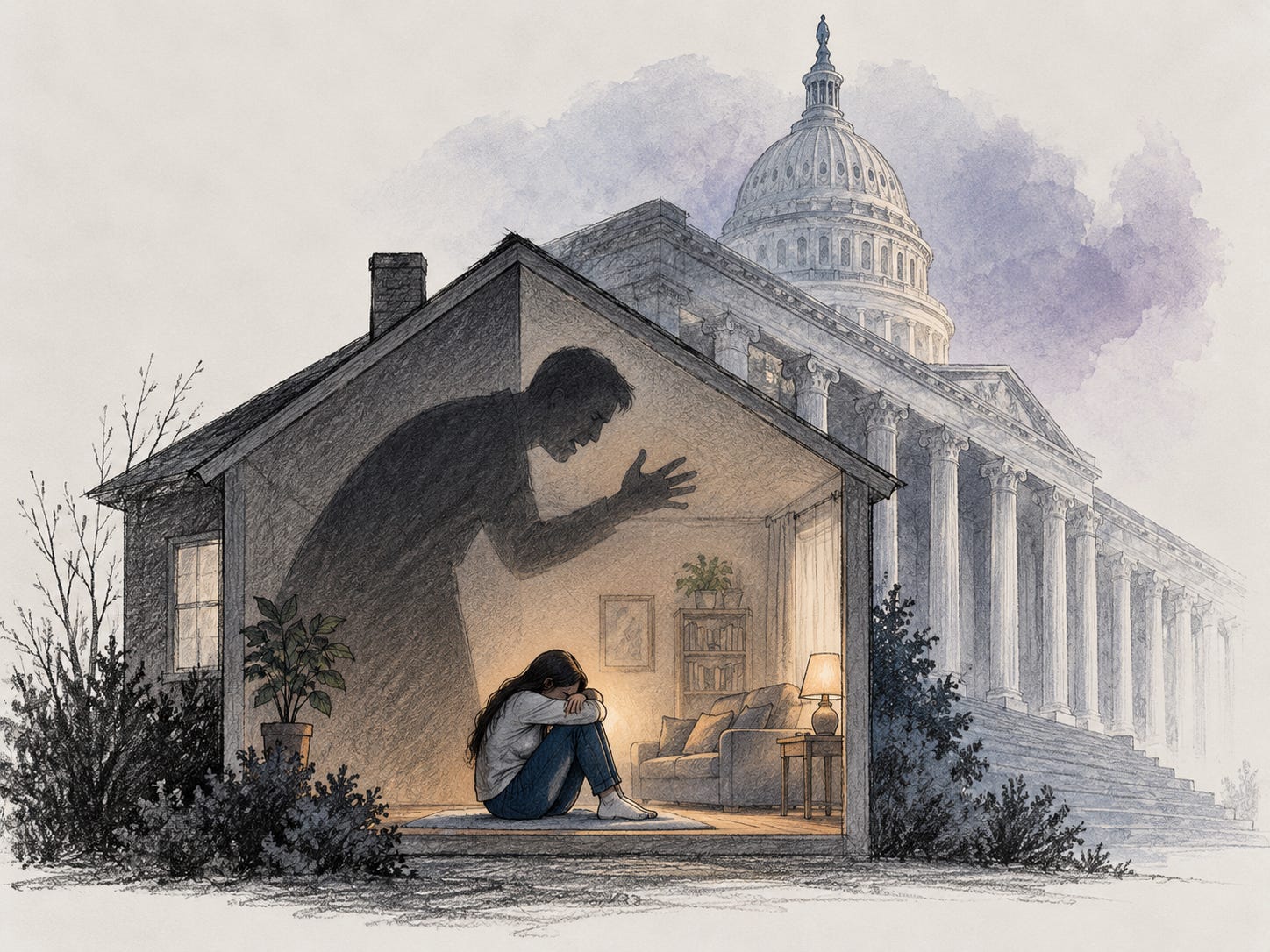
Every October, we wear purple.
We share hotline numbers.
We talk about recognizing warning signs.
We tell people to understand coercive control, financial abuse, isolation, threats, stalking and escalating violence.
And sooner or later, we tell the survivor:
Leave.
But leave for where?
That may be one of the most important questions we are still failing to answer.
A Minnesota analysis published this week reported that at least 16 intimate-relationship-violence deaths have already been identified in the state in 2026, after at least 31 known deaths connected to intimate-partner violence in 2025.
Its larger argument is one we should be talking about everywhere during Domestic Violence Awareness Month:
Awareness without infrastructure is not enough.
Knowing You Are Being Abused Does Not Make Escape Possible
A survivor may understand perfectly well what is happening.
She may know he is controlling the money.
He may recognize that his partner has slowly isolated him from friends and family.
A survivor may recognize the monitoring, threats, humiliation, password control, employment sabotage, financial restrictions, manipulation of children or pets, and the constant recalculation required to avoid provoking the person controlling the household.
They may even know they are in danger.
But knowing does not create somewhere safe to sleep tonight.
It does not pay first month’s rent.
It does not produce a security deposit.
It does not create an available shelter bed.
It does not replace wages lost because an abuser prevented someone from working.
It does not repair ruined credit.
It does not provide childcare while someone goes to court.
It does not provide transportation.
It does not pay an attorney.
It does not make a restraining order enforce itself.
And it certainly does not guarantee that leaving will make the survivor safer.
For some victims, separation is one of the most dangerous periods of the entire abusive relationship. National Institute of Justice research has found that an attempt to leave was the precipitating factor in 45 percent of murders of women by their intimate partners in one major study.
So when we tell someone, “You need to leave,” we need to be willing to answer the next question.
How?
Violent Crime Can Fall While Violence at Home Does Not
This becomes even more urgent because of another troubling finding.
The Police Executive Research Forum recently examined something that should stop us in our tracks.
Violent crime is dropping significantly in many American communities.
Intimate-partner violence is not necessarily dropping with it.
Police departments surveyed by PERF reported that domestic and intimate-partner violence often was not declining at the same rate as other violent crime, and some jurisdictions reported trends moving in the wrong direction.
That matters.
We know how to celebrate falling homicide numbers, fewer shootings, fewer robberies and safer streets.
But a country can become safer on the street while remaining terrifying behind closed doors.
A woman can live in a city where crime statistics are improving while calculating which version of her husband will walk through the door tonight.
A man can live in a statistically safer neighborhood while hiding the fact that his partner controls his money, threatens him or terrorizes him inside his own home.
A child can live on a street with very little crime and still go to bed listening for the sound of an argument escalating downstairs.
Public safety cannot stop at the front door.
The Missing Infrastructure of Escape
Domestic violence is often discussed as though it is primarily a problem of recognition.
Recognize the signs.
Know your worth.
Ask for help.
Leave.
Those things matter.
But coercive control is frequently designed specifically to make leaving difficult.
An abuser may control bank accounts.
Destroy credit.
Prevent employment.
Sabotage transportation.
Threaten pets.
Use custody arrangements as leverage.
Monitor phones.
Track locations.
Threaten suicide.
Threaten homicide.
Threaten deportation.
Threaten to expose secrets.
Threaten to take the children.
Threaten the survivor’s family.
By the time someone is ready to leave, the escape route may have been systematically dismantled.
That is why housing belongs at the center of domestic-violence policy.
California recently took a step in that direction by requiring domestic-violence survivors to be considered more explicitly in local housing planning.
That should not seem remarkable.
It should seem obvious.
If housing instability is one of the forces keeping survivors trapped with abusers, then housing policy is domestic-violence policy.
So is transportation policy.
So is childcare.
So are employment protections.
So are court systems.
So is access to legal representation.
So are firearm laws.
So are police responses.
So is financial protection.
Domestic violence does not exist inside a sealed category marked “relationship problems.”
It intersects with nearly every structure a person needs in order to live independently.
It Takes a Force to Break a Pattern
I wrote a song called “Escape Velocity” about this.
The title comes from physics: escape velocity is the speed something must reach to break free from the gravitational pull holding it down.
Abuse can have its own gravity.
Money holds you.
Children hold you.
Fear holds you.
Shame holds you.
Threats hold you.
And sometimes hope holds you too — perhaps longer than almost anything else.
I wrote:
It takes a force to break a pattern
A fire to cut through atmosphere
I burned through everything to leave you
To live a life without constant fear
And then:
I thought if I got it right
You’d soften, I’d be safe
But your chaos kept things out of focus
And love became a shape I chased
That is something people outside abusive relationships often fail to understand.
The survivor isn’t necessarily sitting there unaware that something is wrong.
She may be spending years trying to get it right.
Be quieter.
Be kinder.
Don’t provoke him.
Make the dinner differently.
Keep the children quiet.
Don’t ask where the money went.
Don’t mention what happened last night.
Don’t say that word.
Don’t make that face.
Don’t leave.
Don’t stay.
Don’t breathe wrong.
The rules keep changing because the purpose was never actually compliance.
The purpose was control.
And eventually escaping that gravitational pull requires more than awareness.
It requires enough force to break free.
Sometimes that force is money.
Sometimes it is housing.
Sometimes it is a friend with a spare bedroom.
Sometimes it is a shelter bed.
Sometimes it is a police officer who takes the threat seriously.
Sometimes it is a judge who understands coercive control.
Sometimes it is simply another human being saying:
I believe you. Come here.
You can listen to my song “Escape Velocity” here:
Coercive Control Often Comes Before the Bruise
There is another problem with the way we talk about awareness.
We still too often wait for visible violence.
A black eye makes sense to people.
A broken bone makes sense.
A police report makes sense.
But coercive control can begin long before anyone is punched.
It may begin with isolation disguised as devotion.
Financial restriction disguised as budgeting.
Constant texting disguised as concern.
Jealousy disguised as love.
Control disguised as protection.
Humiliation disguised as joking.
Threats disguised as temper.
By the time physical violence appears, the survivor may already have been psychologically, socially and financially trapped for years.
That is one reason simply telling people to recognize physical abuse misses so much of what domestic assault actually looks like.
We have to recognize the architecture of control.
Not only the final explosion.
The Body Lives There Too
There is another part of domestic abuse that receives far too little attention.
The body lives inside that environment.
Fear is physical.
Hypervigilance is physical.
Sleep disruption is physical.
Chronic stress is physical.
Living for months or years in a state of constantly anticipating another person’s mood does not remain confined to the mind.
The nervous system participates.
The cardiovascular system participates.
The immune system participates.
Hormonal systems participate.
Sleep participates.
Digestion participates.
This is one reason I also write about the biology of stress and shame at TotalWellCoach.
I recently wrote about “The Biology of Shame” because abuse doesn’t always end biologically when the relationship ends.
A survivor may leave the person and still carry the body’s learned expectation of danger.
Healing therefore cannot mean only getting someone through the door.
We need to think about what happens afterward too.
Safety.
Housing.
Money.
Community.
Healthcare.
Rest.
Nutrition.
Mental-health support.
Legal security.
Rebuilding trust.
Relearning what calm feels like.
Sometimes survival gets someone out.
Healing helps them build a life afterward.
Which Killings Do We Decide to Be Afraid Of?
There is another uncomfortable question we need to ask.
We hear enormous political attention devoted to crimes committed by undocumented immigrants.
When one horrific murder occurs, the victim’s name may be repeated nationally. The case may appear in campaign advertisements, speeches, congressional hearings and presidential rhetoric.
Those murders are real.
Those victims matter.
Every person murdered by an undocumented immigrant is every bit as dead, and every family every bit as devastated, as someone murdered by anybody else.
But if public policy is really about protecting Americans from danger, then we should be willing to look at all of the danger.
Here is the strange part.
The United States does not even maintain a reliable national annual count of homicide offenders according to immigration status.
Texas provides some of the best available data because it has been able to match criminal records with immigration-status information.
From 2013 through 2022, there were 472 undocumented immigrants convicted of homicide in Texas — an average of about 47 convictions per year.
More importantly, when population size is taken into account, the homicide-conviction rate among undocumented immigrants in Texas was 2.2 per 100,000, compared with 3.0 per 100,000 among native-born Americans.
In other words, undocumented immigrants in that dataset were 26 percent less likely than native-born Americans to be convicted of homicide.
In 2022 alone, Texas recorded 67 homicide convictions of undocumented immigrants, compared with 1,209 involving native-born Americans.
We should not pretend Texas automatically represents the entire country.
But suppose, only as an illustration, that the decade-long Texas rate of 2.2 homicide convictions per 100,000 undocumented residents roughly applied nationally.
Pew Research Center’s revised estimate puts the undocumented population in 2022 at about 11.8 million people.
Apply that Texas rate nationally and you get an order-of-magnitude estimate of roughly 260 homicide convictions a year.
Again, that is not an official national count. No such reliable national count exists.
It is an extrapolation designed to give us a sense of scale.
Now compare that with intimate-partner homicide.
The Bureau of Justice Statistics found an intimate-partner homicide victimization rate of 0.7 per 100,000 Americans in 2023.
With a national population well over 330 million, that translates to roughly 2,300 people murdered in a single year by a current or former spouse, boyfriend or girlfriend.
A separate CDC analysis of 2022 violent deaths identified 2,380 homicides in which intimate-partner violence was a precipitating circumstance.
That broader CDC category includes not only murdered partners but also other people killed during intimate-partner violence — for example, a new boyfriend killed by an abusive former partner.
Whichever federal measure you use, the scale is enormous.
And it suggests something startling.
The number of Americans killed in intimate-partner violence each year appears to be many times larger than the number we would estimate are killed by undocumented immigrants.
Yet listen to our national political conversation.
One threat gets rallies.
Speeches.
Campaign advertisements.
Emergency declarations.
Television coverage.
Congressional hearings.
Government operations.
In Ohio on October 3, 2026, Trump even read “The Snake,” a poem he has long used as an immigration metaphor, while campaigning before the midterm elections. The message was unmistakable: fear the person coming in from outside.
Meanwhile, the other threat is already inside the house.
It may have been there for years.
Controlling.
Threatening.
Stalking.
Strangling.
Escalating.
And when somebody finally ends up dead, the television report may reduce the entire history to two words:
“Domestic incident.”
Why?
Why are we taught so relentlessly to fear the danger coming across a border while thousands of Americans are killed by people who already had access to their homes, their children, their bodies and their lives?
And there is an even larger meaning of the word domestic.
Domestic means inside the home.
But domestic also means inside our own country.
That is the territory I keep writing about at DomesticAssault.com: what happens when coercion, intimidation, fear and the abuse of power are normalized—whether the person wielding that power is standing across the kitchen or standing behind a government seal.
Some of the dangers we are told to fear come from outside.
But the most consequential dangers are already inside the house.
Many of These Deaths Do Not Come Out of Nowhere
The comparison becomes even more disturbing when we look at what often happens before intimate-partner homicide.
These murders are frequently not unpredictable eruptions involving people with no prior warning signs.
National Institute of Justice research has documented the importance of prior abuse, escalating violence, threats and attempts to leave.
One NIJ review found that four out of five women killed or severely injured by an intimate partner had experienced prior physical violence from that partner.
That means the fatal or life-threatening assault was the first physical attack for only about one in five.
And, as noted earlier, attempts to leave can themselves become dangerous.
This is why domestic-violence advocates repeatedly tell us that “Just leave” is not a safety plan.
There may already have been threats.
There may already have been stalking.
There may already have been strangulation.
There may already have been police calls.
There may already have been a restraining order.
There may already have been threats involving firearms.
There may already have been terrified relatives and friends saying something was terribly wrong.
And eventually, somebody dies.
We rightly ask after a murder committed by an undocumented immigrant:
How did we fail to prevent this?
We should ask exactly the same question when someone with a history of domestic violence eventually kills a partner.
How did we fail to prevent this?
Why does one kind of murder become evidence of a national crisis while another becomes a private tragedy?
Domestic violence is not private when someone ends up dead.
It is public safety.
Stop Asking Only Whether People Are Aware
During Domestic Violence Awareness Month, perhaps we should ask a different question.
Not simply:
Do people know domestic violence exists?
Most people do.
Ask instead:
What happens when someone recognizes that it is happening to them?
Can they find safe housing?
Can they afford to leave?
Will someone believe them if there is no bruise?
Can they take their children?
Can they protect their pets?
Can they keep their job?
Can they get to court?
Can they obtain competent legal help?
Can they safely disappear from digital tracking?
Can they survive financially for the first month?
The first six months?
The first year?
Can they rebuild?
Those are domestic-violence questions too.
And until we are willing to answer them, we should be careful about congratulating ourselves for raising awareness.
Awareness is the beginning.
Infrastructure is what makes escape possible.
And healing is what makes freedom sustainable.
Join My Community
DomesticAssault.com exists because abuse is bigger than the bruise.
It is coercive control. Gaslighting. Financial control. Isolation. Fear. Power. Shame. Survival. And the long work of rebuilding afterward.
I write here for survivors, people who love them, professionals trying to understand what happens behind closed doors, and anyone willing to look honestly at the systems that allow abuse to continue.
And I write about domestic assault in both meanings of the word domestic — what happens within our homes and relationships, and what happens within our own country when power, fear, coercion and control become normalized.
If this work matters to you, join this community. Subscribe. Share these articles. Send them to someone who may need the words before they know how to find them for themselves.
And if you are able to become a paid subscriber, you help me keep doing the deeper work: researching, connecting the dots, challenging the language we use around abuse and saying the things that too often remain unspoken.
Awareness matters. But awareness must lead somewhere.
I want this community to help build that somewhere.
Sources
Bureau of Justice Statistics, Homicide Victimization in the United States, 2023.
Centers for Disease Control and Prevention, Surveillance for Violent Deaths — National Violent Death Reporting System, 2022.
National Institute of Justice, research on causes, consequences and risk factors for intimate-partner violence.
Police Executive Research Forum, 2026 analysis of intimate-partner violence trends.
Texas Department of Public Safety data analyzed by the Cato Institute, Illegal Immigrant Murderers in Texas, 2013–2022.
Pew Research Center, estimates of the U.S. unauthorized immigrant population.
Minnesota domestic-violence reporting and analysis, October 2026.